The cache container may be found at the following coordinate:
N 36 44.ABC W077 56.DEF
where the values for A, B, C, D, E, and F can be found as clues in several of the THT GeoArt series caches (i.e "THT01 GeoArt (GC568W2)" thru "THT60 GeoArt (GC58T9E)". No night caching. Dawn to dusk only.
WELCOME TO THE TOBACCO HERITAGE TRAIL
Many of Virginia's old railroad grades have been converted into multi-use recreation trails perfect for outdoor lovers who prefer more moderate and leisurely outdoor experiences. The routes' gentle, mostly flat trails range from a few miles to more and wind through some of the most beautiful scenery in Virginia.
Roanoke River Rails-to-Trails, Inc., a 501(c)(3) tax-exempt Virginia corporation, was formed for the purpose of acquiring abandoned railroad rights-of-way for the development of the Trail system. As a nonprofit, Roanoke River Rails-to-Trails is able to accept donations and apply for funding. The corporate bylaws call for representation from each county and each town desiring to join. Currently, fifteen localities have joined the Rails-to-Trails Board. The corporation is coordinating the development of the Tobacco Heritage Trail project.
The mission of the Roanoke River Rails-to-Trails is to enrich southside Virginia communities and countryside by creating a regional network of public trails from former rail lines and connecting corridors. Also, to develop plans for the establishment and development of recreation, transportation, historic preservation, economic revitalization, open-space conservation, and wildlife preservation trails for the enjoyment and use of the general public.
The Tobacco Heritage Trail and its ambitious trail development project will eventually create 174 miles of multi-use trails for biking, hiking, and horseback riding that will link western Virginia counties to the Virginia Beach Pipeline Trail. Currently, the 70-mile phase from Lawrenceville to Clarksville is under active development and the continuous, off-road 17-mile stretch between the southern Virginia communities of Lawrenceville, Brodnax, and LaCrosse are open. Along the way, trail-goers can enjoy wooded landscapes, interpretive signs, picnic areas, and a scenic 300-foot bridge across the Meherrin River. Four restroom facilities have also been placed along the trail. The westernmost section of this route, from Brodnax to LaCrosse is paved; the remainder of the trail to Lawrenceville has a crushed rock dust surface and is, therefore, more “horse-friendly” and preferred by equestrians. Two other disconnected segments of trail are completed and open: about a mile in Victoria and another two miles in South Boston. Work on another mile in Boydton is underway. Eventually, the trail (a mixture of off-road and on-road sections) will connect the counties of Brunswick, Charlotte, Halifax, Lunenburg, and Mecklenburg. The network will incorporate historical sites and local points of interest, including natural and recreational areas. The East Coast Greenway program has plans to use 55 miles of the Tobacco Heritage Trail, from Lawrenceville to Clarksville, in their effort to create a single trail system from Maine to Florida.
This GeoArt caching adventure will utilize only the 7.6 mile segment of the THT between the Town of Lawrenceville and the Evans Creek Trailhead in Brunswick County. The segment of the trail from the western end of the Meherrin River bridge to the Evans Creek Parking area will be closed during hunting season, approximately November 1st until January 1st. None of the GeoArt is located on this part of the trail.
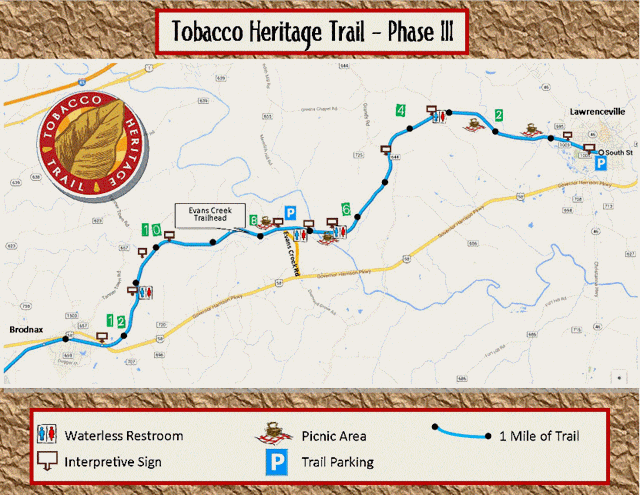
Much of the trail passes through agricultural lands and heavily wooded areas. The trail also abuts residential properties, particularly when it enters town limits. At the Lawrenceville end, it also abuts commercial and industrial uses. Access and right-of-ways have been graciously given so please respect all areas. Do not wander off the trail. All caches in this series can be found usually within 25 feet of the edge of the trail. No night caching. Dawn to dusk use only.
The trail is relatively flat, with some bridges, waterless restrooms and picnic tables. Several interpretive signs offer educational opportunities with themes of tobacco production, railroads, African-American history, American Indian history, and birding. In fact, the trail has been designated a Virginia Birding and Wildlife Trail by the Department of Game and Inland Fisheries. As you hike, bike, or horseback ride, you may see the county bird of Brunswick County, the Bluebird, or hear the distinct call of the yellow Prothonotary Warbler.
Flora and fauna abound. See if you can spot the bright orange cluster blooms on the Butterfly Milkweed or the purple flowers of the Raspberry Tumbleberry, both of which are native to the trail area. Then again, you may want to avoid another native plant and the nemesis of geocachers, good ol' poison ivy.
The THT works in concert with natural resources conservation efforts to act as a continued safeguard for regional watershed (erosion and flood control, bank stabilization) and wildlife (creating and safeguarding habitat and improved opportunities for observing wildlife).
The THT is dotted with historic towns that offer opportunities for shopping, eating, or simply resting along the way. Each town has its own unique character, many associated with the railroad and tobacco production. Their history is still evident in the layout of the towns and architectural styles, as well as the presence of several extant train depots. Let's learn a little about Brunswick County and some of the towns it encompasses and the important role tobacco farming and the railroad played in the economic history of the area. The first English settlers in Brunswick County swarmed into the lands near Fort Christanna (a trading post and school for Indian children) during its four years of operation (1714-1718). Brunswick County was established in 1720. The county is named for the former Duchy of Brunswick-Lunenburg in Germany.
Originally cultivated for tobacco by slave labor in colonial times, its mostly rural economy was diversified for lumber and other mixed farm crops before the American Civil War. Cotton is grown in the southern part of the county. The coming of the railroad in 1890 gave an impetus for growth and the town of Lawrenceville became a significant industrial base. The rich agricultural history is also evidenced by the many tobacco warehouses, cotton gins, creameries, etc., which came and went during the first half of the twentieth century.
Lawrenceville is the Brunswick County seat and was incorporated in 1874. Its oldest public building is St. Andrew's Episcopal Church. Legend has it that the town name was inspired by a famous racehorse, Lawrence. In the early 1800's the town was the home of the Lawrenceville Course, a well-known, one-mile oval racetrack. English thoroughbreds were brought to the area as early as 1729 for training and breeding. One of the first great Thoroughbreds sired in America, Sir Archy, was owned by a Brunswick County resident, Ralph Wormeley. The town did much to foster the best in early equine stock in Virginia and the tradition continues today.
Tobacco has long held a sacred and prominent role among the Indian tribes in the southeast. Well before Christopher Columbus returned with tobacco seeds from the Caribbean or Sir Walter Raleigh made smoking fashionable in Europe when he returned from Carolina with a pipe and tobacco, Indians had universally integrated tobacco into their religious, social, and cultural ways of life. Indians raised a different variety of tobacco than was later grown in Virginia. Tobacco cultivation and exports formed an essential component of the American colonial economy during the seventeeth and eighteenth centuries. A culture of expertise surrounded tobacco planting. Unlike cotton or rice, cultivating tobacco was seen as an art form, and buyers understood that behind every crop of “good” tobacco was a meticulous planter with exceptional skills. Tobacco shipments were “branded” with a signature unique to its planter before they were sent overseas, and guarantors regarded brands as a seal of approval from the planter himself. Furthermore, local reputation, social status, and significant political clout varied with the quality of one's leaf. American tobacco planters, including Jefferson and George Washington, financed their plantations with sizable loans from London. The ability to pay what one owed was not just a financial failing, but a moral one. Many planters accused London merchants of unfairly depressing tobacco prices and forcing Virginia farmers to take on unsustainable debt loans. In conjunction with a global financial crisis and growing animosity toward British rule, tobacco interests helped unite colonial players and produced some of the most vocal revolutionaries behind the call for American independence. Tobacco is still a prominent crop in Brunswick County, but the largest industry at this time is logging pulpwood for a nearby paper mill.
Some other Brunswick County information and points of interest:
Brunswick County, Virginia, is best known as the “Original Home of Brunswick Stew.” The original stew, according to historians, was created in 1828 by an African-American chef, Mr. Jimmy Matthews, also referred to as “Uncle” by some locals. While a group was out hunting, Mr. Matthews, the enslaved camp cook, hunted squirrel for the evening meal. Mr. Matthews slowly stewed the squirrels in butter, with onions, stale bread and seasoning in a large iron pot. When the hunting party returned, they were reluctant to try the new, thick concoction, but one taste convinced them to ask for more. Today, the stew is prepared by many different “stew masters.” Chicken has been substituted for squirrel and a variety of vegetables have been added. According to many “stew masters,” the stew isn't done “until the stirring paddle stands up straight in the stew.” The stew and the County are tied together in the County's promotional theme: “Since 1828 when Ol' Jimmy Matthews created Brunswick Stew, we've been doing things a special way, a little slow, but right.”
Although the County covers a large geographical area of 569 square miles, of which 566 is land and 3.2 is water, it is accessible by means of the major highways running through the county.
- I-85
- US 1
- US 58
- SR 46
- SR 136
- SR 137
- SR 378
Accessible Waterways are:
-The Meherrin River- one of the best-kept secrets in Virginia. Its dark waters remain unpolluted, and the river valley is largely secluded from development. Except at the few bridges crossing the river, it's not unusual to spend the entire day floating the Meherrin without seeing another person or hearing a sound other than the river, the wind, and the abundant wildlife of the Meherrin Forest. The Meherrin River deserves our stewardship. Both the North Fork and the Brunswick County sections and the entire river running through Mecklenburg have Scenic River designation.
-Lake Rawlings- Dive or go swimming in the crystal waters of Rawlings quarry managed by the Lake Phoenix Scuba Park & Family Campgrounds. Scuba instruction and tours are offered.
-Lake Gaston-Located on the Virginia/North Carolina border between Interstates 95 and 85, Lake Gaston's 20,000 acres and 34 miles of shoreline encompass portions of five counties including Brunswick. Activities abound for everyone; both young and old discover a pleasure perfect paradise for vacation or year round living.
You've undoubtedly heard Virginia's tourism and travel slogan, “Virginia is for Lovers.” Brunswick County encompasses the small town of Valentines and its local post office which helps to foster this slogan every February 14th. The Valentines Post Office has been in operation since 1887, now delivering mail to about 225 households. But as February 14th approaches, they will handle approximately 20,000 pieces of valentines mail. Your valentines are hand-cancelled and rubber stamped. This post office is the issuer of the First Day cover for the “Love” postage stamp.
Wanna share a local treasure? Take a drive down Iron Bridge Road, SR 715 and cross the Meherrin River via the Gholson Bridge. This single-lane iron bridge was built in 1864 by the Wrought Iron Bridge Co., Canton, Ohio, and still remains open to traffic today. In fact, you may be surprised at the amount of traffic for this rural area. The Gholson Bridge was posted to the National Register of Historic Places in 1978 and continues to be a place of local pride.
What is this piece of land hidden back on a dirt road in the woods? What is its history? How do we remember it today? What is now known as Brunswick County was selected by Governor Alexander Spotswood as the home of one of the largest frontier forts ever built in Virginia, Fort Christanna (named for Christ and Queen Anne.) The pentagonal shaped fort was built in 1714 and was meant to be a center of trade and protection and to offer education to the resident native Indians. The Fort Christanna Historical Site was officially dedicated on April 25, 2009 with Governor Kaine issuing a proclamation declaring that day as Fort Christanna Day. Many items and illustrations from archaeological digs can be seen at the Brunswick County Museum located on Courthouse Square in Lawrenceville. The fort site itself is listed on the Virginia Birds & Wildlife Trail and offers itself as a park which continues to be a work-in-progress as Brunswick County expands and develops both the historic/cultural and natural history aspects of this county treasure.
In 1888 James Solomon Russell, an Episcopal priest born into slavery in 1857, established a parish school for black children. By 1893, the school was incorporated and became the Saint Paul's Normal and Industrial School and later became Saint Paul's College in 1957. The college is no longer in operation, but three of the early buildings remain on the campus and are listed in the National Register of Historic Places.
Brodnax, Dolphin, Ebony, and Alberta are other towns in Brunswick County. Brodnax is actually located partly in Brunswick County and partly in Mecklenburg County. What is now US Highway 1 used to be a well-travelled Indian trading path that turned into a pioneer wagon trail taking people west. Around the turn of the century, train tracks were built enabling goods and raw materials to be produced and shipped to urban areas. The Norfolk Southern and Seaboard Coastline railroad lines crossed in the town of Alberta and this small town blossomed along the tracks. Alberta is the home to the Southside Virginia Community College. Alberta also has an active Colonial Downs off-track wagering center and restaurant where several events are held, including poker tournaments and a popular comedy hour with dinner theater entertainment.
The Brunswick Speedway boasts a first-class high-banked go kart track attracting karters from several states. Racers, ranging from five years old to over 70 years young, compete there.
Bryant Stith, a retired NBA professional basketball player and a native of Brunswick County, attended Brunswick County High School and the University of Virginia. After retirement he returned to coach basketball at the high school from 2003-2013.
Albertis S. Harrison, Jr.- Virginia state Governor from 1962-1966, was born in Alberta and practiced law in Lawrenceville.
Hopefully, we have properly introduced you to the Tobacco Heritage Trail and to Brunswick County and have also provided you with sufficient information to answer the multiple choice questions you will find in many of the cache pages in this THT GeoArt series. There may be a few that you will just have to “noodle out.” Good Luck as you hit the trail!