Saanich Inlet - A Coastal Fjord EarthCache
Saanich Inlet - A Coastal Fjord
-
Difficulty:
-

-
Terrain:
-

Size:  (other)
Please note Use of geocaching.com services is subject to the terms and conditions
in our disclaimer.
This is a great location to stop for an Earth Cache, a traditional cache, and a bite to eat. There are also some fairly old totem poles on the property if you enjoy native art. Say hi to the owners Randy and Lori while there, they are very friendly.
Geologically, a fjord is a long, narrow inlet with steep sides or cliffs, created by glacial erosion. There are many fjords on the coasts of Norway, Iceland, Greenland, Alaska, British Columbia and Chile.
Saanich Inlet:
Saanich Inlet is a 24 km long glacially carved coastal fjord. The Inlet basin is about 230m deep and is separated from tidally well-mixed waters in the Strait of Georgia by a shallow (70m) sill that restricts water inflow.
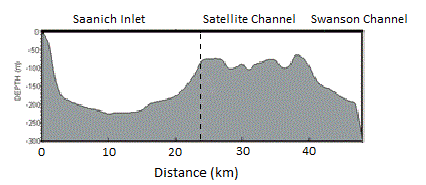
Currents are usually low, although wind squalls are common in winter. Tidally-driven mixing occurs across the fjord mouth during times of spring tides. There is little freshwater input directly into Saanich Inlet; most comes from the Cowichan River to the northwest of the Inlet.
Due to its interesting properties, the Saanich Inlet marine system has been researched since 1927.
Formation of a Fjord:
A fjord is formed when a glacier cuts a U-shaped valley through abrasion of the surrounding bedrock by the sediment it carries. Many such valleys were formed in British Columbia during the last ice age. Glacial melting is accompanied by the rebounding of the Earth's crust as the ice load and eroded sediment is removed. In some cases this rebound is faster than sea level rise. Most fjords are deeper than the adjacent sea. Fjords generally have a sill or shoal (bedrock) at their mouth caused by the previous glacier's reduced erosion rate and terminal moraine. In many cases this sill causes extreme currents and large saltwater rapids. These characteristics distinguish fjords from rias, which are drowned valleys flooded by the rising sea.
Where Are Fjords Found?:
The principal mountainous regions where fjords have formed are in the higher middle latitudes where, during the glacial period, many valley glaciers descended to the then-lower sea level. The fjords develop best in mountain ranges against which the prevailing westerly marine winds are lifted over the mountainous regions, resulting in abundant snowfall to feed the glaciers. Therefore, coasts having the most pronounced fjords include the west coast of Europe, the west coast of North America from Puget Sound to Alaska, the west coast of New Zealand, and the west coast of South America. Other areas which have lower altitudes and less pronounced glaciers also have fjords or fjord-like features.
Logging Requirements:
1) You have learned what causes the formation of a fjord. Can you see anything at this location that would make you think glacial activity formed this inlet? Please explain briefly.
2) Typically fjords have steep sides. Would you consider the sides of Saanich inlet at this location as steep? Estimate the angle of the sides, in degrees, at this location.
3) Let's imagine that Saanich Inlet is in the shape of an inverted triangular prism, and calculate the amount of material that may have been removed during the formation of the inlet during glaciation. Using the information found on this page, calculate the volume of rock (in m³) that could have been removed. Assume material was removed from sea level to the bottom of the inlet. Also assume a constant width (base) of 1000 m. The formula for calculating the volume of a triangular prism is: V=1/2(b x h x l)
4) (optional) Post a photo of yourself or just a photo in general, taken at the cache location.
Sources:
http://microbewiki.kenyon.edu/index.php/Saanich_inlet
http://en.wikipedia.org/wiki/Saanich_Inlet
http://en.wikipedia.org/wiki/Fjord
http://venus.uvic.ca/discover-venus/where-is-venus/saanich-inlet/
Additional Hints
(No hints available.)
Treasures
You'll collect a digital Treasure from one of these collections when you find and log this geocache:

Loading Treasures