Roque Nublo
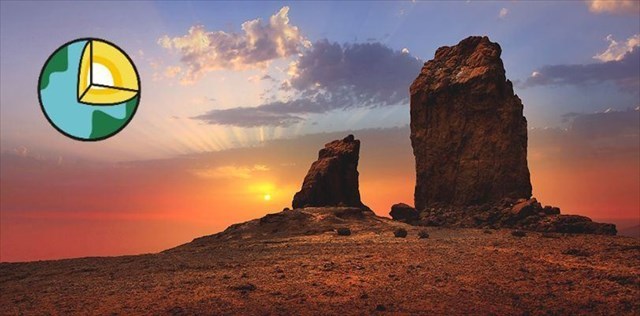
Roque Nublo es una de las formaciones
geológicas más emblemáticas de Gran Canaria, y su origen está
íntimamente ligado a la historia volcánica de la isla. Es un monumento
natural protegido y es un símbolo de Gran Canaria, atrayendo numerosos
visitantes. Históricamente, este lugar tuvo un significado espiritual
para los aborígenes canarios, quienes lo consideraban un lugar sagrado.
Este monolito de 67 metros de altura, situado a 1.813 metros sobre el
nivel del mar, se formó
durante el ciclo eruptivo conocido como el Ciclo Roque Nublo.
Ciclo Roque Nublo
- Tiempo: Este ciclo tuvo lugar hace aproximadamente 5,3 a 3,4 millones
de años, durante el Mioceno superior y el Plioceno.
- Actividad Volcánica: Se caracterizó por erupciones explosivas que
emitieron grandes volúmenes de material piroclástico y lavas
traquíticas y fonolíticas. Estas lavas formaron una gruesa capa de
ignimbritas (depósitos de flujo piroclástico), que cubrieron gran parte
de la isla y constituyen la principal roca madre del Roque Nublo.
Erosión
- Tras el cese de la actividad volcánica, los procesos erosivos
comenzaron a modelar el paisaje. El viento, el agua y los cambios
térmicos actuaron sobre las ignimbritas, desgastando los materiales más
blandos y dejando expuestos los más duros y resistentes, como es el
caso del Roque Nublo, del Roque La Rana (situado al lado del Roque
Nublo) y del Roque El Fraile (situado cerca del camino).
Diferenciación del Material
- El Roque Nublo está compuesto principalmente de traquita fonolítica,
una roca volcánica rica en feldespato y sílice, que es más resistente a
la erosión en comparación con las rocas circundantes. Esta resistencia
diferencial permitió que el monolito se mantuviera prominente mientras
el terreno alrededor se erosionaba.
Roque Nublo es un excelente ejemplo de cómo los procesos volcánicos y
erosivos pueden interactuar para crear paisajes geológicos
impresionantes.
Para las tareas de este Earthcache, tienes que ir a la zona de las
coordenadas y observar el Roque Nublo.
PREGUNTAS
Para poder registrar como
encontrado este Earthcache, nos tenéis que mandar un correo (podéis
hacerlo
desde nuestro perfil de usuario) con las respuestas a las siguientes
preguntas. Podéis loguear el earthcache sin haber recibido
nuestra respuesta. Si no recibimos el correo con las respuestas
correctas, el log podrá ser borrado sin previo aviso.
1.- Cuál de las
siguientes afirmaciones es correcta:
A) El Roque Nublo es un meteorito.
B) El Roque Nublo es una roca sedimentária.
C) El Roque Nublo es una roca volcánica.
D) El Roque Nublo es una fábrica de nubes y nieblas.
2.-
Observa el Roque Nublo. ¿Qué textura tiene y de qué color es la roca?
3.
- Una vez leído el listing y observado la zona del Roque Nublo,
describe con tus palabras cómo crees que se ha formado el Roque Nublo.
4.-
FOTO. Hazte una fotografía con el Roque Nublo. Si no quieres salir,
un papel
con tu nick o tu GPS será válido. Recuerda que esta fotografía es
OBLIGATORIA para demostrar que has visitado este Earthcache.
Si no recibimos las respuestas, el log será
borrado sin previo aviso.
También podrán ser borrados todos los
logs que no incluyan la fotografía obligatoria de la pregunta 4 (desde
la actualización de las guidelines de junio de 2019, la fotografía
puede ser obligatoria para demostrar que se ha visitado el sitio).
No
olvides que estás dentro de un entorno natural, hay que respetarlo y
cuidarlo.
Gracias por vuestra
comprensión y esperemos que disfrutéis del lugar.

ENGLISH VERSION
Roque Nublo (ENG)
Roque Nublo is one of the most iconic
geological formations of Gran Canaria, and its origin is closely tied
to the volcanic history of the island. It is a protected natural
monument and a symbol of Gran Canaria, attracting numerous visitors.
Historically, this place held spiritual significance for the indigenous
Canarians, who considered it a sacred place. This monolith (67 meters
high), situated at
1,813 meters above sea level, was formed during the eruptive cycle
known as the Roque Nublo Cycle.
Roque Nublo Cycle
- Time: This cycle took place approximately 5,3 to 3,4 million years
ago,
during the late Miocene and Pliocene.
- Volcanic Activity: It was characterized by explosive eruptions that
emitted large volumes of pyroclastic material and trachytic and
phonolitic lavas. These lavas formed a thick layer of ignimbrites
(pyroclastic flow deposits), which covered much of the island and
constitute the main bedrock of Roque Nublo.
Erosion
- After the volcanic activity ceased, erosive processes began to shape
the landscape. Wind, water, and thermal changes acted on the
ignimbrites, wearing down the softer materials and exposing the harder,
more resistant ones, as is the case with Roque Nublo, Roque La Rana
(The Frog Rock in Spanish, located next to Roque Nublo) and Roque El
Fraile (The Friar Rock in Spanish, located near the path).
Material Differentiation
- Roque Nublo is mainly composed of phonolitic trachyte, a volcanic
rock rich in feldspar and silica, which is more resistant to erosion
compared to the surrounding rocks. This differential resistance allowed
the monolith to remain prominent while the surrounding terrain eroded.
Roque Nublo is an excellent example of how volcanic and erosive
processes can interact to create impressive geological landscapes.
For the tasks of this Earthcache, you need to go to the coordinates
area and observe Roque Nublo.
QUESTIONS
To log this Earthcache as found, you must send us an email (you
can do it from our user profile) with the answers to the following
questions. You can log the earthcache without having received
our response. If we do not receive the email with the correct answers,
the log may be deleted without prior notice.
1. Which of the following statements is correct:
A) Roque Nublo is a meteorite.
B) Roque Nublo is a sedimentary rock.
C) Roque Nublo is a volcanic rock.
D) Roque Nublo is a cloud and fog factory.
2.-
Observe Roque Nublo. What texture does it have and what color is the
rock?
3.
- After reading the listing and observing the area of Roque Nublo,
describe in your own words how do you think Roque Nublo was formed.
4.-
PHOTO. Take a photo of yourself with Roque Nublo. If you don't want to
appear in the photo,
a paper with your nickname or your GPS will be OK. Remember this photo
is REQUIRED to prove that you have visited this Earthcache.
If we don't receive the answers, the log
will be deleted without prior notice.
All logs that don't include the
required photo in question 4 may also be deleted (since the June 2019
guidelines update, the photo may be required to prove that you have
visited the place).
Don't
forget you are in a natural environment, you have to respect it and
take care of it.
Thank you for your
understanding and we hope you enjoy the place.