This multi-cache will take you on a tour of the important places in RLS’s life as a boy and young adult in Edinburgh. This tour includes visits to three main areas of Edinburgh – Canonmills, the New Town and the Old Town. It may take a few hours to visit these places, but Edinburgh is a very walkable city. Or you may wish to attempt it over several days. No 23 bus goes from Princes Street down to the starting point. You may wish to make note of the opening hours of both St Giles Cathedral and The Writers' Museum.
The clues will lead you to a final location in Stevenson’s Edinburgh to find a micro cache, which contains the coordinates for a bonus cache as compensation for all of your hard work. Note that transport is required to get to the bonus cache.
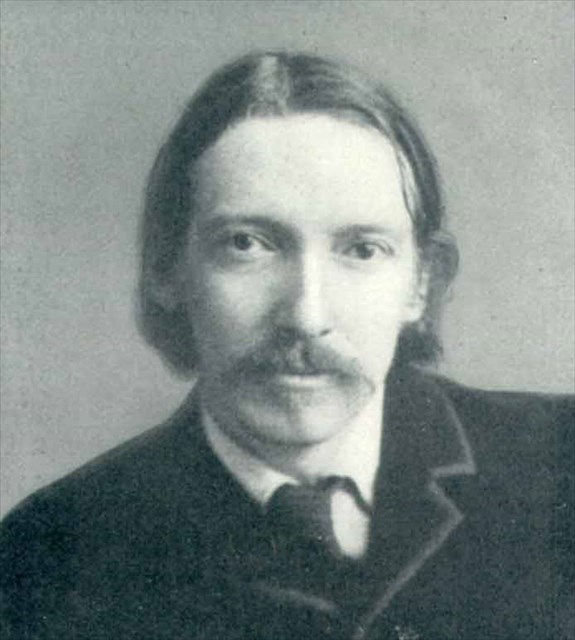
RLS was the grandson of Robert Stevenson (1772-1850), the designer and builder of the Bell Rock Lighthouse, as well as bridges and roads. RLS’s father, Thomas, and his uncles Alan and David, as well as his cousins David Alan and Charles Stevenson, all made their careers as civil engineers. RLS was also destined for a career as an engineer, but eventually, “on being tightly cross-questioned during a dreadful evening walk (by his father), I owned I cared for nothing but literature”. When his father took him for a voyage he found that, instead of being interested in lighthouse construction, his mind was filled with romances about the coast and islands which they visited.
8 HOWARD PLACE N55 57.817 W003 12.085
RLS was born here in 1850 to Thomas and Margaret Stevenson. He was their first child. Howard Place was one of the first developments north of the New Town. Between 1926 and 1962, the house was a museum of the Robert Louis Stevenson Club of Edinburgh. The house was sold in 1964 for £4,320 and the collection returned to the City of Edinburgh, where it forms part of the display at The Writers Museum. There is a plaque on the house commemorating RLS’s birth. How many words (excluding the two numbers) are on the plaque? 1A
9 (formerly 1) INVERLEITH TERRACE N55 57.832 W003 12.207
In 1853, when RLS was 2 years old, the family moved across the road to this house, which was the first of a small row of 3 houses. It is hard to imagine now, but at that time there were fewer than half a dozen houses in the street altogether and the rest was open land with the Royal Botanic Gardens across the street. Stand across the street at the coordinates to get a better view of the house. On No 9 only, how many windows have small wrought iron balconies? B
CANONMILLS SCHOOL N55 57.756 W003 11.895
This building is now a Baptist Church, but it was formerly a school and is where RLS began his education. There is a plaque on the building commemorating this event. At the bottom of the inscription is a date “circa 185C”.
17 HERIOT ROW N55 57.322 W003 12.070
In 1857, the family moved to a large house in the New Town, where they lived for 30 years. RLS’s rooms were the two connected rooms that make up the front of the top floor. As a young child, RLS was often unwell, possibly with tuberculosis. In his memoirs, he recalled how his nurse cared for him during long nights kept awake by coughing, and how she lifted him out of bed to look out of the window at the lamplit street. He drew upon these memories for one of his most famous poems ‘The Lamplighter’. It was his great-grandfather who installed street lights all over Edinburgh.
“My tea is nearly ready and the sun has left the sky;
It’s time to take the window to see Leerie going by;
For every night at teatime and before you take your seat,
With lantern and with ladder he comes posting up the street.
Now Tom would be a driver and Maria go to sea,
And my papa’s a banker and as rich as he can be;
But I, when I am stronger and can choose what I’m to do,
O Leerie, I’ll go rounds at night and light the lamps with you!
For we are very lucky, with a lamp before the door,
And Leerie stops to light it as he lights so many more;
And O! before you hurry by with ladder and with light;
O Leerie, see a little child and nod to him tonight!”
At the coordinates on the other side of the street from the house is a framed information board about RLS. There is a small engraved brass plaque attached to the lamp outside No 17 (a privately owned house). How many lines are there on the plaque? D
36 INDIA STREET N55 57.368 W003 12.356
Thomas S Henderson School
RLS attended this school for nearly four years. He was sent home ill one day and came down with scarlet fever, and missed his end of year examination. He won a book prize for English, which is now in the Writers’ Museum. How many curved panes of glass are there in the window above the door? 1E
84 GEORGE STREET NORTHERN LIGHTHOUSE BOARD N55 57.151 W003 12.094
This address is the headquarters of The Commissioners of Northern Lighthouses, and is where RLS’s civil engineering family members had their offices. RLS used books and records here and wrote a number of scientific papers. The family’s engineering papers are in the National Library of Scotland. Above the doorway is a model lighthouse. How many rows of small windows are on it? F
NEW CALTON BURIAL GROUND N55 57.218 W3 10.537
N55 57.236 W003 10.666 Access to cemetery
These coordinates are for the Stevenson family tomb. His grandfather and grandmother, father and mother and uncles are buried here. RLS and his wife are buried at the top of Mount Vaea in Samoa, South Pacific. On the memorial to his famous grandfather Robert Stevenson, directly facing you, how many lines of text are there? 1G
OLD COLLEGE N55 56.864 W003 11.205
Edinbugh University
After attending school in India Street, RLS spent a short time at Edinburgh Academy, followed by another school at 40 Frederick Street, in a building no longer there. RLS enrolled in an engineering and law course at Edinburgh University, but was not a great attender of classes and followed no regular curriculum. He has described being kept poor by his family, and much like many students “My monthly pound was usually spent before the evening of the day on which I received it”.
RLS was a member of the famous debating society, 'The Speculative Society' between 1869-75, and became its President. The Society’s rooms are in the NE corner of the quad, behind a locked blue door on the right as you face the Law School. The meeting room is still lighted only by candles. Unfortunately the rooms are not open to the public except on occasional open house days.
Standing in front of the blue door, you will see a large round drainage cover set into the stone floor, with 'H****** Brothers' stamped on it. Using A=1, B=2, etc convert the last letter denoted by the asterisks into a number = H. NOTE: This area is currently hidden by construction work. Use the nearest plaque and take the last letter of the 3rd word to convert to a number.
RLS is mentioned in Chizu’s nearby cache ‘Scottish Literary Tour: Writers’ Corner’, where there is a plaque on the corner of Drummond Street near The Rutherford Bar, which as The Pump Room, was one of RLS’s haunts.
PARLIAMENT HOUSE N55 56.953 W003 11.438
RLS passed his Bar exam in 1875, a profession as a lawyer being a back-up plan in the event that a career as a writer did not bear fruit. According to his mother, RLS found Parliament House “too pleasant a place to be idle in and he told his father that he would fall between two stools if he went on, so the pretence was given up and he stayed at home and worked busily and happily at his literary work. He got four briefs in all”. Around the colonnaded walkway in the frontage of the building there are a number of numbered doorways. What is the highest number? 1J
ST GILES CATHEDRAL N55 56.964 W003 11.499
St Giles’ is open to visitors all year except 25th-26th December and 1st-2nd January. Opening hours are:
Summer (May-September)
Monday - Friday 09.00-19.00
Saturday 09.00-17.00
Sunday 13.00-17.00
Winter (October-April)
Monday - Saturday 09.00-17.00
Sunday 13.00-17.00
RLS travelled and met his future wife, a married American lady called Fanny Osbourne. They married in America after she obtained a divorce. RLS’s respiratory problems afflicted him as an adult too, and in search of a climate suited to his health, he and Fanny set up home on the Samoan island of Upolu, where they built a house named ‘Vailima’. On December 3, 1894, at the age of 44, Stevenson died of a stroke. He was buried on the peak of Mount Vaea. RLS was revered by the Samoans, who called him 'Tusitala', which was as close as they could get to pronouncing 'Storyteller'.
In the Moray Aisle in the SW corner of the cathedral is a bronze relief depicting a reclining RLS. Underneath is his poem ‘Requiem’:
“Under the wide and starry sky, dig the grave and let me die;
This be the verse you crave for me: Here he lies where he longed to be.
Glad did I live and gladly die, And I laid me down with a will
Home is the sailor or home from the sea, and the hunter home from the hill.”
There are two dates in roman numerals in the bottom left corner of the relief. How many letters are in the first number? 1K In the NE corner of the cathedral is a stained glass window erected by RLS and his brothers in memory of his grandfather. The date at the end of the inscription at the bottom of the window is 187L.
THE WRITERS’ MUSEUM N55 56.972 W3 11.614
Lady Stair’s Close
The Writers' Museum is dedicated to the lives and work of three of Scotland's great literary figures, Robert Burns, Sir Walter Scott and Robert Louis Stevenson. Admission is free and the museum is well worth visiting not only for its displays but also as an example of one of Edinburgh’s oldest houses. Opening hours are:
Monday - Saturday 10am - 5pm
Sundays during August 12 noon - 5pm.
If the museum is closed, find the stone inscription in the pavement, among the many from Scottish writers, by RLS. How many words are there in it? Take the second digit=X+3=M. Secondly, find the date carved into the stonework on the South side of the building in the top left side “S R 1622-189N”.
If the museum is open, visit the RLS rooms in the basement and find the photograph of Vailima on the wall in the second room. The 2nd wing was added in 189M. In the main hall on the floor above is a large tapestry commissioned by the City Museums. There is an information panel about it on the galleried floor. Find the date it was commissioned: May 19N1.
The cache, a small dogtag container, can be found at N55 56.UVW W003 11.XYZ where:
U=E+H+A
V=G+B
W=C-M
X=D+K
Y=N-F
Z=L+J-G
You can check your answers for this puzzle on GeoChecker.com.