St Patrick, the patron Saint of Ireland, is widely loved across the world and the anniversary of his death on March 17th is a day when many people become a little bit Irish, wearing shamrocks and drinking Guinness!
Despite St Patrick’s popularity, there are many contradictions around his life and little factual information is agreed. Even his birthplace is unknown for some people say that “Bannaventarbernia”, was Kilpatrick in Scotland or even Ravenglass in West Cumbria.
But we North Cumbrians know better and believe that “Bannaventarbernia” was actually Birdoswald, not far from here on Hadrian’s Wall. We think this because a Roman carved stone was dug up in the area with the word “Banna” on it. The stone is now in Lanercost Priory, near Brampton. “Vent” has a double meaning of “outlet in an embattled wall” or “going to” and between Birdoswald and Irthington there is such an outlet where a stream runs through the wall. “Arbeia” was a prominent Roman site overlooking and protecting the Tyne Estuary and a significant supply base for “Wall”. If “Bannaventarbernia”, is broken down into components, Banna (Birdoswald) Vent (going to) Arbeia (modern fort name in Tynemouth), it’s fair to say that St Patrick may have indeed been describing Birdoswald as his homeplace.
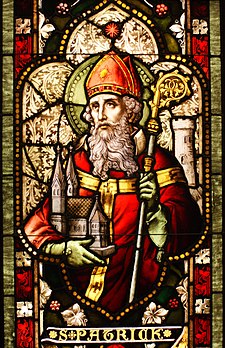
But, irrespective of where his place of birth to Roman parents was, it is agreed that during his mid teens, he was captured as a slave and taken to Ireland to become a goat and sheep herder. He turned to God during his captivity, eventually escaping from his slavery and returning to England where he entered the Priesthood. He eventually returned to Ireland as a Bishop and began life as a Missionary, converting many of the native people to Christianity. He used the Shamrock, which looks like clover as it has three leaves on each stem, to explain the concept of the Holy Trinity; in one God there are three divine beings: God the Father, God the Son and God the Holy Spirit. St Patrick is also attributed with banishing snakes from Ireland and although it’s true that Ireland has no snakes, this is more probably the result of Ireland being an island separated from the rest of Europe with no easy way of snakes establishing a habitat there. These stories of Saint Patrick and the snakes are probably a metaphor for his bringing Christianity to Ireland and driving out the pagan religions, symbolised by the serpents.
Although it began in Ireland, Saint Patrick’s Day is celebrated in countries around the world as over the centuries, many Irish people left the island to find a new life elsewhere. People with that Irish heritage remind themselves of the beautiful green countryside of Ireland by wearing green and taking part in various festivities.