Questa è una cache come le altre, ma...
...può essere il punto di partenza per mettere in piedi una
cooperazione internazionale! Questa cache è una di 12 chiamate "IMC
No. 3 ..." (IMC = International Multi-Cache). Queste cache sono
nascoste in 6 paesi distinti: Belgio (BE), Canada (CA), Germania
(DE), Italia (IT), Portogallo (PT), USA (US).
In ogni Paese è presente una "Cache Primaria", come questa, ed una
"Cache Secondaria", che può essere trovata solo grazie a 6
suggerimenti, distribuiti all'interno di ciascuna delle cache
primarie, uno per cache.
Le 6 cache primarie hanno nome "IMC No. 3 P-XX - yyy" e le
secondarie "IMC No. 3 S-XX - zzz" dove XX è il codice del paese
indicato sopra, e yyy, zzz sono nomi aggiuntivi.
I suggerimenti per le cache secondarie sono presenti come "lista di
suggerimenti", e sono solo all'interno delle cache primarie. Ogni
"lista di suggerimenti" contiene 6 suggerimenti, relativi ad uno
per Paese. Dato che le cache primarie sono sparse per il mondo, per
evitare di viaggiare parecchio - ed è questa l'intenzione delle IMC
No. 3 - si deve aprire una cooperazione internazionale: se volete
trovare i 6 suggerimenti che vi consentono di trovare la cache
secondaria, dovete contattare gli utenti che hanno trovato le cache
primarie negli altri Paesi, e scambiare con loro i suggerimenti
trovati.
E per cortesia, non barate!
Non pubblicate i suggerimenti da alcuna parte: nè in un log, nè in
un sito web. I suggerimenti possono solo essere scambiati tra i
geocachers che hanno trovato le cache primarie e vogliono trovare
le cache secondarie.
Il team dell'IMC No. 3 vi augura buon divertimento
IMPORTANTE
L'argomento della IMC No. 3 è "Earth", la terra. Potete
trovate la lista di tutte le IMC No. 3 alla url http://www.woelper.net/gc/imc-no3.php
oppure come risultato della ricerca
per "IMC no. 3" nel presente sito.
Per favore, scrivete il log in italiano, se volete, ma comunque
accompagnatelo dalla traduzione ANCHE IN LINGUA INGLESE, in quanto
questa è una cache internazionale. Grazie.
San Giuliano Terme  è un piccolo paese, edificato a
ridosso del monte che separa Lucca da Pisa; nonostante si
componga di poche case intorno ad una piazza, la sua
estensione amministrativa è tra le più grandi della provincia
di Pisa.
è un piccolo paese, edificato a
ridosso del monte che separa Lucca da Pisa; nonostante si
componga di poche case intorno ad una piazza, la sua
estensione amministrativa è tra le più grandi della provincia
di Pisa.
La notorietà del paese viene dalle sue Terme, sfruttate fin dal
periodo romano, e rinomate ancora al giorno d'oggi.
Anche l'attività estrattiva, in particolare la cavatura della
pietra, è stata una parte fondamentale dell'economia del paese fin
dal periodo etrusco, ma oggiogiorno non è quasi più praticata.
Pertanto alcune cave abbandonate da decenni sono state riadattate
ad aree per manifestazioni e sagre (come nell'anfiteatro ricavato
dalla ex-cava di nord-est); in altri casi è possibile trovare i
segni di vecchie escavazioni e resti di costruzioni ed impianti, a
testimonianza di un passato recente ormai non più remunerativo.
La cache è un contenitore tondo medio-piccolo, ed è stata posta tra
i resti di una antica cava di pietra, i cui impianti sono ancora
ben visibili. Alle spalle della cache potete vedere la "ferita"
inferta negli anni alla montagna per cavarne materiale da
costruzione. Tuttavia questo habitat è ideale per alcuni tipi di
animali. In particolare, se avete la passione per il birdwatching,
sulle pareti rocciose è possibile individuare, con un po' di
fortuna, il Picchio muraiolo e (più facilmente) una coppia
nidificante di Gheppio.
Un ultimo avvertimento - i cartelli di divieto di accesso
sono stati messi per evitare che gente vada con motocarri o furgoni
- a proprio rischio - a portarsi via pietre o a scaricare
materiali. Il terreno è demaniale, ed è liberamente accedibile a
piedi.
This cache can be searched and found like any other traditional
cache, but...
it can be the starting point for an international cooperation as
well: This cache is just one cache of a set of 16 caches named "IMC
No. 3 ..." (IMC = International Multi-Cache). These caches are
hidden in 6 Countries worldwide: BE = Belgium, CA = Canada, DE =
Germany, IT = Italy, PT = Portugal, US = USA.
In each country there is a "primary cache" like this one and a
"secondary cache" that can only be found with "hints" distributed
to all primary caches. The 6 primary caches are named "IMC No. 3
P-x - yyy" and the 6 secondary caches "IMC No. 3 S-x - zzz" where x
is the country code given above and yyy and zzz can be any
additional name. The hints for the secondary caches are printed on
"lists of hints" that are inside the primary caches.
As the primary caches are scattered all over the world it will
either require a lot of travelling or - and that is the intention
of the IMC No. 3 - international cooperation: If you want to find
the secondary cache as well, you should contact finders of other
primary IMC No. 3 caches and exchange the hints.
And please don't be a poor sport!
Never publish these hints anywhere! Not in a log report or on any
web side. The hints shall only be exchanged / traded between
geocachers that found the primary caches and want to search the
secondary caches.
The IMC No. 3 team wish you good luck!
IMPORTANT NOTES
IMC No. 3 theme is "Earth". You can find the
full IMC No. 3 cache list at http://www.woelper.net/gc/imc-no3.php
or in the present website as a search
result for "IMC no. 3".
As this is an international cache, LOGS SHOULD BE IN ENGLISH!
Translations in local language are welcome. Thank you.
San Giuliano Terme 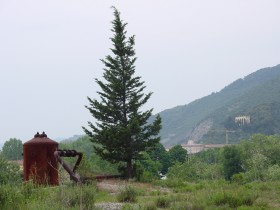 is a small village at the bottom of
the mountain between Pisa and Lucca. Even if it is a small
village, its administrative territory is one of the greatest
of Pisa county.
is a small village at the bottom of
the mountain between Pisa and Lucca. Even if it is a small
village, its administrative territory is one of the greatest
of Pisa county.
The town is well known from Roman period for its Termal bath (still
in use), an important curative station for hundred of tourists each
year. Even the stone mining has been very important for village
economy, but today this activity has ended. Actually, lot of mine
ruins are still in place: some old caves have been recycled and
used as open spaces for festivals (like the new "anfiteatro" built
on the top of the old "north-east stone mine"), other ones have
been abandoned, and lot of machineries are still in place.
Tha cache is a medium round plastic box, put near some old rusty
machinery. Rear the cache you can see the "wounds" made on the
mountain, in order to extract stones for buildings. But this
habitat is perfect for some kind of animals: if you like
birdwatching, here it is possible to see a couple of Kestrel (Falco
tinnunculus) and, if you have luck, a Wallcreeper (Tichodroma
muraria)
Just a little reminder The "access denied" signs are
placed only to avoid people coming inside with trucks to risky
steal stones or drop waste; the terrain is not owned by anyone, and
it is freely accessible by foot.