FTF: Merritt4Cache
First: The junior high chemistry lesson:
 Fluorine is the most reactive of all elements and no chemical
substance is capable of freeing fluorine from any of its compounds.
For this reason, fluorine does not occur free in nature and was
extremely difficult for scientists to isolate. The first recorded
use of a fluorine compound dates to around 1670 to a set of
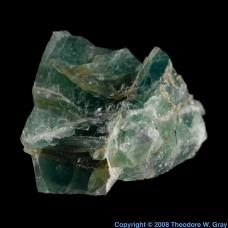
instructions for etching glass that called for Bohemian emerald
(CaF2). Chemists attempted to identify the material that was
capable of etching glass and George Gore was able to produce a
small amount of fluorine through an electrolytic process in 1869.
Unknown to Gore, fluorine gas explosively combines with hydrogen
gas. That is exactly what happened in Gore's experiment when the
fluorine gas that formed on one electrode combined with the
hydrogen gas that formed on the other electrode. Ferdinand Frederic
Henri Moissan, a French chemist, was the first to successfully
isolate fluorine in 1886. He did this through the electrolysis of
potassium fluoride (KF) and hydrofluoric acid (HF). He also
completely isolated the fluorine gas from the hydrogen gas and he
built his electrolysis device completely from platinum. His work
was so impressive that he was awarded the Nobel Prize for chemistry
in 1906. Today, fluorine is still produced through the electrolysis
of potassium fluoride and hydrofluoric acid as well as through the
electrolysis of molten potassium acid fluoride (KHF2).
Fluorine is the most reactive of all elements and no chemical
substance is capable of freeing fluorine from any of its compounds.
For this reason, fluorine does not occur free in nature and was
extremely difficult for scientists to isolate. The first recorded
use of a fluorine compound dates to around 1670 to a set of
instructions for etching glass that called for Bohemian emerald
(CaF2). Chemists attempted to identify the material that was
capable of etching glass and George Gore was able to produce a
small amount of fluorine through an electrolytic process in 1869.
Unknown to Gore, fluorine gas explosively combines with hydrogen
gas. That is exactly what happened in Gore's experiment when the
fluorine gas that formed on one electrode combined with the
hydrogen gas that formed on the other electrode. Ferdinand Frederic
Henri Moissan, a French chemist, was the first to successfully
isolate fluorine in 1886. He did this through the electrolysis of
potassium fluoride (KF) and hydrofluoric acid (HF). He also
completely isolated the fluorine gas from the hydrogen gas and he
built his electrolysis device completely from platinum. His work
was so impressive that he was awarded the Nobel Prize for chemistry
in 1906. Today, fluorine is still produced through the electrolysis
of potassium fluoride and hydrofluoric acid as well as through the
electrolysis of molten potassium acid fluoride (KHF2).
Fluorine is added to city water supplies in the proportion of about
one part per million to help prevent tooth decay. Sodium fluoride
(NaF), stannous(II) fluoride (SnF2) and sodium monofluorophosphate
(Na2PO3F) are all fluorine compounds added to toothpaste, also to
help prevent tooth decay. Hydrofluoric acid (HF) is used to etch
glass, including most of the glass used in light bulbs. Uranium
hexafluoride (UF6) is used to separate isotopes of uranium.
Crystals of calcium fluoride (CaF2), also known as fluorite and
fluorspar, are used to make lenses to focus infrared light.
Fluorine joins with carbon to form a class of compounds known as
fluorocarbons. Some of these compounds, such as
dichlorodifluoromethane (CF2Cl2), were widely used in air
conditioning and refrigeration systems and in aerosol spray cans,
but have been phased out due to the damage they were supposed to be
causing to the earth's ozone layer. The ozone hole has since been
shown to be a natural phenomenon with an 11 year cycle
corresponding to the sunspot cycle.
Due to muggling problems, the cache has been relocated. It is now
off the back road between Bremerton and Gorst.