The place where the chapel is built has a very special
athmosphere. It's a very nice little place to rest a while. The
well can be found on the right side of the chapel.
About the village:
The village is the most known pilgrimage place of the region
today. The village is placed opposite of Mosonmagyaróvár across the
Mosoni Danube. The start of the pilgrimage at Máriakálnok can be
followed back to the 16th Century and the chapel was built during
the rise of the Marian cult.

History and legends:
According to the legend the spring had some healing power and
was situated outside of the village. In 1529, the Christian army
camped here while in retreat from the Turks, and the warriors
wounds were healed. Later another miracle took place, a Kálnoker
fishing men has drawn out of the spring a carved lime wooden statue
of Maria. He built to her honour a small edifice nearby the spring
in order to protect the wooden sculpture. Later his son built a
chapel that was replaced afterwards, and lived next to it as an
eremite. At 1663 the landlord János Viczay erected at the same
place a new chapel to the honour of the blessedly lady of Sarló in
gratitude of its miraculous escape. The sanctuary was decorated
with the statue of Mary which was found in the spring. Though
situated in the flood catchment of the Danube, the chapel wasn't
damaged by water. At 1873 an extreme fire destroyed the chapel
completely, but the statue of Maria was without harm. The bishop of
Györ János Zalka initiated and lead the reconstruction of the 240
year old chapel in neo romantic style at 1874. At the presbytery of
the chapel you can find the Kálnoker Maria still today.
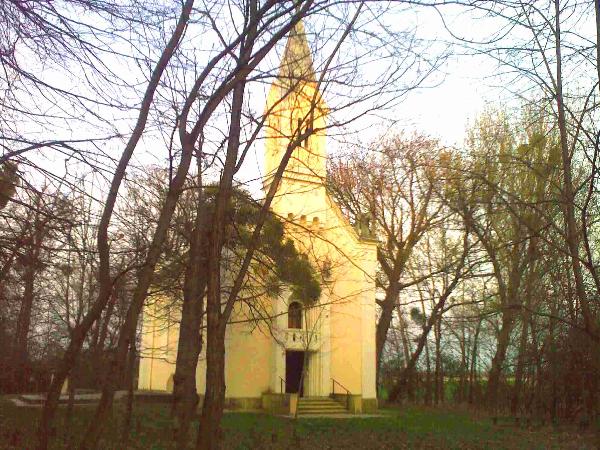
The most important pilgrimage days are: Sunday of the Holy
trinity and Sunday of the Little Blessedly Lady (8. September).
Architecture:
Following a fashion, which emerged towards the end of the 16th
century, Frigyes Summerpach designed the new building using the
characteristics typical of the early medieval Romanesque style. The
gate with its orders of arches is one of the typical Roman
characteristics and is set off by the pillars. The ornamented
plaster on the facade is in a typical Neo-Romanesque style. The
Romanesque arched facade breaks through the one-storey steeple. The
interior also recalls historicism. Stars are shining in the blue
sky of the sanctuary. A gorgeous free-standing altar standing
independently can be seen in the middle. The sanctuary is decorated
with the sculptures of Mary. The sculpture was re-painted after the
fire. The infant received a crown, a silver mace and a brocade
pelisse interwoven with gold. The water of the spring was diverted
into the pool of the edifice. The terrain was lifted and protected
with dikes.

Version 2.0 (29.01.2010): Update of coords; Replacement
of the box; hint deleted; rated up 1/2 star and listing
improved.

If you like to rate the cache I'm happy if you use GCvote.
Please tell your true opinion about the cache in the log. If you do
not like something, please write it down. I'll see what will be
possible to do it better. Maybe you have an idea to improve too
:-).
