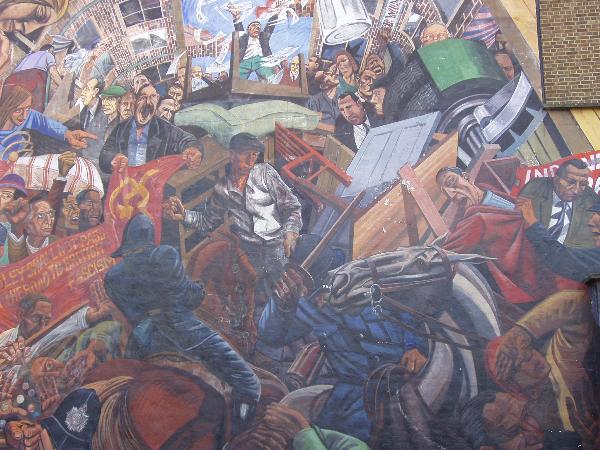
The illustration shows a detail from the large mural covering the whole side of the Library in Cable Street E1, which can be viewed from Library Passage.
This commemorates the events of October 4th 1936, when Sir Oswald Moseley planned to lead a march of the black-shirted members of the British Movement of Fascists through the streets of East London and to hold street meetings in five boroughs, as a provocative show of strength.
Link to YouTube newsclip
The local population who were predominantly Jewish or politically left-wing or perhaps both, strongly opposed the march.
The five local mayors went and appealed beforehand to the Home Secretary, Sir John Simon, to ban the march; but were only able to speak to the deputy under secretary.
Some Jews presented a hastily prepared petition signed by nearly 100,000 people; but the Home Office refused to act.
By 1936, the Hitler had been in control of Germany for three years, had remilitarised the Rhineland and introduced anti-Semitic laws, Mussolini had invaded Abyssinia, Franco had started a civil war in Spain. and British Fascists had been escalating anti-Semitic attacks in the East End. So, the East End was more concerned about the threat of Fascism than was the British government at that time.
The Fascists gathered near the Tower and the police tried to force a way through the massed crowd blocking the streets, to allow the march to proceed.
This struggle became known as the Battle of Cable Street. Despite a number of arrests, the proposed march had to be abandoned.
One result of the episode was that shortly after this, parliament passed a law banning political parties from wearing uniforms.
Artist: David Binnington. 1983.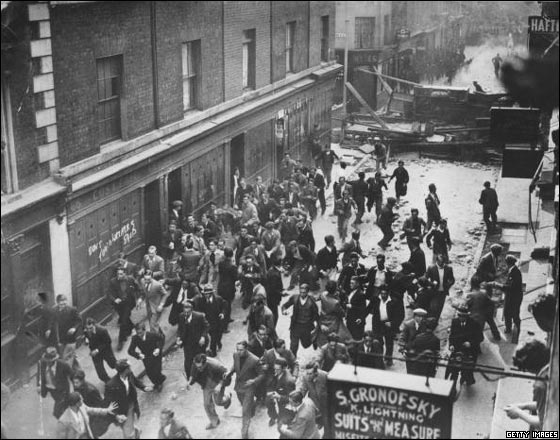
Link to wikipedia article
Link to BBC article "Does Cable Street still matter?"
The Terry Pratchett discworld book 'Night Watch' is loosely based on these events.