FTF: Fledermaus
First: The junior high chemistry lesson:
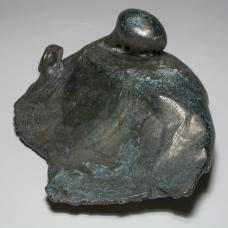
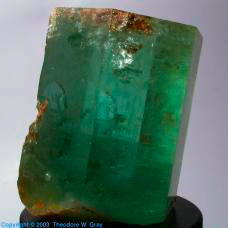
Although emeralds and beryl were known to ancient civilizations, they were first recognized as the same mineral (Be3Al2(SiO3)6) by Abbé Haüy in 1798. Later that year, Louis-Nicholas Vauquelin, a French chemist, discovered that an unknown element was present in emeralds and beryl. Attempts to isolate the new element finally succeeded in 1828 when two chemists, Friedrich Wölhler of Germany and A. Bussy of France, independently produced beryllium by reducing beryllium chloride (BeCl2) with potassium in a platinum crucible. Today, beryllium is primarily obtained from the minerals beryl (Be3Al2(SiO3)6) and bertrandite (4BeO·2SiO2·H2O) through a chemical process or through the electrolysis of a mixture of molten beryllium chloride (BeCl2) and sodium chloride (NaCl).
Beryllium is relatively transparent to X-rays and is used to make windows for X-ray tubes. When exposed to alpha particles, such as those emitted by radium or polonium, beryllium emits neutrons and is used as a neutron source. Beryllium is also used as a moderator in nuclear reactors.
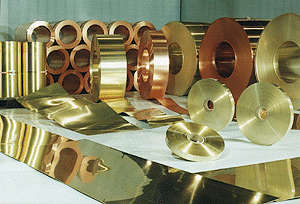
Beryllium is alloyed with copper (2% beryllium, 98% copper) to form a wear resistant material, known as beryllium bronze, used in gyroscopes and other devices where wear resistance is important. Beryllium is alloyed with nickel (2% beryllium, 98% nickel) to make springs, spot-welding electrodes and non-sparking tools. Other beryllium alloys are used in the windshield, brake disks and other structural components of the space shuttle.
Beryllium oxide (BeO), a compound of beryllium, is used in the nuclear industry and in ceramics.
Beryllium was once known as glucinum, which means sweet, since beryllium and many of its compounds have a sugary taste. Unfortunately for the chemists that discovered this particular property, beryllium and many of its compounds are poisonous and should never be tasted or ingested.
Interesting note about the geology of the location: This is one of the few places in Kitsap County where the bedrock is visible at the surface. It is fossiliferous sedimentary rock and contains chalky shellfish and snails.
Approximately 200 feet due north of the cache site runs the Seattle fault. If the glacial sediment was gone, you would see a 2000 foot escarpment (cliff) just about where the road turns up the hill. This is an active fault; the last time it moved was about 1700 AD. Spots in the area moved 30 feet in elevation.
Now for the cache!
The cache has been replaced and is now larger. You don't need to go onto the beach.
The cache can be accessed from the road.