KARLUV MOST
Karluv most je nejstarší stojící most pres reku Vltavu v Praze a druhý nejstarší dochovaný most v Ceské republice (po moste v Písku). V Cechách to byla v poradí ctvrtá kamenná mostní stavba, po mostu Juditine, Píseckém a Roudnickém.
Karluv most nahradil predchozí Juditin most, stržený roku 1342 pri jarním tání ledu. Stavba nového mostu zacala v roce 1357 pod záštitou krále Karla IV. a byla dokoncena v roce 1402. Karluv most byl až do roku 1841, kdy byl dostaven most císare Františka I., jediným komunikacním spojením pres Vltavu v Praze (nepocítáme-li prívozy a brody). Praha se stala i díky kamennému mostu významnou zastávkou na evropských obchodních cestách.
Most byl postupne ozdoben triceti sochami a sousošími. Puvodne se mu ríkalo jen Kamenný nebo Pražský most. Název Karluv most se vžil až kolem roku 1870 na základe drívejšího podnetu Karla Havlícka Borovského.
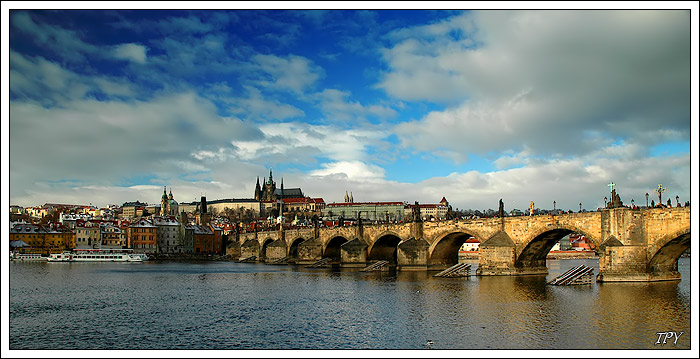
Konstrukce mostu
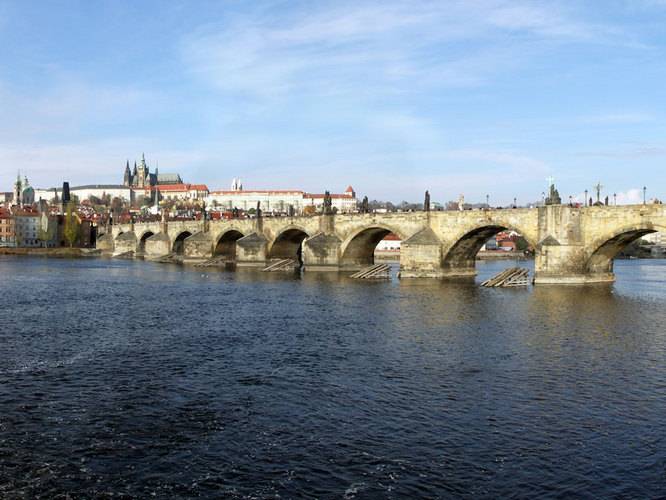
Most je 515 metru dlouhý a jeho šírka je 9,40 až 9,50 m. Výška vozovky je 13 m nad normální hladinou. Je tvoren šestnácti oblouky. Ve své délce je trikrát zalomen a proti proudu je nepatrne vypouklý.
Mostní pilíre nebyly založeny až na skálu, protože ležela príliš hluboko. Spolehlivé záznamy o zpusobu založení mostních pilíru se nezachovaly. V literature se uvádejí ruzné hypotézy:
- založení na šterk v recišti,
- založení na drevených roštech, na než byly položeny mlýnské kameny,
- založení pomocí voru s mlýnskými kameny, které byly potopeny v místech pilíru.
Most je doplnen tremi vežemi. Na Malé Strane jsou to vetší a menší Malostranská mostecká vež. Na strane Starého Mesta pak Staromestská mostecká vež. Staromestská vež nestojí na krajní opere mostu, jak je u mostních veží obvyklé, ale na prvním vnitrním pilíri. Staromestská opera mostu je dnes zabudována ve sklepích domu cp. 193.
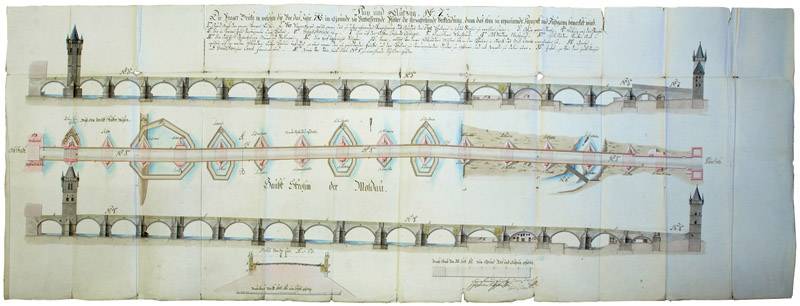
Predchudci Karlova mostu
Od praveku lidé precházeli reku Vltavu v dnešním centru Prahy pres nekolik brodu. Jeden z nich se táhl od dnešní paty Mánesova mostu na Starém Meste (Námestí Jana Palacha) šikmo na druhou stranu k dnešní Hergetove cihelne. Pozdeji byl na míste dnešního Karlova mostu postaven most drevený, který byl ale roku 1157 stržen povodní. Poté dal král Vladislav II. vybudovat první pražský kamenný most, který byl dokoncen v roce 1172 a dostal jméno po králove manželce Judite. Toto dílo znicila povoden 3. února 1342.
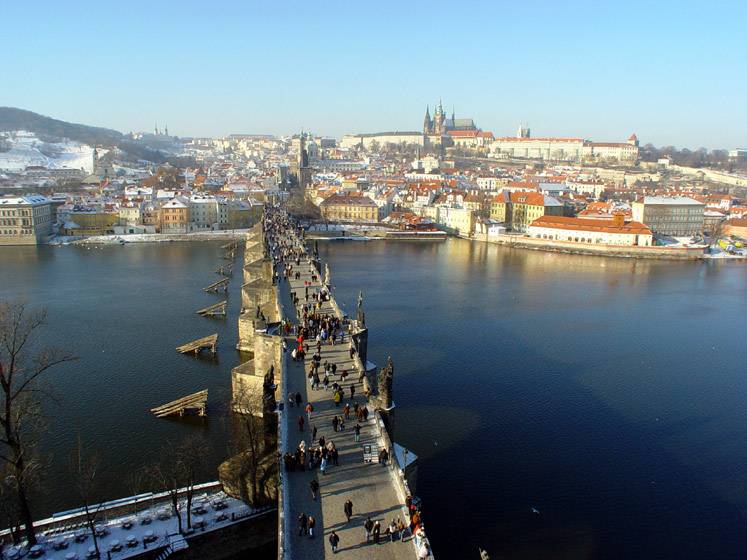
Budování mostu
Kronikári se vesmes shodují na tom, že základní kámen nového kamenného mostu byl položen v roce 1357. V presném datu se ale záznamy rozcházejí; nekteré uvádejí cervenec, jiné svátek sv. Víta, tedy 15. cerven.
Astronom Zdenek Horský (1929–1988) spekuloval o datu 9. cervence 1357, v 5 hodin a 31 minut. Bylo to prý z toho duvodu, že tomuto datu zrovna odpovídala príznivá konstelace (konjunkce Slunce se Saturnem). Soucasne datum odpovídá sledu lichých císel od jedné do devíti a zpet. Tedy 1-3-5-7-9-7-5-3-1.
Za stavitele byl dlouhou dobu považován Petr Parlér ze Švábského Gmündu. V roce 2007 byla však publikována hypotéza, že projektantem a prvním stavitelem mostu byl kameník a pražský meštan Oto, zvaný též Otlin.
Mnohokrát byl ohrožován povodnemi, a to již v prubehu stavby. Bylo to v letech 1359, 1367, 1370, 1373 a 1374. V cervenci 1432 veliká povoden zaplavila vetší cást Starého Mesta, bylo zboreno 5 pilíru mostu. Most byl poté opravován až do roku 1503, tedy celých 71 let. Další povodne ohrožovaly most v letech 1655, 1784, 1845, 1872 a 1890. Války telesu mostu príliš neublížily, pri obléhání švédskými vojsky v 17. století ale byly poniceny sochy a Staromestská mostecká vež.
V roce 1393 dal Václav IV. do reky svrhnout telo umuceného generálního vikáre Jana Nepomuckého. Na míste svržení Jana Nepomuckého z mostu se nachází v kamenném zábradlí malý kovový krížek.
Na obrázku jsou videt severneji také pilíre starého Juditina mostu, které jsou pod hladinou Vltavy dodnes.
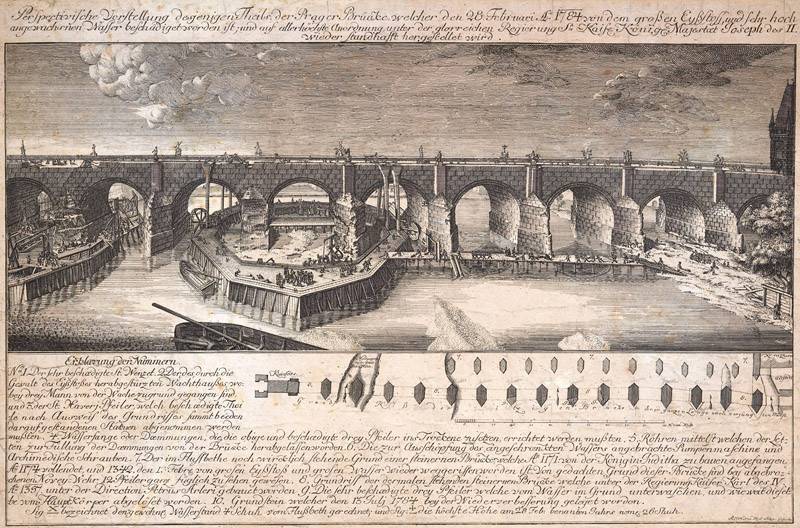
Povoden 1784
V únoru 1784 stržené vory a ledy ucpaly oblouky mostu a voda podemlela pilíre. Zrítilo se prední zhlaví pilíre, na nemž stála vojenská strážnice. Celkem pet mostních pilíru bylo silne poškozeno.
Rekonstrukcní práce vedl inženýr Herget spolu s navigacním stavebním reditelem Františkem Traxalem. Po odstranení porušeného zdiva byly základy zpevneny novými pilotami, které se do dna zatloukaly rucními beranidly. Na piloty byl nasazen drevený rošt a na nej pokládány mlýnské kameny.
Povoden 1890
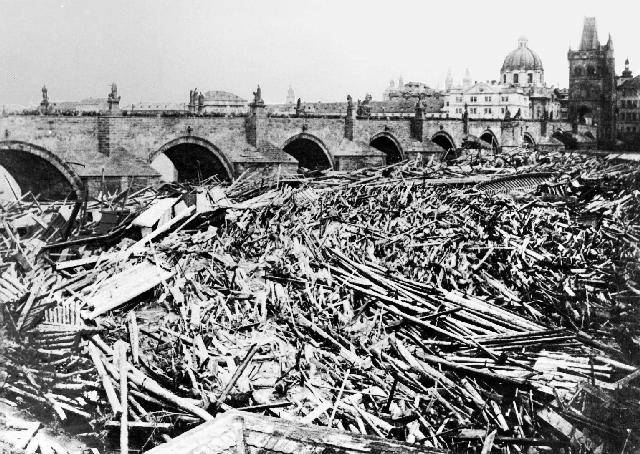
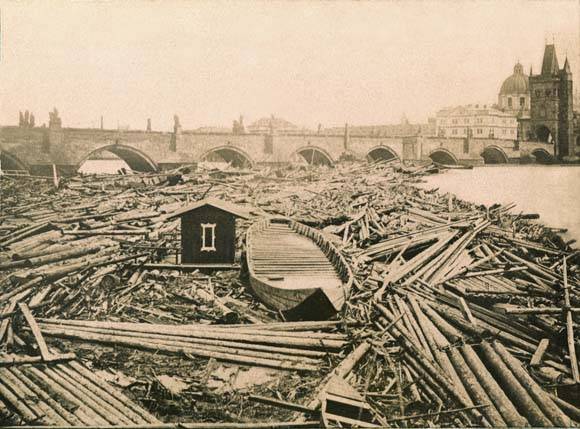
V zárí 1890 protrhly most klády z utržených voru, které se o Karluv most zarazily a bily do jeho pilíru. 4. zárí o pul šesté ráno spadly dva oblouky mostu a o pul desáté se zrítil další oblouk. Byly to oblouky pátý, šestý a sedmý (pocítáno od strany malostranské).
Po dva roky nahrazovala zborené cásti drevená konstrukce. Pri oprave již byla použita nová metoda – pilíre se nove zakládaly na železných kesonech. Pri oprave se uvažovalo i o tom, že zrícené tri klenby budou nahrazeny dvema, aby se usnadnil prutok vody. Nakonec však zvítezila zásada zachování puvodní podoby mostu. Obnova zrícené cásti mostu byla dokoncena 19. listopadu 1892. V dalších letech (1902–1904) se postupne puvodní pilíre zpevnovaly menšími kesonovými venci, spuštenými kolem základu.
Generální oprava 1965–1978
Stavební pruzkum v letech 1966–1967 ukázal, že most ohrožují zejména trhlinky, jimiž vnikala do konstrukcí deštová voda se solí ze zimních posypu vozovky. Rozevírání mostu melo proto být zastaveno soustavou kotev, po délce byla vložena železobetonová deska se sítí táhel. Teplotní zmeny a pronikání vody mely omezit vrstvy izolací.
V celém plášti byly vymeneny poškozené pískovcové kvádry. Predchozí asfaltový povrch, zrízený ve 20. letech 20. století, nahradily štípané pásky žuly. Most byl od dokoncení rekonstrukce vyhrazen pouze pro peší. Náklad na celkovou opravu cinil asi 50 milionu korun.
Vetšina pískovcových kvádru již v dnešní dobe není puvodních, tedy ze 14. a 15. století. Nove vymenené kvádríky jsou šedé nebo jasne žluté. Puvodní kameny jsou pak na povrchu silne erodované a nekteré z nich nesou na svém povrchu kamenické znacky (napr. pilír v korytu Certovky, tretí pilír na strane Starého Mesta).
Diskuse o nové oprave mostu
Asi od r. 2001 se v odborných kruzích i verejne vedla debata o dalších opravách mostu. Predchozí generální oprava mostu se neobešla bez chyb. Hydroizolace pod dlažbou neplnila místy svou úlohu a plne nezabránila prusaku srážkové vody do konstrukce. Druhou diskutovanou otázkou byla funkce zminované železobetonové desky, která mela mít stabilizacní funkci pro konstrukci mostu, omezovat možnost protržení oblouku pri nebezpecných povodních, spínat poprsní zdi a sloužit jako podklad pro izolacní vrstvy. Vyhranený spor o tuto desku – zda ji ponechat, rozrezat ci zcela odstranit – vyústil v krajne polarizované názory.
V roce 2002 Prahu postihla stoletá voda. Karluv most ji prestál bez viditelného poškození, címž se prokázalo, že koncepce opravy z let sedmdesátých (železobetonová deska a její zakotvení do kleneb a obvodových zdí) zpevnila výrazne celou konstrukci a zabránila v krajní situaci znicení mostu.
V letech 2004–2005 byl spor konecne uzavren a byl stanoven casový program realizace stavby. Roky 2005 a 2006 mely být venovány dopracování pruzkumu a shromáždení kompletní dokumentace. V roce 2006 byly také první dva pilíre (osmý a devátý z malostranské strany) ukotveny do betonových sarkofágu.
Oprava horní stavby zacala 20. srpna 2007 a potrvá asi 3 roky. Most se bude opravovat po cástech a za provozu, zustane zachován ctyrmetrový koridor prístupný verejnosti.
V druhé etape se po dobu peti až deseti let mají opravovat mostní oblouky. Jedním z nejduležitejších bodu pred samotným zapocetím rekonstrukce je výber vhodné lokality pro težbu pískovce. Behem oprav již byla zjištena dosud neznámá fakta o historii mostu.
Doprava na moste
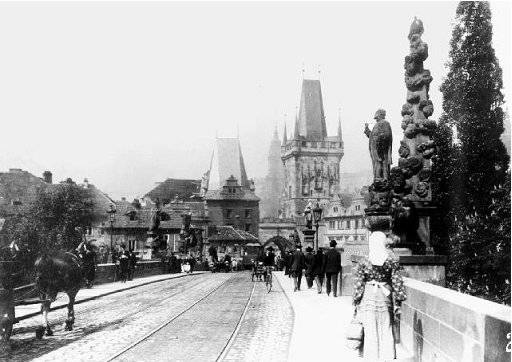
Od roku 1883 jezdila na moste konka. V roce 1905 ji vystrídala elektrická tramvaj. Elektrický proud byl pres most veden mostovkou po speciálních kolejnicích, které zkonstruoval František Križík. To proto, aby nebyl narušen umelecký vzhled mostu trolejemi. Po trech letech se ukázalo, že težké tramvaje most dosti porušují a tak byly nahrazeny v roce 1908 autobusy. Ty se však také neosvedcily. Následující rok byl autobusový provoz zrušen a byl obnoven až v roce 1932 autobusy na pneumatikách. Verejná doprava zde fungovala až do druhé svetové války. Automobilový provoz skoncil v roce 1965 a od té doby slouží most jen pro peší.
Sochy a sousoší
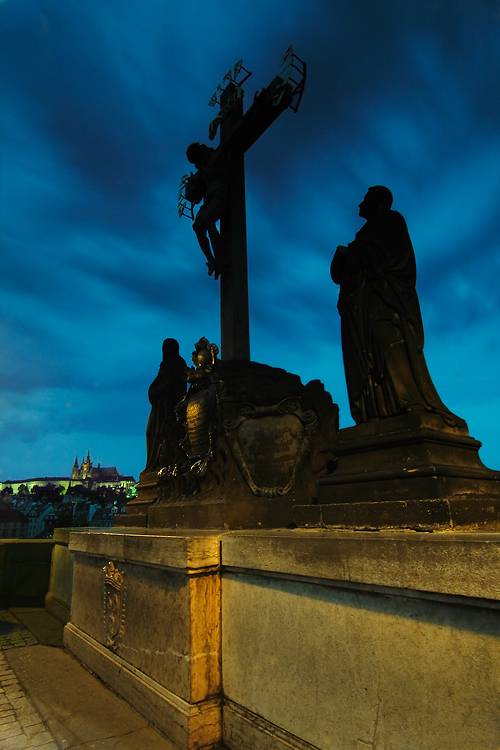
Puvodne byl most bez výzdoby. Pozdeji byl na nej umísten kríž s Ježíšem Kristem a od 17. století bylo postupne na most umísteno celkem 30 prevážne barokních soch a sousoší. Ty jsou postupne nahrazovány kopiemi.
Zdroje: text z wikipedie + vlastní doplnení, fotografie z ruzných zdroju
CHARLES BRIDGE
Charles Bridge is a famous historical bridge that crosses the Vltava river in Prague, Czech Republic. Its construction started in 1357 under the auspices of King Charles IV, and finished in the beginning of 15th century. As the only means of crossing the river Prague, the Charles Bridge used to be the most important connection between the Old Town, Prague Castle and adjacent areas until 1841. Also this 'solid-land' connection made Prague important as a trade route between east and west Europe. The bridge was originally called the Stone Bridge (Kamenný most) or the Prague Bridge (Pražský most) but has been the "Charles Bridge" since 1870.
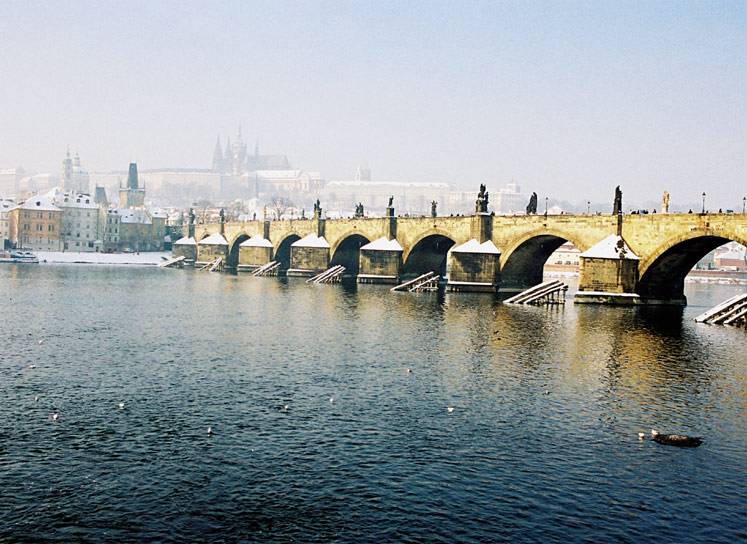
The bridge is 516 meters long and nearly 10 meters wide, resting on 16 arches shielded by ice guards. It is protected by three bridge towers, two of them on the Lesser Quarter side and the third one on the Old Town side. The Old Town bridge tower is often considered to be one of the most astonishing civil gothic-style buildings in the world. The bridge is decorated by a continuous alley of 30 statues and statuaries, most of them baroque-style, erected around 1700.
During the night Charles Bridge is a quiet witness of medieval times. But during the day it changes its face into a very busy place. Painters, owners of kiosks and other traders compete for the attention of numerous tourists crossing the bridge.
Building the bridge
The need for building a new bridge emerged after the old romanesque Judith Bridge (Juditin most, built around 1170 and named after king Vladislav I's wife Judith) was destroyed by a flood in 1342. Royal astrologers and numerologists specified a precise moment for Charles IV to personally assist in the laying of the foundation stone as 9 July 1357, at 5:31 am. This minute can be enumerated as 135797531. This palindromic sequence of ascending and descending odd digits is carved out on the Old Town bridge tower. The building was supervised by Peter Parler and led by a "magister pontis", Jan Ottl.
The bridge was built from Bohemian sandstone. There is a legend saying that eggs were used to enrich the mortar used to bind the stone blocks to make it harder. Although the saying cannot be verified, modern laboratory tests have indeed proved anorganic and organic ingredients to the mortar. [1] The construction of Charles Bridge took place until the beginning of 15th century. To sustain the bridge, tolls were taken, first by the religious order of the Knights of the Cross with the Red Star, who had their mother-house nearby, then by the Old Town municipality (until 1815).
Until the 20th century
Throughout its history, Charles Bridge suffered several havocs and witnessed many historic events. A flood in 1432 damaged three pillars. In 1496 the third arch (counting from the Old Town side) broke down after one of the pillars lowered, being undermined by the water (repairs were finished in 1503). A year after the Battle of White Mountain, when the 27 leaders of the anti-Habsburg revolt were executed on 21 June 1621, the Old Town bridge tower served as a deterrent display of the cut-off heads of the victims to stop Czechs from further resistance. During the end of the Thirty Years' War in 1648, the Swedes occupied the west bank of Vltava and as they tried to advance into the Old Town, the heaviest fights spread out right on the bridge. During the fighting, they severely damaged one side of the Old Town bridge tower (the side facing the river) and the remnants of almost all gothic decorations had to be removed from it afterward. During the late 17th and early 18th centuries the bridge gained its typical appearance when an alley of baroque statues was installed on the pillars. During a great flood in 1784, five pillars were severely damaged and although the arches didn't break down, the traffic on the bridge had to be greatly restricted for some time.
The original stairway to Kampa Island was replaced by a new one in 1844. The next year, another great flood threatened the bridge, but the bridge escaped major damage. In 1848, during the revolution days, the bridge escaped unharmed from the cannonade, but some of the statues were damaged. In 1866, the pseudo-gothic gas (later changed to electric) lights were erected on the balustrade. In the 1870s, the first regular public transport (omnibus) line went over the bridge (officially called "Charles Bridge" after 1870), later replaced by a horse-tram. The bridge towers underwent a thorough reconstruction between 1874 and 1883.
On 2-5 September 1890, another disastrous flood struck Prague and severely damaged the Charles Bridge. Thousands of rafts, logs and other floating material that escaped from places upstream gradually formed a huge barrier leaning against the bridge. Three arches were torn down from the great pressure and two pillars collapsed from being undermined by the water, while others were partly damaged. With the fifth pillar, two statues - St. Ignatius of Loyola and St. Xavier, both by Ferdinand Brokoff - also fell into the river (the former statue was replaced by a statuary of Cyril and Methodius by Karel Dvorák, the latter was replaced by a replica of the original). Repair works lasted for two years (the bridge was reopened on 19 November 1892) and cost 665,000 crowns.
20th century to present-day
In the beginning of the 20th century, Charles Bridge saw a steep rise of heavy traffic. The 15 May 1905 was the last day of the horse-line on the bridge, as it was replaced with an electric tram until 1908 and with buses afterward. At the end of World War II, a barricade was built in the Old Town bridge tower gateway. A capital repair of the bridge took place between 1965 and 1978, based on a collaboration among various scientific and cultural institutes. The stability of the pillars was reassured, all broken stone blocks were replaced, the asphalt top was removed and all traffic has been excluded from the Charles Bridge since then, making it accessible by pedestrians only. The repair cost 50 million crowns.
During the 1990s, some people started criticizing the previous reconstruction of the bridge and proposing a new one. As of the beginning of the new millennium, most of the experts appeared to agree that the previous reconstruction had not been flawless but disputed the need for further interference with the bridge. However, after the disastrous floods of 2002 (which itself caused only minor harm to the bridge), it was decided that repair and stabilization of the two pillars (number 8 and 9) on the Malá Strana side of the Bridge would happen. These are the only river pillars that have not been repaired after the 1890 floods. The floods intensified the voices of the supporters of an overall bridge reconstruction and, as of 2005, the current repair of the pillars is considered as the first phase of the reconstruction, which will concentrate especially on building a new hydroisolation system protecting the bridge. The whole reconstruction will be done gradually without needing to close the bridge and is scheduled to finish in 2007.
Statues on the bridge
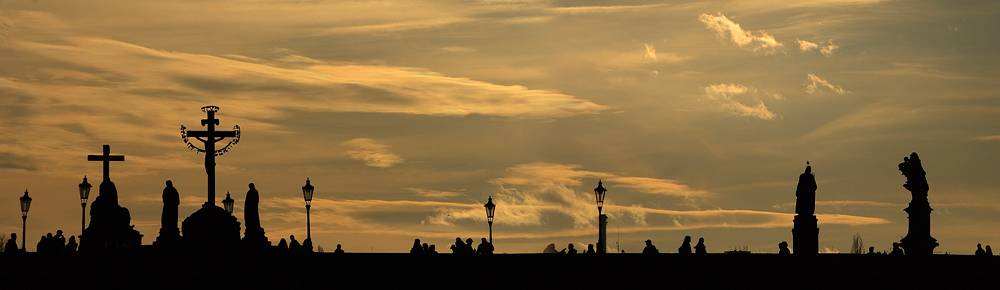
The alley of 30 mostly baroque statues and statuaries situated on the balustrade forms a unique connection of artistic styles with the underlying gothic bridge. Most sculptures were erected between 1683 and 1714. They depict various saints and patron saints venerated at that time. The most prominent Bohemian sculptors of the time took part in decorating the bridge, such as: Matthias Braun, Jan Brokoff and his sons Michael Joseph and Ferdinand Maxmilian.
Among the most notable sculptures, one can find the statuaries of St. Luthgard, St. Crucifix or St. John of Nepomuk. Well known is also the statue of knight Bruncvík, although it does not belong to the main alley.
Beginning in 1965, all of the statues have been systematically replaced by replicas and the originals have been exhibited in the lapidarium of the National Museum.
In popular culture
KEŠ – THE CACHE
Keš je uložena ve vyvrtaném otvoru po sonde na boku mostu. Na bocní strane keše je císlo, které si mužete nebo nemusíte zapsat. Mohlo by se Vám hodit k otevrení Prague bridges 6….
The cache is hidden in a small hole left from a probe on the side of the bridge. There is a number on the side of the cache, which you can note and use it for opening Prague bridges 6…