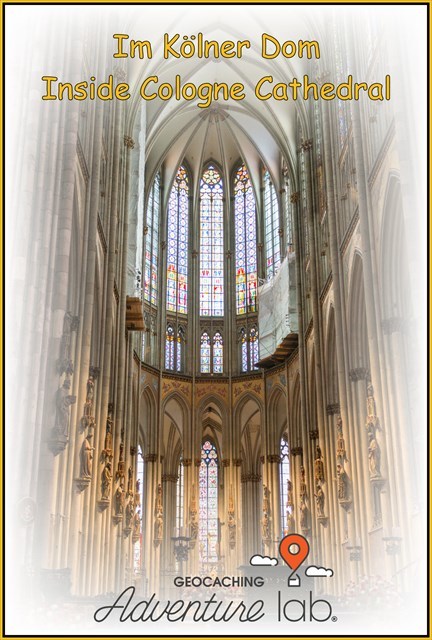
Lab Cache Touren "Rund um den Kölner Dom" Teil 1 & 2 und "Im Kölner Dom"



 |
Deutsche Version (English version below): |
Was hat der Kölner Dom mit Geologie zu tun? Vielleicht hast du noch nie über die Frage nachgedacht, aber es gibt einige Beziehungen. Der Kölner Dom wurde über einen langen Zeitraum (1248 – 1880) gebaut und zahlreiche unterschiedliche Gesteinsarten von verschiedenen Orten wurden beim Bau dieser berühmten Kirche verarbeitet. Alle diese verschiedenen Gesteinsarten haben ihre eigene Herkunft und können uns ihre eigene Entstehungsgeschichte erzählen. Zum Beispiel finden einige Arten ihren Ursprung in flüssiger Lava, während andere einst in tiefen Meeren abgelagert waren. Wenn wir also die Geologie der Region verstehen wollen, so lohnt sich der Blick auf deren historische Gebäude. Wegen der begrenzten Transportmöglichkeit stammen die Baumaterialien meist aus der unmittelbaren Umgebung. Dabei sind einige Gesteinsarten für bestimmte Bautätigkeiten besser geeignet als andere, was sich häufig über die Jahre am Ausmaß der Verwitterung zeigt.
Die nachfolgende Abbildung zeigt, welche verschiedenen Gesteinsarten wo im Kölner Dom verbaut wurden. Anschließend finden sich noch weitere detaillierte Informationen zu den verschiedenen Gesteinen.
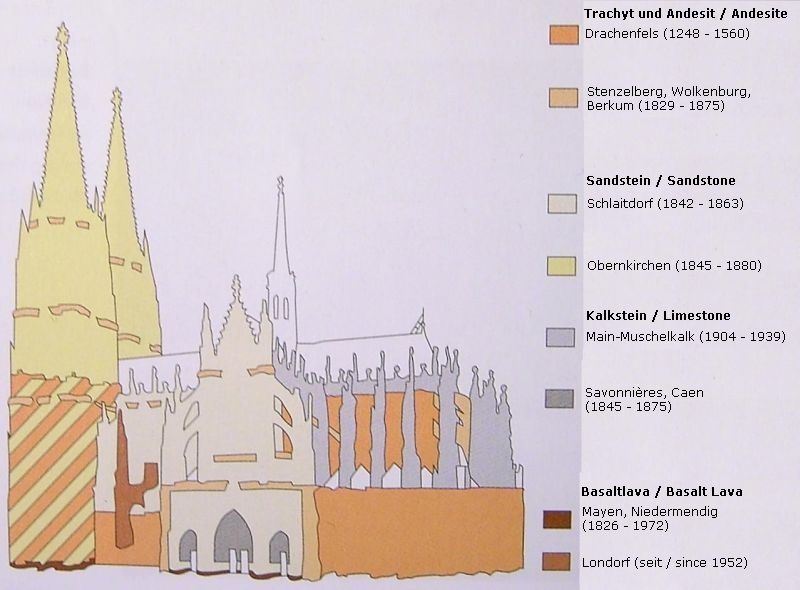
Die Gesteine des Kölner Doms
Kalkstein vom Main
Die schlechten Erfahrungen mit Sandstein bewogen Dombaumeister Hertel, für die Restaurierung des Chores den Muschelkalk aus Krensheim bei Lauda zu verwenden. Er und sein Nachfolger Güldenpfennig haben zwischen 1926 und 1940 praktisch das ganze Strebewerk des Chores in diesem Material ersetzt, was sich bald als schwerer Fehler erwies. Schon vor der Beendigung der Maßnahme wurde klar, dass das Material der starken Verwitterungsbelastung am Dom nicht gewachsen war. Zur Zeit erwachsen aus der zusehends stärker werdenden Zerstörung des Muschelkalks bereits ernste Gefahren.
Sandstein aus Schlaitdorf
| Seit dem Weiterbau des Domes von 1842 ließ Dombaumeister Zwirner den hellen, grobkörnigen Sandstein aus Schlaitdorf im Neckargebiet verarbeiten. Es ist ein in trockener Deposition entstandener Keuper-Sandstein, der sehr inhomogen ist und bei dem sich recht beständige Zonen mit schnell verwitternden in kurzen Abständen ablösen. Aus diesem Material bestehen die beiden Querhausfassaden und die oberen Teile von Lang- und Querhaus. Das Gestein wurde bis 1863 verwendet. Es wurde kostengünstig mit Schiffen von Schlaitdorf am Neckar bis nach Köln gebracht. |
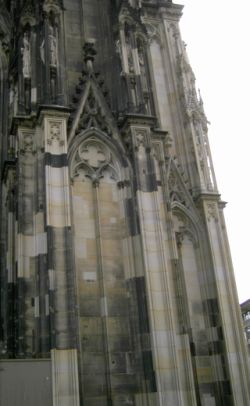
Sandstein |
Basalt aus Londorf
Im Jahre 1952 führte Dombaumeister Weyres die aus den tertiären Eruptionen des Vogelsberg-Massivs stammende Londorfer Basaltlava ein. Sie hat für den Kölner Dom fünf entscheidende Vorteile: sie ist so verwitterungsfest wie Eifelbasalt, sie ist leicht zu bearbeiten, sie verursacht bei den Steinmetzen keine Gesundheitsschäden, sie hat eine lebendige Struktur, und sie wird niemals ganz schwarz, sondern bleibt auch nach längerer Zeit grau. Insofern wäre sie der ideale Dombaustein. Aus diesem Gestein sind die meisten der im Kriege zerstörten Bauteile wieder errichtet worden.
Trachyt vom Drachenfels
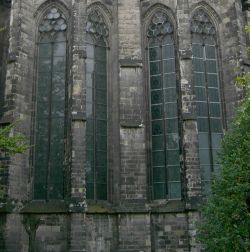
Trachyt |
Von der Grundsteinlegung am 15. August 1248 an bis zum Ende der mittelalterlichen Bautätigkeit im Jahre 1560 wurde am Dom für Sichtflächen fast ausschließlich der Trachyt vom Drachenfels verwendet. Er eignete sich gut zu Quadern und zu plastischen Werken mittlerer Feinheit und ließ, was bei Profilen, Basen und Maßwerken wichtig war, die Herstellung einer geschliffenen Oberfläche zu. Noch zu Beginn des 19. Jahrhunderts bestand der Dom fast ausschließlich aus diesem Material. |
(Quelle und weitere Informationen www.koelner-dom.de)
Um diesen Earthcache zu loggen, erfülle folgende Aufgaben (Du brauchst nicht auf eine Logfreigabe zu warten, ich melde mich, wenn etwas nicht stimmt):
- Schicke mir eine Email mit den Antworten auf folgende Fragen (das Internet wird dir helfen):
- Was ist der Nachteil des verwitterungsfesten Basalts aus der Eifel?
- Welche Außenfläche wurde mit der Basaltlava aus Londorf erneuert?
- Warum war der Drachenfelstrachyt relativ leicht zu beschaffen?
- Gehe auf der Vorderseite zur linken Ecke der Kirche (dort, wo die Sandsteinblöcke zu sehen sind [vgl. obiges Foto]). Vermesse dort den nachfolgend abgebildeten Sandstein und sende mir die Maße (Länge und Breite in cm) per Mail!
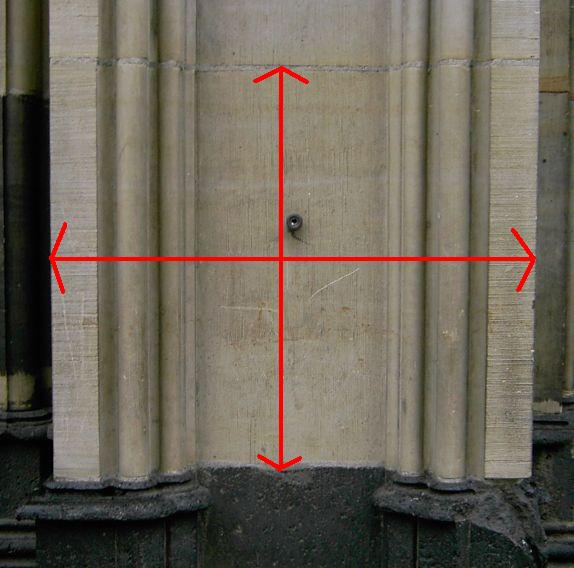
Zur Vergrößerung bitte Klicken
- Mache bitte ein Foto von Dir oder einem persönlichen Gegenstand vor dem Kölner Dom.
 |
English version: |
What is the connection between the Cologne Cathedral and geogoly? Maybe you have not thought about this question yet, but there are a lot of connections. The Cologne Cathedral was build over a long period of time (1248 – 1880) and lots of different stones from different locations have been used to construct this great and famous building. All this different stones have got their own origin and can tell us their own interesting story. For example some of them have their origin in the burning hot lava other in the deep sea. If you want to understand the geology of a region, have a look at the historical buildings. Because of the limited transportation capacity the building materials came from the immediate vicinity. Thereby some stones are more suitable for certain building activities than other stones. This can be seen at the weathering of the stones.
The following figure shows you, what different stones can be found, where they came from and at which part of the cathedral they were used. Afterwards you will get some more detailed information about the stones.
Geological overview
Limestone from Main
The bad experience with the sandstone moved Cathedral architect Hertel to use for the restoration of the choir the Muschelkalk from Krensheim near Lauda. He and his successor, Güldenpfenning had practically replaced the entire flying buttresses system of the choir between 1926 and 1940 with this material. Shortly after, this was proved to be a huge mistake. Already before completion of this work it was clear that the strong weathering problems would not leave the Cathedral. Currently growing destruction of the Muschelkalk is producing serious danger.
Sandstone from Schlaitdorf
| Since further construction of the Cathedral in 1842, Cathedral architect Zwirner allowed the large-crystal sandstone from Schlaitdorf in the Neckar area to be used. Out of this material are made the two transept façades and the upper parts from the nave and the transept. The stone was used until 1863. It was economically shipped along the Rhine from Schlaitdorf on the Neckar to Cologne. |
Sandstone |
Basalt from Londorf
In 1952 Cathedral architect Weyres introduced Londorf basalt lava which comes from the Vogelsberg massif. This stone has five distinct advantages for Cologne Cathedral: it resists weathering much like Eifel basalt, it is easy to work, it does not cause any health danger to the stone masons, it has a lively structure, and it will never turn completely black, but remain grey for a long time. In this respect it would be the ideal Cathedral stone. Most of the Cathedral sections destroyed during the war were made of this stone.
Trachyt of the Drachenfels
Trachyte |
From the laying of the foundation stone on the 15th of August, 1248, to the end of medieval construction in the year 1560, the visible surfaces of the Cathedral were constructed, almost without exception, of trachyte from Drachenfels. It is suitable for blocks and for sculptural works of average delicacy. It also allows, important with profiles, bases and tracery, the production of a refined surface. Even up to the beginning of the 19th century, the Cathedral was almost entirely comprised of this material. |
(Origin and further information www.koelner-dom.de)
To log this earthcache, perform the following tasks:
- Write me an email with the following information (the internet will help you to answer the questions):
- What ist the disadvantage of the weather-resistant basaltlava from the Eifel?
- Which outside surface has been renewed by using the basalt from Londorf?
- Why was the trachyte from Drachenfels relatively easy to obtain?
- Go at the front side to the left corner of the cathedral (where you see the sandstones [compare with the above picture]). Measure there the following sandstone and send me its length und width (in centimeter) in your mail!
Click for enlargement
- Please take a photo of you or your GPS in front of the main entry of the Cathedral (maybe you have to ask the people at the cathedral to help you).

