Purpose: This EarthCache is created by the Connecticut
Geological and Natural History Survey of the Department of
Environmental Protection. This is the first in a series of
EarthCache sites designed to promote an understanding of the
geological and biological wealth of the State of Connecticut.
Supplies: You will need a measuring tape and park trail
map. Spoilers may be included in the descriptions or links.
Directions: Exit 23 off I-91 in Rocky Hill, CT. Follow
park's signs east on West Street for approximately 1 mile. The park
is directly off West Street. Watch for signs and a large geodesic
dome. No cost to park and walk grounds. Admission into the Center
is $10 for adults, $4 for children 6-12, Connecticut residents who
are 65 or older, and children 5 and under are free.
History of the Park: In August 1966, bulldozer
operator Edward McCarthy was excavating a rocky site for a state
building. He turned over a slab of gray sandstone and saw something
very exciting: six large, three-toed footprints.
Officials, local scientists and the media were notified, and the
news of the discovery quickly spread. Many more tracks were
uncovered and the site was fenced in and guarded. Within a few
weeks officials decided to preserve the site as a state park. Two
seasons of careful excavation resulted in one of the largest
on-site displays of dinosaur tracks in the world.
Anyone who likes dinosaurs and plans to undertake the EarthCache
should allow time to experience this incredible park. In addition
to the 200 million year old fossil trackway there are interactive
exhibits and the chance to cast your own dinosaur footprint to take
home. Contact the park on materials you need to bring to makes
these molds. There are several nature trails that are also of
interest. One is the blue trail that hosts a board walk over a
classic red maple swamp, a natural spring and at the furthest
bench, traprock ridge views of a forested area below. The 10 acre
arboretum surrounding the Exhibit Center have conifer trees and
plants that grew in the Mesozoic Era, such as gingkos, dawn
redwoods and magnolia.
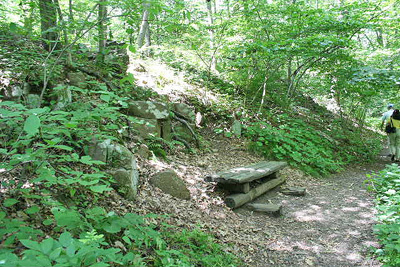 |
| Figure 1. Furthest bench along Blue Trail. |
>
To log this EarthCache: Answer the 5 questions below, and send a
photo from the given coordinates and number in their group.
Earthcache Logging Questions: Start your tour by
examining the time-line walk. With the understanding that 12”
equals 50 million years please answer the following questions:
1. What is the measurement in feet along the walkway
between the emergence of dinosaurs and their
extinction?
2. What is the measurement in feet along the walkway
between the extinction of dinosaurs and the emergence of
man?
3. Based on the answer to question 2 how many years does
this measurement equal?
The rocks exposed at Dinosaur Park were formed about 200 million
years ago. At that time Connecticut was located near a tropical to
sub-tropical latitude, in the middle of a large super-continent
created by plate tectonic processes. As such it was a long distance
from a major ocean that could supply moisture to the climate:
Connecticut's climate was semi-arid most of the time. That
inference is supported by the recognition of numerous ancient soil
horizons embedded in the rock layers. The paleosoils contain
features called caliche found in modern soils that develop in
semiarid climates. Thus, we infer that the ancient soils also
developed in semiarid conditions that existed 200 m.a. The
sedimentary rocks that contain ancient soils are reddish brown in
color and are abundant along highway cuts in most the central part
of Connecticut, from New Haven to the MA border. The reddish-brown
color is caused by oxidation of iron contained within the sediment,
caused by repeated desiccation of the sediment after its
deposition. Exposure to air (oxygen) and water caused the iron
minerals to rust, forming the reddish pigments.
Some layers, however, are gray and greenish colored, including
those at Dinosaur Park. Examples of these outcrops can be seen
about 100 feet towards the right of the Center’s entrance.
These layers were deposited in large permanent lakes that were deep
enough to have stagnant bottom conditions. That led to the
preservation of organic matter in the lake bottom muds. The
preserved organic matter captured all the available oxygen in the
lake water and later in ground water and any iron in the sediment
could not be oxidized. As a result the muds and sands now shale and
sandstone have a grey and greenish grey color. That large, deep
lakes could form into which abundant organic matter collected
suggests a wetter climate during the time. Rock layers exposed
elsewhere in the Connecticut valley are dominantly reddish brown in
color, but are regularly punctuated with grey layers. This suggests
that the climate rhythmically fluctuated between wet and dry
conditions.
4. What is the name of the rock formation that contains
the trackway? (Hint: answer to this question can be found
on the plaque at the outcrop, which is to the north of the walk
through geologic time.)
Now head towards the mold and casting site stopping at the
retaining wall.
What are fossils? By definition a fossil is any remnant or trace
of an ancient living organism preserved in rock. They are usually
found in sedimentary rock or in some low-grade metamorphic rocks.
We normally think of fossils as ancient shells or bones that are
preserved in rock. But fossils can take many forms such as:
- An actual remnant of the organism such as a shell, bone or
other tissue, which may be preserved in ice, amber, silica or
sedimentary rock;
- A mold of the organism after the original hard part or tissue
dissolved or decayed such as an impression of a leaf or shell;
- In some places a mold had been filled with a different mineral,
precipitated from groundwater solutions, making a cast of the plant
or animal; and
- In some places plant tissue is transformed into a film of
carbon or the surface of an impression.
A final class of fossils is referred to as trace fossils, which
include tracks, trails, burrows, and petrified fecal material. It
is this last class of fossil that we will see at this park. Tracks
are impressions made by a passing animal in soft sand or mud. Most
tracks get destroyed shortly after they are created. Several things
must occur for a track to be preserved in geologic materials.
First, the surface upon which the track was impressed must be
rapidly covered by another layer of sand or mud of sufficient
thickness that track depression is filled in. Later the layers of
sediment must be lithified or hardened into rock. In order for the
rock to split at a later time and reveal the fossil track the layer
immediately on top of the track must be of some different
composition than the layer upon which the track was formed, thus
forming a bedding plane. Beds break along their bedding planes when
muddy sediment overlies sand or when mica concentrates along the
bedding plane.
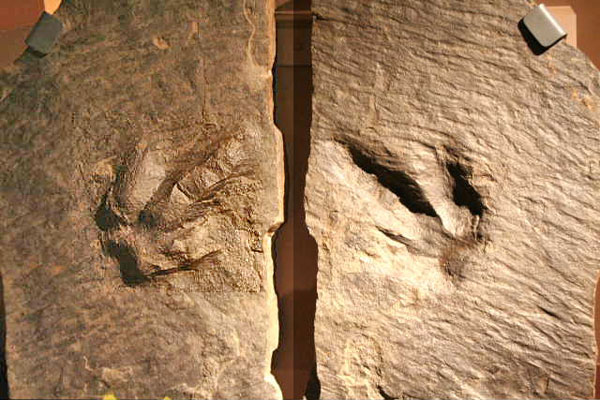 |
| Figure 2. Mold and cast of Eubrontes track, the
State Fossil displayed inside the Exhibit Center. |
Notice the large stones that cap the retaining wall along the
path straight ahead beyond (west of) the time-line walkway. These
stones contain dinosaur footprints. But note that the footprints
are all raised rather than being depresses as our experience show
footprints to be. We find raised footprints when a rock slab is
split off the ledge containing a normal track. The slab will have a
raised foot print that exactly fits into the normal depression left
on the rock forming the ledge.
5. The State Fossil is a dinosaur track whose skeletal
remains have never been found. What is the name of the State
Fossil?.
References:
McHone, G. (2004). Great Day Trips to Discover the Geology of
Connecticut. Perry Heights Press, Wilton CT. 206p. [Ch. 5 provides
a concise, readable, history of Connecticut during the Mesozoic
Era. Pages 115-120 describe Dinosaur Park.]
Bell, M. (1985). The Face of Connecticut. State Geol. & Nat.
Hist. Survey of CT, Bull.110, 196p. [Contains several chapters,
(ch. 2,6, & 8) written for the layperson, about geology of
Connecticut.]
Coleman, Margaret (2005). The Geologic History of
Connecticut’s Bedrock. State Geological & State Geol.
& Nat. Hist. Survey of CT Natural History. Survey of CT,
Special Publications 2, p. 29 see p. 22-24.
Trail Map for Dinosaur State Park: There are black and
white trail maps at the Park. If you want to view or print a color
map, click this  .
.