Hidden in Westchester: Snowflake Quarry EarthCache
Hidden in Westchester: Snowflake Quarry
-
Difficulty:
-

-
Terrain:
-
Size:  (not chosen)
Please note Use of geocaching.com services is subject to the terms and conditions
in our disclaimer.
Hidden in Westchester: Snowflake
Quarry
Believe it or not, geology has played a central role in the
development of Westchester County and beyond. There are surprises
hidden in the rocks; sometimes they’re out in the open for
you to discover… if you know where to go! The parking
coordinates below will bring you to a defunct rock quarry in the
hamlet of Thornwood, part of the Town of Mt. Pleasant (the town
Lady Gneiss grew up in). Now, I know you’re going to say to
yourself, “This doesn’t look like a quarry to me!
It’s just a shopping center!” And sure enough, it
is…at least now. Marble was once quarried here, but the pit
was filled in during the 1980’s after the business closed.
The Town Center Shopping center was built over it. Luckily, the
quarry walls are still exposed. But before you pay a visit to this
once-busy quarry, get to know the bedrock of the area. There are
three main types…
WESTCHESTER ROCKS!
Much of Westchester County lies on three main types of
bedrock (the solid rock that lies underneath layers of soil
and sediment). These rocks hold lots of information about the area
and its formation, even though it is only sometimes exposed for us
to examine. These are Marble, Schist and
Gneiss; all of which are types of Metamorphic Rock.
Rocks that have been changed over time by heat and pressure are
known as Metamorphic Rocks.
MEET THE ROCKS
Marble is a gray-white rock that is commonly formed from the
metamorphism of limestone (a Sedimentary rock) or Dolomite (a
mineral). This rock occurs in thin veins throughout the county (in
comparison to the amounts of other types of bedrock). These veins
form ribbons on a geologic map.

Marble is mined for many uses, such as building materials and
sculpture work. Because marble is metamorphosed limestone or
dolomite, it is a rock that is composed primarily of carbonate
minerals, like calcite (CaCO3). This mineral reacts with acids and
can be slowly dissolved by groundwater. Many of the rivers in
Westchester County, like the Bronx River, follow narrow bands of
weak marble in the bedrock. It is easier for the water to travel
over and work its way through this rock material than others.
The marble in Thornwood is dolomitic marble, meaning it is
metamorphosed dolomite. Dolomite is a calcium magnesium carbonate
mineral (CaMg)(CO3)2. Its common name is Inwood Marble. After the
population boom in NYC after 1825 (due to the completion of the
Erie Canal), building materials were required, and a lot of them!
There were brickyards, iron foundries, and marble quarries all over
Westchester. These materials were used to build many row houses and
large buildings in Manhattan. The rock quarry in Thornwood was
called Snowflake Quarry where “snowflake” white marble
was removed. The rock from this particular quarry was crushed and
used for terrazzo (floors and walkways) and stucco (ceiling and
wall coatings). Snowflake Quarry supplied Inwood Marble until 1973.
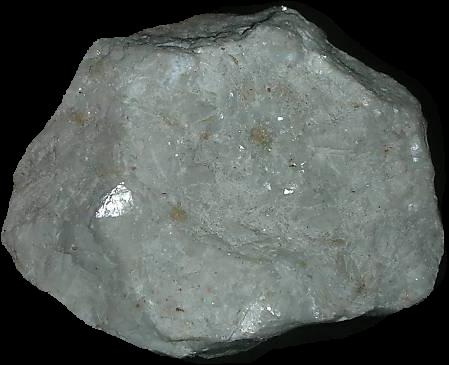
Schist is a dark, sparkly rock that is formed by the
metamorphism of sedimentary rocks like shale. Mica schist, which is
common in Westchester and Manhattan, is strong and was considered
great bedrock on which to build foundations of large buildings.
Because of Schist, tall skyscrapers and other large buildings could
be constructed, leading to the creation of nearby New York
City’s midtown and downtown areas.

Gneiss is a rock that is usually formed by the metamorphism
of igneous or sedimentary rocks. It has a very coarse-grained
texture and can show banding with light and dark layers. This
durable, eye-catching stone has been widely used for construction.
It can sometimes be labeled as Granite (in the mason and
construction industries) and also Granitic Gneiss.

VISITING THE FORMER QUARRY:
Parking Coordinates: N 41 07.608 W 073 46.725
This will bring you to a place you can park closest to the exposed
rock. This is a public shopping center.
Starting Point: N 41 07.595 W 073 46.685
Start here and work your way around (watch out for stinky,
bee-infested dumpsters); follow the rock outcrop behind the
shopping center (you can’t miss it). Be mindful that there
might be trucks making deliveries. It is also advisable to NOT
visit at night. EarthCaching and Geocaching are meant to be fun.
Avoiding muggles is one thing, but being suspicious at nightfall is
another.
Logging Question Coordinates: N 41 07.555 W 073 46.586
These coordinates will help you answer question # 2. You should be
able to answer the question without them, but they’re here if
you need some direction.
LOGGING REQUIREMENTS:
Send me an email with the following information and answers
(Remember: DO NOT post any of this in your log):
1) GC code (GC30QGZ) and the title of the EarthCache (Hidden in
Westchester: Snowflake Quarry)
2) What evidence do you see that shows HOW the rock was
quarried?
3) Is this area solely marble? If not, what other rock types can
you identify based on the information provided above?
4) BONUS: After visiting this shopping center, take a quick walk
Southwest towards the large intersection at Kensico Rd. and
Broadway (Route 141) known as “The Four Corners.” As
Kensico Rd. continues Northwest, what is the name that Kensico Rd.
turns into? (a street sign should be nearby...check each street
corner) Why is the name of this street significant to this
EarthCache?
5) OPTIONAL: Include a photo of the former quarry area, or
yourself/group in front of the area. Please do not post photos that
give away information related to logging requirements.
JUST FOR FUN:
Check out Westchester County bedrock for yourself! (visit link)
Sources:
KINGSBRIDGE, AN EARLY QUARRYING DISTRICT ON MANHATTAN ISLAND
(visit link)
History of Westchester County (visit link)
The Regents Earth Science and Regents Physics Web Resource for
Students and Teachers (marble) (visit link)
Kluge’s Geoscience News (Steve Kluge is a great Earth Science
guru, teacher, and friend) (visit link)
Additional Hints
(No hints available.)