Betsy Big Gun . . . Revisited!
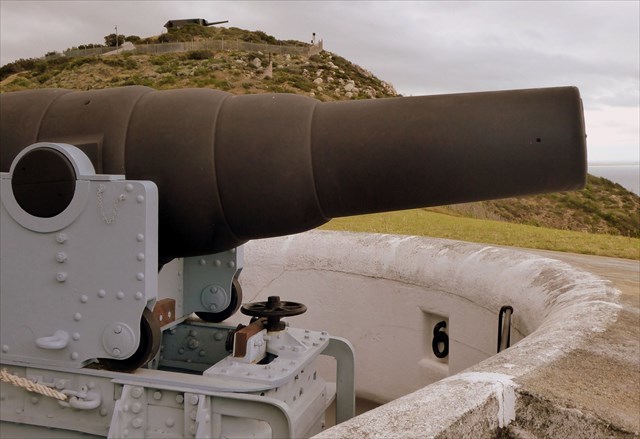
This mystery/multi combo cache, a small camo-taped tablet pot, is hidden at the Middle North Battery, a semi-derelict gun emplacement near Scala Barracks on a steep hillside with fine views (favourable weather permitting!) over False Bay and Simon’s Town. It is in the process of being refurbished.
It was hidden as a replacement for my cache GC1RR76 Betsy - Big Gun which was hidden on 24/5/09 and archived on 9/1/21 after some 199 finds and 5 FPs. It was archived in anticipation of the hole in the wall where it was hidden being filled during further work on the site.
To find the cache you will need to use the final coordinates formula - revealed together with a hint on completion of the jigsaw accessed by clicking the above image.
Then you will need to complete the 6-steps of the multi below to obtain the required figures to use in the formula to determine the final coordinates.
All the necessary information can be collected on or near the gun.
The cache may be conveniently combined with the nearby GC1RAM5 Scala Big Gun, GCWKQE Forgotten Lookout and GC1R7VF Red Hill Viewpoint caches and others in the Red Hill area.

TO REACH THE CACHE LOCATION:
Take the Red Hill Road M66 starting at the M4 junction @ S 34 10.803 E 18 25.517 and follow the narrow twisting road up to the hairpin bend near the top @ S 34 10.663 E 18 25.010. Turn right here onto Scala Rd and follow this past another old gun on your right (location of GC1RAM5 Scala Big Gun) and the SA Navy building to the junction @ S 34 10.288 E 18 25.133, the start of a narrow twisty road heading down to the cache location, where you will find adequate space to safely park your cachemobile.
To return to the main road, simply carry on down the twisty concrete road to the bottom. In doing this, remember to take care and sound your horn approaching the hairpins – although this is not exactly a busy road and is supposed to be one way, there is no sign to this effect at the lower end and you might therefore meet a vehicle coming up!

To Find the Cache:
Note – all stages are close to and easily reached from the given coordinates, so no separate coordinates are necessary or provided.
Step 1: climb the A left hand steps up to the gun platform
Step 2: from here you will quickly note that the gun has B large black wheels which enable it to be rotated on its mounting.
Step 3: under the front of the gun you will see a ‘steering’ wheel with C spokes
Step 4: above and behind this wheel you will see a small DOD plastic identification plaque with a QR code and a bar code below which is a 6-digit number the last digit of which = D
Step 5: at the rear of the gun you will find 2 more ‘steering’ wheels each of which has E spokes
Step 6: return down the steps to the road and look back to the right-hand doorway (which leads down to underground structures). Above this is an inscription with the letters VR (for Victoria Regina) and a date 189F
Use the figures obtained in the above steps in the final coordinates formula (found by completing the jigsaw puzzle - accessed by clicking on the first image in the cache description) to find where the cache is hidden.

Through a Google search, I was somewhat surprised and rather pleased to find the following detailed background info on the gun which makes it even more interesting. This is extracted/edited from a short archived 2014 article by Bevan Pank - see here [Additional notes taken from an info plaque on site]
BETSY - BIG GUN
Betsy was British born from wrought iron stock in Woolwich at the Royal Gun Foundry in 1865. A 9-inch [30cm] Mark 1 12-ton rifled muzzle loader, she was one of 190 (note: this particular gun has a No. 22 on its side) built there as broadside guns for ironclad ships and for harbour defences. [It was first issued on 18 May 1866].
 Her 147-inch barrel could fire shot, shrapnel or armour-piercing shells. However, her favourite ammunition was the 257 lb. [Studded Palliser or] Common Shell [plugged or with blowing charge], which at an elevation of 13 degrees, she could hurl 6,000 yards - that’s 5.48 km!
Betsy’s first trip abroad was to Halifax in Nova Scotia from 1866 to 1878. She then visited Bermuda to 1881 and Sheerness in the UK to 1885, before finally settling in her present position near Simon’s Town in 1896.
Her last firing was on 27th April 1903 [and was struck off charge 19 September 1896], after which she slowly aged until 1983. This was when the marines moved to Scala Battery and Capt. Mike Thomson arranged for her rejuvenation [gun, carriage, slide and mounting] at the Gun Shop in the SA Naval Dockyard.
[It was declared a National Monument in Government Notice 472 of 17 March 1989].
Although her massive mounting could now do with another coat of paint, she still looks good. Unfortunately, this cannot be said for the underground magazine and other masonry structures.
The Navy has neither the money nor time to maintain what is essentially obsolete equipment. In any case, it is wasted effort outside security areas because of vandalism.
 Most of us are quite happy to drool over the Simon’s Town Navy Museum’s fabulous collection of old guns. The adjacent Simon’s Town Museum also has some very interesting displays, including an 18th century Dutch East India Company cannon at its entrance.
However, those enthusiasts who use technical terms like ‘cascable’ and ‘slide’ will no doubt find their way to Betsy - the only gun with six rifling grooves . . .
Additional Information found in: Artillery: an illustrated history of its impact (Weapons & Warfare), by Jeff Kinard . . .
Info on the inventor and design of the gun:
 (p223) Originally trained as a lawyer, Sir William George Armstrong (1810-1900) turned his talents to engineering . . . In 1854 he patented a wrought iron rifled cannon that incorporated a number of reinforcing bands, giving it a distinctive stepped profile.
Armstrong also developed a ‘shunt’ type of rifling, with each groove cut to two depths to accommodate the system’s special studded projectiles. The deeper half of the groove provided extra space to ease loading, whereas upon firing the studs shifted to the shallow side to provide the close fit withing the bore necessary for accuracy. The powder charge was contained in a separate bag.
Armstrong was appointed superintendent of the Royal Gun Factory at Woolwich in November 1859 . . .
Info on muzzleloaders and the reason for their subsequent demise:
(p237) During the 1860s and 1870s, Woolwich manufactured several marks of large naval and seacoast Armstrong muzzleloaders ranging from the 12-ton 9-inch Mk IV (like Betsy) to the 81-ton 16 inch Mk I . . .
The largest rifled muzzleloaders in British service (the largest ever made) were 17.72 inch 100-ton giants that with a 460 lb charge fired a 1-ton projectile at a muzzle velocity of nearly 1,700 ft/sec. Four of these were manufactured and mounted in the defences of Malta and Gibraltar.
In 1879 a devastating disaster aboard the HMS Thunderer provided the impetus for the Royal Navy to end the use of muzzle loaded artillery. During gunnery practice one of the Thunderer’s 12-inch turret-mounted Armstrongs misfired – a mishap that went unnoticed owing to the heavy recoil and report of its twin.
The gun was subsequently reloaded with a second charge and exploded killing 11 and wounding 35 of the ship’s crew. Spurred by the public outcry, advocates for modernizing naval guns cited the accident to argue that, had the piece been a breech-loaded, the unfired charge would have been readily detected and the disaster averted.
NOTES ON THE SIMON'S TOWN BATTERIES

Lower North Battery, the oldest continuously armed artillery site in South Africa, dating from 1793 (Zoutman Battery), this is now the SA Navy's gunnery range battery. Queen's Battery, built on this site in 1887-9, served in both World Wars and part has now been converted into the SA Naval War Memorial.
Middle North Battery was built in 1886, and retains a 9-inch 12-ton RML. This gun (Betsy) has travelled - Halifax, Nova Scotia, in the 1860s, Bermuda, Sheerness in 1881 and was installed here in 1895.
Scala/Upper North Battery was constructed 1904-6 and armed with three 9.2-inch Mk X guns, two converted to Mk VII mountings in 1939. This is the location of Scala Big Gun cache.
Information extracted from: FORTRESS STUDY GROUP. Fort 34: Three centuries of fortifications in South Africa 1652 to 1958, Richard Tomlinson (visit link)
See here for an interesting illustrated blog on the mid-day firing of the gun on 16 June 2018. This has additional fascinating background on the gun – including its use for many years as a Simon’s Town timepiece!