
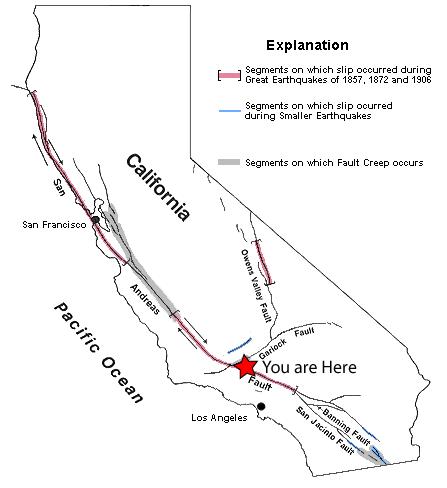
 This earthcache put you smack dab on top of the San
Andreas Fault. The San Andreas Fault is the boundary between
the Pacific Plate to the west and the North American Plate to
the east. This is one of the few plate boundaries where you
can walk from one plate to the next. Most other plate
boundaries are under water.
This earthcache put you smack dab on top of the San
Andreas Fault. The San Andreas Fault is the boundary between
the Pacific Plate to the west and the North American Plate to
the east. This is one of the few plate boundaries where you
can walk from one plate to the next. Most other plate
boundaries are under water.

Source: USGS
(http://pubs.usgs.gov/gip/earthq3/what.html)
The San Andreas Fault is called a transform fault because the
plates on either side of the fault are predominantly moving past
each other. No matter which plate you are standing on, the other
plate appears to be moving to the right, thus this is called a
right lateral strike-slip fault. The result is that the Pacific
Plate is moving northward compared to the North American Plate. One
of the pieces of evidence for this movement is coorelation between
the rocks at the Pinnacles National Monument
(GCPRKP and
GCPRKJ) and the rocks of the Neenach
formation
(GCQ5FZ)
source: USGS
(http://pubs.usgs.gov/gip/earthq3/where.html)
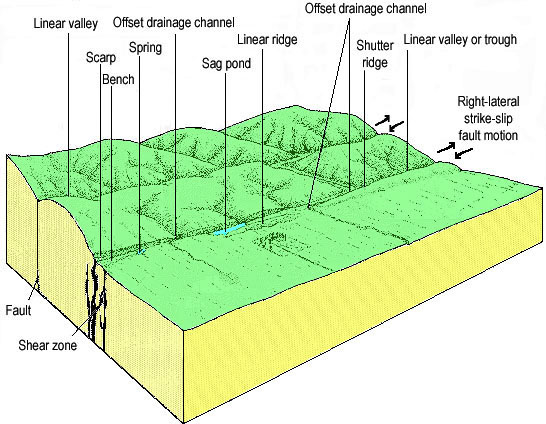
This earthcache describes two of the many geomorphologic
features typical of strike slip faults. The geomorphology of an
area is the explanation of the events and processes that have
resulted in the current landforms of the region. The two features
shown here include the linear valley and a sag pond. The linear
valley is at the secondary point. And locations for additional sag
ponds further north are given.
 The Sag Pond
Elizabeth Lake is a sag pond on the San Andreas Fault, a rather
large one. Movement along the fault causes cracks and fractures in
the rocks adjacent to the main line of the fault. This area of
cracks and fractures is called the fault zone. While the main
movement along the San Andreas is right-lateral strike-slip, blocks
of rock in the fault zone experience a variety of movements.
Sometimes a block of rock ends up moving down, creating a
depression. When this depression fills with water, it becomes a Sag
Pond.
Additional sag ponds can be found to the northwest along Pine
Canyon Road at the following coordinates:
- Lake Hughes:N34 44.444 W118 25.981
- Unnamed:N 34 44.238 W118 38.836
- Unnamed:N 34 44.582 W118 40.033
- Quail Lake: N34 46.103 W118 44.334(this lake had a little help
from the California Aqueduct)
Linear Valley N34 40.062 W118 25.032
The shape of the valley you are in, is a direct result of the San
Andreas Fault. The valley follows the straight line of the fault
from the northwest to southeast. This feature is called a fault
controlled valley. If you travel northwest to see Quail Lake you
will follow this straight canyon and find the additional sag
ponds.
The reason the valley follows the fault line is due to the
weakening of the rocks near the fault line. The fault breaks up the
rocks as the two rock masses move past each other. This makes it
easier for water, wind, and plants to erode the rocks along the
fault line. Over the years, a valley forms that roughly follows the
fault.

Source: Geologic Map of the Los Angeles
Quadrangle, State of California, Division of Mines and
Geology
Logging requirements:
Send me a note with :
- The text "GCQCT7 Elizabeth Lake - San Andreas Fault" on the
first line
- The number of people in your group.
- Describe the rough shape of the lake and guess as to why it is
shaped that way and oriented as it is
- the number on the telephone pole at the Linear Valley
coordinates or post photos of the site.
The following sources were used to generate this
cache:
- USGS Earthquake Hazards
Program, Glossary of earthquake Terms
(http://earthquake.usgs.gov/image_glossary/transform_fault.html)
- National Atlas of the United States®, San
Andreas Fault, Last modified: June 28, 2005 12:20
(http://nationalatlas.gov/articles/geology/features/sanandreas.html)
- Online version of "The San Andreas Fault" U.S.
Geological Survey, Maintained by John Watson and Kathie Watson Last
modified 06-24-97 (jmw)
(http://pubs.usgs.gov/gip/earthq3/contents.html)
- Geologic Map of the Los Angeles Quadrangle,
California, 1:250,000, Compilation by Charles W. Jennings and
Rudolph G. Strand, Published 1969, Revised, 1991, State of
California Division of Mines and Geology
- Robert E. Wallace Ed. The San Andreas Fault
System, California U.S. GEOLOGICAL SURVEY PROFESSIONAL PAPER 1515,
2. GEOMORPHIC EXPRESSION
http://3dparks.wr.usgs.gov/pp1515/chapter2.html
-
http://3dparks.wr.usgs.gov/haywardfault/html/glossary.html#geomorph