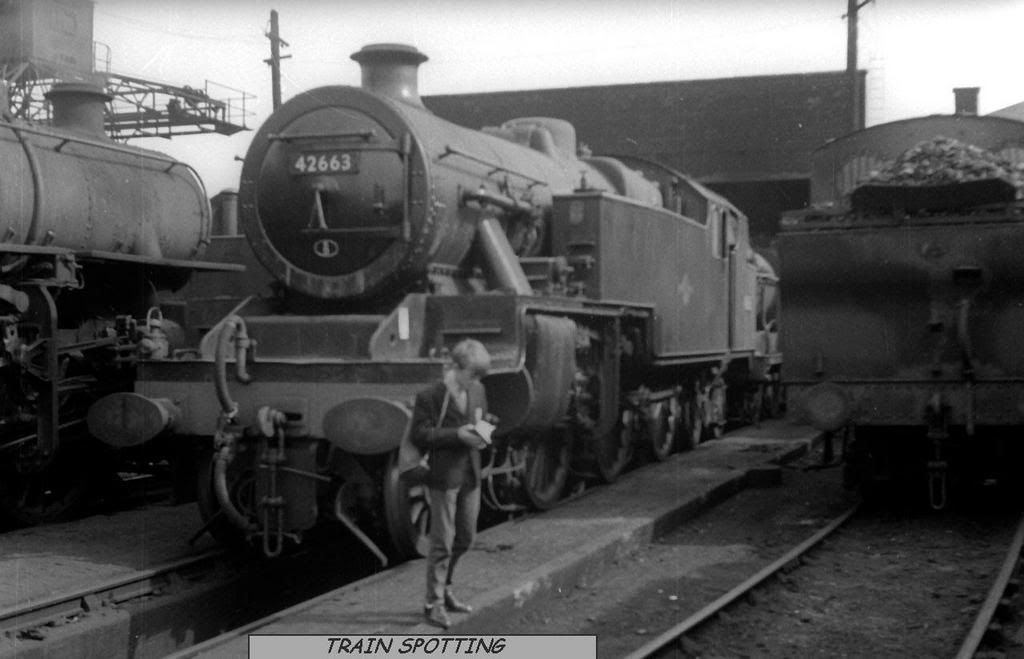
To find the cache read about the railway
companies and the locomotives described below, then figure out what
you need to research to solve the equations at the end of the page
to calculate the co-ordinates. Yup you guessed it, the ones at the
top of the page ARE FAKE.
Then the fun starts... get out there and
find it !
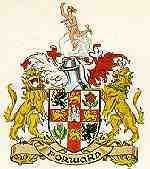
GWR
LMS
LNER
The Great Western Railway (GWR, colloquially known as God's Wonderful Railway) is a British railway company and a marvel of civil engineering, linking South West England, the West Country and South Wales with London. It was founded in 1833, kept its identity through the 1923 grouping, and became part of British Railways at nationalisation in 1948.
Known admiringly to some as "God's Wonderful Railway", jocularly to others as the "Great Way Round" (some of its earliest routes were not the most direct), and by some as the "Goes When Ready" due to the casual way in which some of its branch lines were run, it gained great fame as the "Holiday Railway", taking huge numbers of people to resorts in the southwest.
The Great Western Railway originated from the desire of Bristol merchants to maintain the position of their port as the second port in the country and the chief one for American trade. The increase in the size of ships and the gradual silting of the River Avon made Liverpool an increasingly attractive port, and with its rail connection with London developing in the 1830s it threatened Bristol's status. The answer for Bristol was, with the co-operation of London interests, to build a line of their own, a railway built to unprecedented standards of excellence to outperform the other lines being constructed to the north-west.
The Company was founded at a public meeting in Bristol in 1833, and was incorporated by Act of Parliament in 1835. Isambard Kingdom Brunel was appointed as engineer at the age of 27, and made two controversial decisions: to use a broad gauge of seven feet (actually 7 ft 0.25 in or 2140 mm) for the track, to allow large wheels, providing smoother running at high speeds; and to take a route which passed north of the Marlborough Downs, an area with no significant towns, though it did offer potential connections to Oxford and Gloucester and then to follow the Thames Valley into London. He surveyed the entire length of the route between London and Bristol himself.
The London Midland and Scottish Railway (LMS1) was a British railway company. It was formed in 1923 by the forced Grouping of over 300 separate railway companies into just four. It was an unwieldy construction, claiming to be the world's largest joint stock organisation, the largest transport organisation, and the largest commercial undertaking in Europe (although they did not say on what basis), including the largest chain of hotels. In 1938, the LMS operated 6,870 route miles (11,056 km) of railway (excluding its lines in Northern Ireland), but it was not very profitable with a rate of return of only 2.7%. Along with the other British railway companies, the LMS was nationalised in 1948.
The LMS was formed from the following major companies:
Caledonian Railway 1114.4 miles (1793.5 km) route length
Furness Railway 158 miles (254 km)
Glasgow and South Western Railway 498.5 miles (802.3 km)
Highland Railway 506 miles (814 km)
London and North Western Railway (including Lancashire and Yorkshire Railway, amalgamated 1 January 1922) 2667.5 miles (4292.9 km)
Midland Railway 2170.75 miles (3493.5 km)
North Staffordshire Railway 220.75 miles (355.3 km)
The total route mileage of the LMSR in 1923 was 7790 miles (12,537 km).
The railway's main business was the transport of freight between these major industrial centres. Particularly notable were the Toton–Brent coal trains, which took coal from the Nottinghamshire coalfield to London.
The early history of the LMS is dominated by infighting between its two largest constituents, the Midland and the North Western, previously two fierce rivals. Men from each of which believed that their company's way was the right — and only — way of doing business. Generally, the Midland prevailed, with the adoption of many Midland practices, such as the livery of crimson lake for passenger locomotives and rolling stock. Perhaps most notable was the continuation of the Midland Railway's small engine policy.
The arrival of the new Chief Mechanical Engineer William Stanier, who was head-hunted from the Great Western Railway by Josiah Stamp in 1933, heralded a change in the LMS. Stanier introduced new ideas rather than continuing with the company's internal conflict.
The London and North Eastern Railway (LNER) was the second-largest of the "Big Four" railway companies created by the Railways Act 1921 in Britain. It existed from 1 January 1923 until nationalisation on 1 January 1948. It formed the new British Railways' Eastern Region, North Eastern Region and partially the Scottish Region.
Sir Ralph Wedgwood was the Chief Officer of the LNER for 16 years from its inauguration in 1923
The LNER was formed out of a number of constituent railway companies, the principal of which were:
Great Eastern Railway
Great Central Railway
Great Northern Railway
Great North of Scotland Railway
Hull and Barnsley Railway
North British Railway
North Eastern Railway
The total route mileage was 6590 miles (10,605 km). The North Eastern Railway owned the largest mileage: 1757 route miles (2828 km), as compared with the North British Railway (1378 miles or 2218 km) and the Hull and Barnsley Railway, at 106.5 miles (171 km).
The LNER also owned: 7700 locomotives; 20,000 coaching vehicles; 29,700 freight vehicles; 140 pieces of electric rolling stock and six electric locomotives; and 10 rail motor cars
six turbine and 36 other steamers; a number of river boats and lake steamers, etc
docks and harbours in 20 locations, including the North East coast ports, some eastern Scottish ports, Harwich and London
wharves, staithes, piers in similar places
23 hotels
In partnership with the London, Midland and Scottish Railway (LMS), the LNER was co-owner of the Midland and Great Northern Joint Railway, the UK's biggest joint railway system, much of which competed with the LNER's own lines. The M&GNJR was wholly incorporated into the LNER system in 1936.
The LNER, as its name suggests, covered the arc of the country between north and east of London. It encompassed the East Coast Main Line from London to Edinburgh via York and Newcastle upon Tyne, as well as the routes from Edinburgh to Aberdeen and Inverness. Most of the country east of the Pennines was the LNER's purview, including the large, flat expanse of East Anglia. The LNER's main workshops were in Doncaster.
The LNER used a number of paint colours on its trains. Most common, though, were lined apple green on its passenger locomotives (much lighter and brighter than the green used by the Great Western Railway) and unlined black on freight locomotives, both with gold lettering. Passenger carriages were often left in a varnished wood finish; often, teak veneer was used.
Some special trains and their A4 Pacific locomotives were painted differently, including silver and blue.
The LNER covered quite an extensive area of Britain, running trains from London to the north east of England and Scotland. The enforced re-grouping of the railway companies in 1923 meant that former rivals within the LNER, spread across England and Scotland, had to work together. The task of creating an instantly recognisable public image for the LNER went to William M. Teasdale, their first advertising manager. Teasdale was influenced by the philosophies and policies of Frank Pick, who controlled the style and content of the London Underground's widely acclaimed poster advertising. Teasdale did not confine his artists within strict guidelines but allowed them an entirely free hand. When Teasdale was promoted to Assistant General Manager of the LNER, this philosophy was carried on by Charles Dandridge who succeeded him and was the LNER's Advertising Manager until nationalisation in 1948.
The LNER was a very industrial company; hauling more than one-third of Britain's coal, it derived two thirds of its income from freight services. Despite this, the main image that the LNER presented of itself was one of glamour, of fast trains and sophisticated destinations. The LNER's advertising campaign was highly sophisticated and advanced compared to those of its rivals. Teasdale and Dandridge commissioned top graphic designers and poster artists such as Tom Purvis to promote its services and encourage the public to visit the holiday destinations of the east coast during the summer.
The public face of a railway system was and is in large part the locomotives and rolling stock in service upon it, and therefore the personalities of the Chief Mechanical Engineers of the LNER impressed their distinctive visions upon the railway. There were three CMEs of the LNER.
Sir Nigel Gresley
Sir Nigel Gresley was the first CME and held the post for the greatest proportion of the LNER's life, and thus he had the greatest effect on the company. He came to the LNER via the Great Northern Railway, where he also held the post of CME. He was noted for his "Big Engine" policy, and is best remembered for his large express passenger locomotives, many times the holder of the world speed record for steam locomotives. LNER Class A4 4-6-2 Pacific locomotive Mallard holds the record to this day. Gresley died in office in 1941.
Edward Thompson
Edward Thompson's short reign (1941-1946) was a controversial one. A noted detractor of Gresley even before his elevation to the post of CME, there are those who interpret many of his actions as being motivated by dislike of his predecessor. Against this it must be said that Gresley's designs had their flaws as well as their brilliance. His record is best served by his solid and dependable freight and mixed-traffic locomotives built under and for wartime conditions. He retired in 1946.
Arthur H. Peppercorn
Peppercorn's career was cut short by nationalisation and he served only 18 months in the position of CME. In this short period and in an atmosphere of reconstruction rather than great new endeavors, his only notable designs were his A1 and A2 Pacific express passenger locomotives, most of which were completed after nationalisation. Peppercorn was a student and admirer of Gresley and his locomotives combined the classic lines of Gresley's with the reliability and solidity Gresley's locomotives never quite achieved.
After the Second world war the company was nationalised in 1948 under the Transport Act 1947 and became part of British Railways, in part so that the severe war damage in the big, inner-city stations could be repaired more swiftly. Following the privatisation of BR in 1996, the franchise to run long distance express trains on the East Coast Main Line was won by Sea Containers Ltd, who named the new company Great North Eastern Railway (GNER). The name and initials of the company were deliberately chosen to echo LNER.
The
Locomotives
<<
>
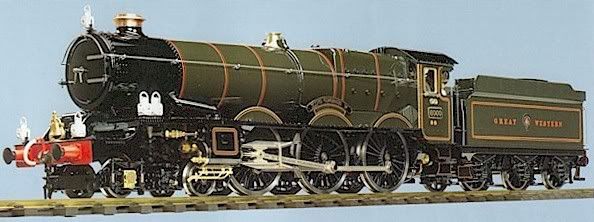
KING GEORGE V.
Nearly a year before the opening of the world's first commercially operated railway between Stockton and Darlington, it was proposed that a line should link Bristol with London. A company was formed by a group of Bristol merchants to carry out the scheme. This proposal, although it did not materialise until some time later, was really the foundation of the Great Western Railway, the originators of the now famous "King," class of locomotive.
THE "KING GEORGE V." The Great Western Railway's most powerful express passenger locomotive, designed by Mr. C. B. Collett C.B.E. the company's chief mechanical engineer. This engine, built at Swindon Works, is 68 ft. 2 in. long over the buffers, and weighs in working order, with the tender, 135 tons 14 cwt. The locomotive has four cylinders, two inside and two outside the frames, supplied with steam at a pressure of 250 lb. per sq. in.
The "King" locomotives gave astonishing service. They not only proved capable of handling, the heaviest traffic in accordance with schedule, but they were responsible for considerable economies in running costs-an important aspect of railway work.
The King George V is 68 ft. 2 in. long over the buffers, including tender.
The total weight of one of the "Kings" on the six driving wheels is 67½ tons, giving a load of 22½ tons on each of the three axles. The total weight of the engine in running order-that is, with the boiler filled with water to the working level-is 89 tons; so that, after deducting the weight on the driving wheels, we have 21½ tons to be carried by the bogie truck, the four wheels of which are each 3 ft. in diameter.
The tender is of the six-wheel pattern standard in G.W.R. practice, and weighs, when full, 46 tons 14 cwt. The coal capacity is six tons, and the water space enables 4,000 gallons to be carried at one time, apparatus being fitted to pick up water from troughs between the rails. The coal space in the tender is so shaped that as the fuel is fed into the furnace fresh supplies are constantly falling on to the footplate.
The "Kings" proved themselves fully capable of hauling the fastest and heaviest expresses of the Great Western Railway. The first service run, in fact, of the "King George V" was accomplished in under scheduled time with the Cornish Riviera Express from Paddington to Plymouth-a particularly fine run since, although no records could be attempted with a new engine fresh from the shops, the 155 miles from Slough to Exeter were covered at a speed of over 61 m.p.h.
The famous Dainton and Rattery banks, ranging in steepness from 1 in 50 down to 1 in 36, were climbed by the locomotive with ease, the express being the heaviest passenger train ever worked by one engine over this stretch of line. The weight behind the tender on this run, without counting passengers or luggage, was 410 tons, reduced to 338 tons after Westbury, where two coaches were slipped.
An interesting sidelight on performance was displayed during the "King George V's" trip to America, when the G.W.R. had the honour of representing Great Britain at the Centenary celebrations and Exhibition of the Baltimore and Ohio Railroad, U.S.A. After the Exhibition a special trial trip of the engine was arranged between Washington and Philadelphia with a train weighing 543 tons. According to an American source, at one point during the run a speed of 76 m.p.h. was attained with the steam regulator open to only three-quarters of its capacity.
The Centenary Medals of the Baltimore and Ohio Railroad were awarded to the "King George V," and these are now carried on the sides of the cab. Another interesting acquisition from the U.S.A. is the large brass bell, similar to those carried on American locomotives, which is now mounted on the British engine's buffer beam. These bells are a feature of locomotives in the U.S.A. since, with so many level crossings, miles of unfenced track, and open towns, warning of a train's approach is essential.
The "King George V" was the only British locomotive at the Baltimore Exhibition, with one exception, namely, a full-sized model of Robert Stephenson & Company's "North Star." The original of this engine was built for the New Orleans Railway Company of America over a century ago, but a financial crisis prevented the Americans from taking delivery and it was accordingly altered for the G.W.R. to the specification of the Company's engineer, Isambard Kingdom Brunel.
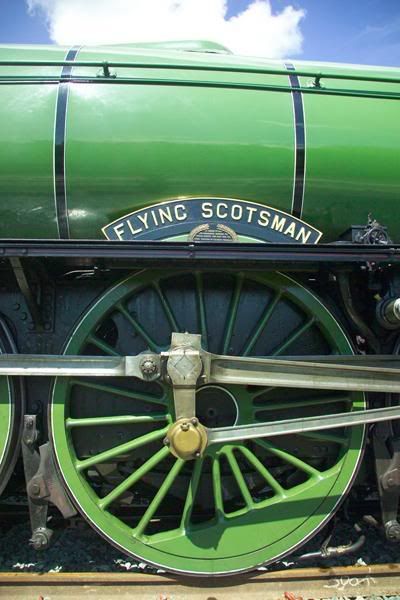
FLYING SCOTSMAN.
The LNER Class A3 Pacific locomotive "Flying Scotsman" was built in 1923 for the London and North Eastern Railway (LNER) at Doncaster Works to a design of Sir Nigel Gresley. It was employed on express trains on the East Coast Main Line from London King's Cross to Doncaster, Leeds, York, Newcastle-upon-Tyne or Edinburgh. It was commonly employed on the Flying Scotsman service, its namesake, from London to Edinburgh. In its career, the Flying Scotsman has travelled 2,000,000 miles (3,200,000 km).
During its period of British main line service the Flying Scotsman could travel the 633 kilometres from London to Edinburgh in 8 hours non-stop, with water replenishment using the water trough system. For this train, it was fitted with a large eight-wheel tender which included a corridor connection to allow the crew to change over.
History
The locomotive was completed in 1923, construction having been begun under the Great Northern Railway. It was built as an A1, but later (January 1947) rebuilt as an A3. It initially carried the number 1472.
Flying Scotsman was something of a flagship locomotive for the LNER. It represented the company at the British Empire Exhibition at Wembley in 1924 and 1925. At this time it acquired its name and the new number. From then on it was commonly used for promotional purposes.
This locomotive was the first of its class to haul the prestigious Flying Scotsman train, on its first non-stop service from London to Edinburgh on May 1st 1928. The following year, it appeared in the film The Flying Scotsman.
When in 1934 it became the first locomotive to be officially recorded at 100 miles per hour and earned a place in the Land speed record for railed vehicles the publicity-conscious LNER made much of the fact.
Following the Second World War it was renumbered 103, and at the nationalisation of the railways in 1948 it became number 60103. It acquired a set of smoke deflectors and a double chimney to improve steaming.
It ended service with British Railways in 1963 and was sold for preservation. It was restored as closely as possible to its original LNER condition and worked a number of railtours, including a non-stop London-Edinburgh run in 1968 - the year steam traction officially ended on BR. During this time, it was fitted with a second tender to increase its water capacity, a move that divided enthusiasts.
In 1969 it went on a promotional tour to the USA, where it was fitted with cowcatcher, high-intensity headlamp, bell, air brakes and buckeye couplings. The trip was initially a success, but when backers withdrew their support fears then arose for the engine's future, the speculation being that it could take up permanent residence in America or even be cut up. Fortunately in January 1973 William McAlpine stepped in at the eleventh hour and had the locomotive repaired and repatriated.
In 1988 the locomotive travelled to Australia to take part in that country's bicentenary celebrations. There it set another record, travelling 442 miles from Parkes to Broken Hill non-stop, the longest such run by a steam locomotive ever recorded.
In 2004 Flying Scotsman was bought in April by the National Railway Museum in York and is now part of the national collection.
Flying Scotsman is often referred to as "the most famous steam locomotive in the world".
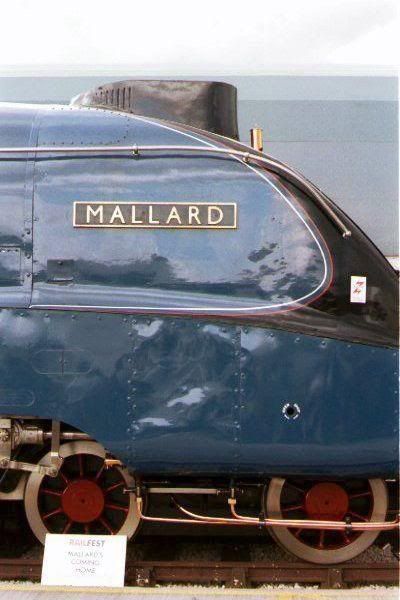
MALLARD.
Mallard is a London and North Eastern Railway Class A4 4-6-2 Pacific steam locomotive built in the 1930s by the LNER and designed by Sir Nigel Gresley in Doncaster, England. It was designed as an express locomotive with a wind-tunnel tested, aerodynamic body that allowed it to reach speeds of over 100 mph (160 km/h). It was in service until 1963 when it was retired after a lifetime distance of almost 1.5 million miles (2.4 million km). It was restored to working order in 1988 to celebrate its 50th anniversary and is now part of the national collection at the United Kingdom's National Railway Museum in York. Mallard is 70 ft long and weighs 165 tons.
The Record
Mallard is the holder of the world speed record for steam locomotives at 126 mph (203 km/h). The record was achieved on July 3, 1938 on the slight downwards grade of Stoke Bank south of Grantham on the East Coast Main Line, and the highest speed was recorded at milepost 90¼, between Little Bytham and Essendine. It broke the German 1936 record of 200.4 km/h (124 mph).
Mallard was the perfect vehicle for such an endeavour; one of the A4 class of streamlined locomotives designed for sustained 100+ mph (160 km/h) running, it was one of a small number equipped with a double chimney and double Kylchap blastpipe, which made for improved draughting and better exhaust flow at speed. The A4's three-cylinder design made for better stability at speed, and the large 6 ft 8 in (2.032 m) driving wheels meant that the maximum revolutions per minute was within the capabilities of the technology of the day.
Stoke Bank had a descending gradient of between 1:178 and 1:200. Mallard, with six coaches plus a dynamometer car in tow, topped Stoke Summit at 75 mph (121 km/h) and began to accelerate downhill. The speeds at the end of each mile (1.6 km) from the summit were recorded and the indicator diagrams on the dynamometer car traced a momentary maximum of 126 mph (203 km/h).
Mallard's world record has never been officially exceeded by a steam locomotive, though German locomotives came very close. Many rumours and stories exist of higher speeds, but Mallard's is the only one with adequate documentation. Other steam locomotives were probably capable of such speeds; the LNER's long, straight, slightly downhill raceway of Stoke Bank played as much of a part in the record as the locomotive or crew.
Mallard still holds the crown; plaques affixed to each side of the locomotive commemorate the feat.
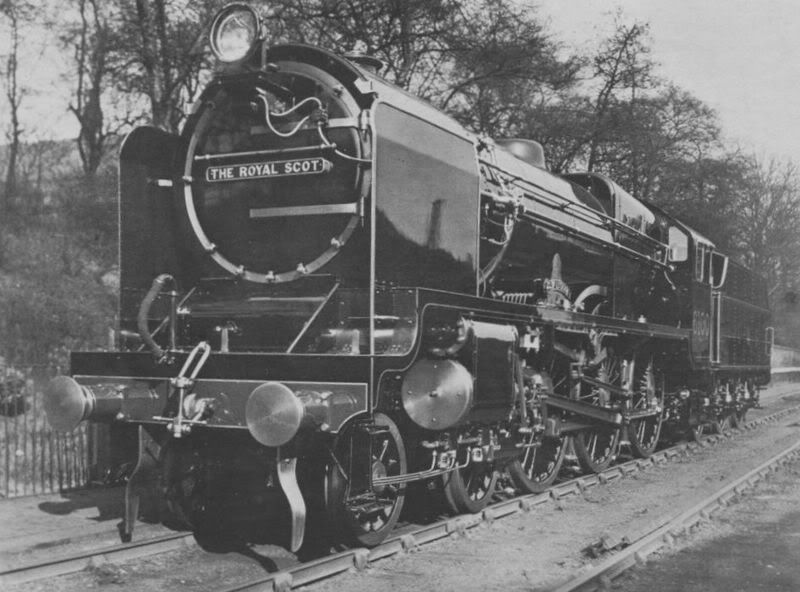
ROYAL SCOT.
Royal Scot was built in August 1927 to the design of Sir Henry Fowler by the North British Locomotive Company in Glasgow. Royal Scot was the first of a class of locomotives (of the same name) designed for working the heaviest and fastest duties on the Western and Scottish divisions of the LMSR including the Royal Scot train.
In 1933 Royal Scot entered works in preparation for a tour of Canada an North America, the highlight being a place in the Century of Progress Exposition at the World's Fair in Chicago.
The tour was a huge success, drawing great crowds and the original schedule being extended with requests to visit extra cities. Between May and November 1933, Royal Scot travelled 11,194 miles, was exhibited at over 80 cities and towns and inspected by 3,061,601.
The Royal Scot class of locomotive were rebuilt by British Railways to use the better performing tapered 2A boiler and in an attempt to improve some ride of the locomotive in 1950.
The locomotive was withdrawn in October 1962 after running 2.2 million miles from new.
Locomotive Statistics
Length 64' 11"
Wheelbase 54' 51/4"
Driving Wheel Dia. 6' 9"
Boiler Pressure 250lbs per Sq. Ins
Grate Area 31.25 Sq Ft
Tractive Effort 33,150 lbs
Weight in working order 137 tons 13 cwt
Final co-ordinates
are: N47°
0A.B W122° C.D
King George V =
£ RoyalScot = $ Flying
Scotsman = & Mallard = @
A
= ($-£)÷50
B
= (&-@)²+96
C
= (£-@)-1486
D
= (($-&)÷2)+132