A Return To Drewry's Bluff Mystery Cache
A Return To Drewry's Bluff
Related Web Page
Please note Use of geocaching.com services is subject to the terms and conditions
in our disclaimer.
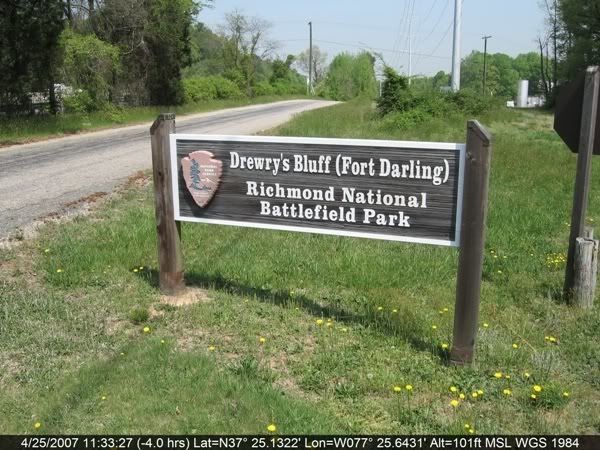
This cache marks a long overdue return to the Drewry's Bluff (Fort
Darling) Richmond National Battlefield Park. Don't worry, no rules
have been broken!
This cache is a Mystery due to the fact that although there are
several locations you need to find, there is only one container
(the Final), and it is NOT located in the bounds of the park. It is
very close, though.
I'm dedicating this cache to
Code_Zero, since he's done quite a bit to raise
awareness of local Civil War Forts and Camps. Also, the first
cache in this National Park belonged to him.
Richmond-Capital of the
Confederacy
As capital of the newly formed
Confederate States of America, Richmond, Virginia, became the
constant target of northern armies. During the four years of the
Civil War, Union generals made repeated attempts to capture the
city by land. Richmond, however, was vulnerable by water as well as
by land. Gunboats could navigate the James River all the way to
Richmond. The key to the city's river defenses lay in a small fort
only seven miles south of the capital. Known throughout the south
as Drewry's Bluff, northern troops referred to it as Fort
Darling.
Drewry's Bluff-Key to the
River Defenses
Drewry's Bluff, named for local
landowner Captain Augustus H. Drewry, rose 90 feet above the water
and commanded a sharp bend in the James River, making it a logical
site for defensive fortifications. On March 17,1862, the men of
Captain Drewry's Southside Artillery arrived at the bluff and began
fortifying the area. They constructed earthworks, erected barracks,
dug artillery emplacements, and mounted three large seacoast guns
(one 10-inch Columbiad and two 8-inch Columbiads) in the
fort.
On May 9,1862, Norfolk fell to
Union forces. The crew of the C.S.S. Virginia, forced to scuttle
their vessel to prevent her capture, joined the Southside Artillery
at Drewry's Bluff. Commander Ebeneezer Farrand supervised the
defenses of the fort. He ordered numerous steamers, schooners, and
sloops to be sunk as obstructions in the river beneath the bluff.
Six more large guns occupied pits just upriver from the fort. Men
worked around the clock to ensure a full state of readiness when
the Union fleet arrived.
The Federal squadron steamed
around the bend in the river below Drewry's Bluff early on the
morning of May 15. The force, under Commander John Rodgers,
consisted of five ships. The ironclad Galena and gunboats Port
Royal, Aroostook, and Naugatuck joined the famous Monitor to
comprise Rodgers' force. At 7:15 a.m. the Galena opened fire on the
fort, sending three giant projectiles toward the Confederate
position.
The five Union ships anchored in
the river below the fort. When Confederate batteries in the fort
replied, the whole vicinity shook with the concussion of the big
guns. Southern infantry lined the banks of the river to harass the
sailors. On the Monitor, the rifle balls of the sharpshooters
"pattered upon the decks like rain."
On the bluff the defenders
encountered several problems . The 10-inch Columbiad recoiled so
violently on its first shot that it broke its carriage and remained
out of the fight until near the end. A casemate protecting one of
the guns outside the fort collapsed, rendering that piece
useless.
After four long hours of
exchanging fire, the "perfect tornado of shot and shell" ended.
With his ammunition nearly depleted, Commander Rodgers gave the
signal to discontinue the action at 11:30. His sailors suffered at
least 14 dead and 13 wounded, while the Confederates admitted to 7
killed and 8 wounded. A visitor wrote that the Galena "looked like
a slaughterhouse" after the battle. The massive fort on Drewry's
Bluff had blunted the Union advance just seven miles short of the
Confederate capital. Richmond remained safe.
Expansion at
Drewry's Bluff 1862-1864
Following the repulse of the
Union flotilla in May 1862, Drewry's Bluff saw no battle action for
two years. Captain Sydney Smith Lee (General Robert E. Lee's
brother) took command of the site and supervised its expansion and
strengthening into a permanent fort. While some workers constructed
an outer line of entrenchments to protect the land approach to
Richmond, others built improvements for the fort, including a
chapel, barracks, and quarters for the officers.
During this time, Drewry's Bluff
became an important training ground for the Confederate Naval
Academy and the Confederate Marine Corps Camp of Instruction. In
May 1864, the fresh threat of an attacking Union force disrupted
the daily routine at Drewry's Bluff.
Drewry's Bluff
in the Bermuda Hundred Campaign, 1864
On May 5, 1864, Union Major
General Benjamin F. Butler and his Army of the James landed at
Bermuda Hundred, a neck of land only 15 miles south of Richmond.
Marching overland, they advanced within three miles of Drewry's
Bluff by May 9. While several Union regiments did manage to capture
the fort's outer defenses, delays by Union generals spoiled the
success. Confederate infantry under General P.G.T. Beauregard
seized the initiative and successfully counterattacked on May 16.
Once again a Union drive on Richmond met defeat at Drewry's Bluff.
The area remained an integral part of Richmond's defense until the
fall of Petersburg in April 1865.
Drewry's Bluff
at the End of the War
The garrison at Drewry's Bluff
took part in the evacuation of Richmond and Petersburg on April
2-3, 1865. Soldiers, sailors, and marines from the fort joined the
movement westward, ultimately surrendering at Appomattox Court
House. Many of the sailors served as infantry during the fighting
along the way.
Union forces quickly cleared a
path through the obstructions in the James River beneath Drewry's
Bluff. On April 4, 1865, President Abraham Lincoln passed the fort
on his way up the James to visit Richmond.
Finding the cache
To obtain the coordinates for the final location, you will need to
visit 8 references inside the park:
Sign 1: 37 25.206, -077 25.584
(Title: Drewry's Bluff
1862)
Sign
2: 37 25.336, -077 25.359 (Title: A Very Neat Chapel)
Sign 3: 37 25.329, -077 25.304
(Title: Drewry's
Bluff)
Sign 4:
37 25.329,
-077 25.304(Title:
Duty Above and Beyond)
Sign
5: 37 25.329,
-077 25.304(Title: May
15, 1862 - The Battle of Drewry's
Bluff)
Cannon:
37 25.331, -077 25.304
Sign
6: 37 25.320, -077 25.304 (Title: Finishing Fort
Drewry)
Sign
7: 37 25.282, -077 25.333 (Title: Covered Way)
A= Sign 1, "On May
10-1 A
, retreating Confederates abandoned Norfolk...."
B= Sign 2, Number of
letters in the fourth word from the end of the paragraph beginning
"The little white chapel that stood here...."
C= Sign 3, The number in
the compass rose to the left of the "Drewry's Bluff" title.
D= Sign 4, Find the
paragraph about John Mackie. "For his courage and leadership,
the D
7-year-old
New Yorker...."
E=
Sign 5, Sum of the digits in the number of casualties suffered by
southern forces.
F= Cannon, A 2-digit number
is etched on the end of the barrel. You're looking for the first
digit
G= Sign 6, "...for the
boats will probably be back here again in G hours."
H= Sign 7, There are two
four-digit numbers listed on this sign. Subtract the smaller from
the larger.
Final: 37 25.AB(C+D), -077 25.E(F-1)(G-H)
The cache's original contents
are:
- Log
- FTF Prize ($5)
- 5
Inertial personal pathtags - feel free to take
one, no need to trade!
- 4 AA batteries
- 3 mini carabiners
- 1 zipper pull
thermometer/compass
- 1 carabiner drink
carrier
Good luck! When you're done
with this one, you might consider visiting Code_Zero's Civil War
Series (CCCWMR Series):

If you're curious
about the Central Virginia Geocaching Association, drop
by our Yahoo Group's page and see what we're all
about....especially if you're a metro-Richmond area cacher and
aren't a member of the group yet.
Additional Hints
(No hints available.)
Treasures
You'll collect a digital Treasure from one of these collections when you find and log this geocache:

Loading Treasures