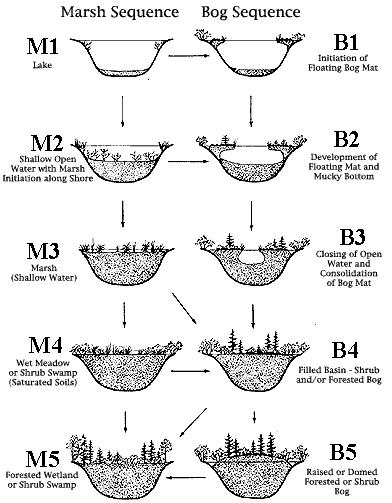
In the wake of the retreating Pleicestone glacier 10,000-13,000 years ago, huge chunks of ice were buried in sand and gravel. When the ice blocks melted, they left steep-sided basins in the glacial till, many of which filled with water to become kettle ponds. The sluggish, deep waters of some kettle ponds provide nutrient-deficient, acidic, anoxic (oxygen deficient) conditions that few species other than Sphagnum mosses tolerate. A floating mat of Sphagnum on a framework of leatherleaf would take hold at the margins of these ponds. The mat expands both vertically and horizontally into the water as peat accumulates to create quaking Sphagnum bogs.
In kettlehole ponds, leatherleaf is the principal pioneer of the bog mat which Sphagnum mosses, and shrubs become established. As the root system became increasingly dense, Sphagnum colonizes the mat. Sphagnum peat and partially or undecomposed stems and roots of leatherleaf continuously enlarge the mat. Over time, the floating bog mat deepens vertically and spreads horizontally over the pond's surface. Acidic water-saturated conditions help retard decomposition so that peat can build up. Over time the mat becomes grounded and compacted where the bottom and floating peat layers join together. The grounded mat can support larger shrubs and even trees. Concentric rings or distinct vegetation zones are typical of many kettlehole bogs.
Bogs receive all or most of their water from precipitation rather than from runoff, groundwater or streams, and are encircled by higher ground which blocks the outward flow of water. Thus, whatever materials are washed into or deposited in a bog remain there permanently; dead plant materials build up to great depths. Because the filling of a bog pond is a very slow process, taking several thousand years depending upon the original depth of water, all stages of bog development may be encountered. In some bogs, a small pool may remain in the center of the bog. In others, the spreading mat has engulfed most of the open water and trees have invaded the floating mat. And in still other bogs, the forest may have closed in, hiding all outward traces of the former open bog. The end product in all cases is a mature forest generally dominated by trees adapted to water-logged, peaty soils.
Bog water is stagnant. Without oxygen, many bacteria responsible for plant and animal decay cannot live. In addition, the glacial debris underlying and surrounding most bogs is predominantly acidic granite rock deficient in elements essential to plant growth. Meanwhile, certain organic compounds, primarily humic acids accumulate in the bog waters, increasing the acidity of the bog and further inhibiting the usual decay organisms. Without movement and overturn in the water, temperatures remain under the 70F to 75F degree range required for bacterial action. Dead animal and plant parts may undergo partial decay at the surface of the bog, but when such material sinks into the bog, decay virtually ceases.
In kettlehole bogs, the plant communities often form concentric rings around the pond. Vegetation patterns change from pond edge to upland edge based on environmental gradients of hydrology, topography, water chemistry, abundance of nutrients, and depth of the peat mat. Due to fluctuating water levels and nutrient regime, size and species composition of the plant communities can vary. As often as not, the plant assemblages grade into transition zones that may be barely distinguishable out in the bog.
What makes bogs so interesting is the fact the researchers can’t simply look at a bog and know exactly how it formed. Surface vegetation is a poor indicator of bog formation and succession because it simply shows what the climate is like today. The actual history of a bog lies well below surface in the layers of accumulated peat. Only, by studying a core sample, analyzing the past of the bog can a researcher know how a bog was developed. Studying stratigraphy can reveal the historical development of a bog and shifts in the distribution of plant species due to climatic. Stratigraphy affords a paleoecological record of the peatland itself and the surrounding environment. The bog is a window into climate change in the past. Bogs are fascinating not only because they are wet and soggy, because each one is truly unique. So take the time to look carefully at the bog, as it is a very special place for wildlife and unique plants.
Do not venture into the bog, as it is much deeper then it appears form the roads edge. Using the drawing below select the stage of either the marsh or bog that this kettlehole in and email me the answer.
 For more scientific information go to Natural History of a Bog