Boundary Bog - PANP EarthCache
-
Difficulty:
-

-
Terrain:
-

Size:  (other)
Please note Use of geocaching.com services is subject to the terms and conditions
in our disclaimer.
To log your visit, you must do the following:
- obtain the Boundary Bog trail brochure. The link is listed in the description below. Sadly, there are no longer brochures available at the trail head.
- email me the answers the 3 questions listed below (all answers can be found in the trail brochure)
- hike the 2km trail to post a picture of yourself or your GPS at the Eye of the Bog To prevent false logging, the last step is required.
Boundary Bog - a black spruce bog
IMPORTANT: Please stay on the trail at all times to not disrupt the ecosystem. Do not disturb nature, collect souvenirs, nor step off the boardwalk into the bog (you may get stuck). Only a portion of the trail contains a boardwalk, and the rest is on packed ground that has some smaller hills. The boardwalk does not have guardrails, therefore wheelchairs and strollers are not recommended due to safety reasons. Bicycles are not allowed on the trail. Dogs must be leashed at all times.
Bog - Muskeg - Peatland
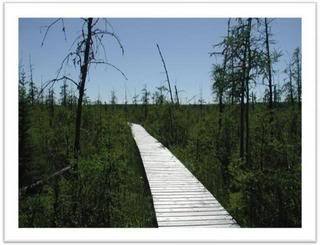
12% of Canada's landscape is comprised of bogs and muskegs, yet few have ever seen, let alone ventured into one.
Traditionally, bogs have been blacklisted as "waste lands", useless for habitation or agriculture. What people don't realize is bogs are strange and exciting living components of Canada's north which directly affect wildlife, vegetation, water levels, and even climate.
The Formation of the Bog:
A kettle was formed during the glacial retreat from a huge ice block that became buried. As the ice slowly melted, a crater was left in its place. The Boundary Bog is one such glacial-formed kettle.
Steps in forming a bog:
- Basin drainage becomes blocked
- Sedge mat forms at water's edge
- Peat accumulation begins
- Peat mat spreads and thickens while sedimentation continues to form along the edge
Sphagnum Moss grows faster than other mosses and becomes the "Master of the Bog", creating an acidic environment for itself, robbing what little nutrients there are in the surrounding water from other plants. The invasion of the peat mat continues until it closes over the entire surface of open water.
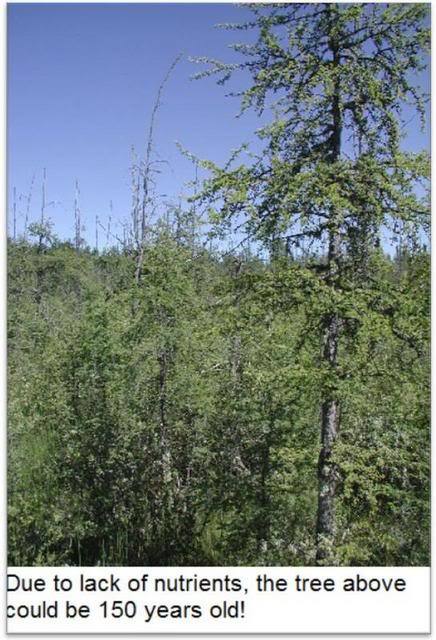
Question #1: The walkway path that goes through the Boundary Bog goes over a mat of peat that could be ___ meters thick and _____ years old!
Few species of wildlife make their home in a bog. Most herbivores don't eat moss and it takes a lot of energy to slug through the water-logged peat. Bog Lake is home to some tiny creatures such as Nymphs.
Question #2: What types of animals and birds may feed in a bog?
There are fascinating forms of plant life in a bog. The Bladderwort, two species of Sundew, and the Pitcher Plant are green carnivores that grow in a bog. As you walk the trail, look for the Pitcher plant. The Pitcher plant's red glaze and luring nectar-rimmed lip of the leaf takes the insect down a nectar trail into the trap to be consumed.
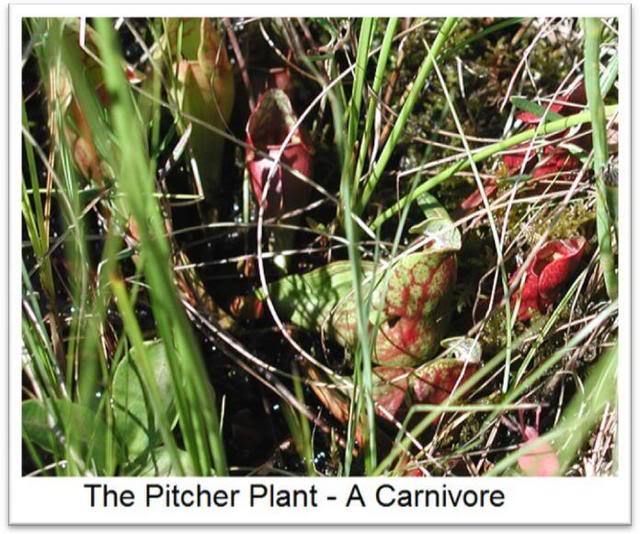
Question #3: Describe 3 ways peat has been used, both presently and in the past.
Permafrost is ground that remains frozen year round. In Canada's high north, it underlies the tundra everywhere. Prince Albert National Park contains permafrost in isolated pockets where the peat insulates the ground so well that even the heat of mid-summer fails to melt them.
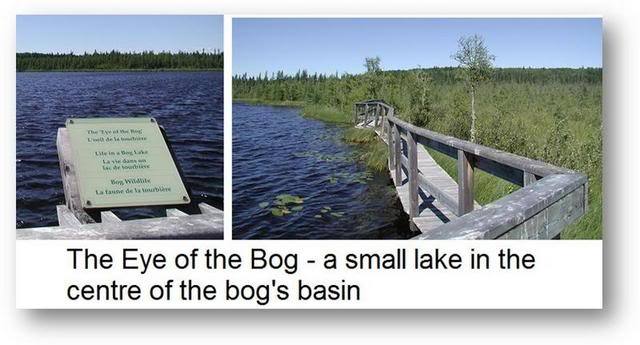
One Last Word About Bogs:
Bogs are worth protecting! Peatlands all over the world are important natural regulators of water levels. They hold a tremendous volume of water and release the supply gradually to continental watersheds.
As storage sites for undecomposed plant tissue, they are critical factors in the global regulation of carbon dioxide levels in the atmosphere. Thus, bogs and their kid may prove to be man's allies in controlling the "green house effect" and its impact on the earth's heat balance.
As you walk the trail through Boundary Bog, appreciate and realize the important role that bogs play.
Bonus Question (just for fun): How many steps are there on the Lookout Tower?
Email answers to the three questions to Northbound through my profile and post a picture of yourself at the Eye of the Bog in your log. Do not post the answers to the questions in your log.
The trail brochure can be found at the following link: Boundary Bog Brochure
NOTE: Despite my believing this link to be safe, you open it at your own risk.
For more information about Geocaching in Prince Albert National Park, visit this link:
English Version
French Version
This cache has been approved by Parks Canada.
Additional Hints
(No hints available.)
Treasures
You'll collect a digital Treasure from one of these collections when you find and log this geocache:

Loading Treasures