About Broke Leg Falls...
Broke Leg Falls is located on HWY 460, in Menifee County, Kentucky.
The posted coordinates will take you to the parking lot for the
falls. From there you will have to ascend some stairs that lead you
the viewing area. The water of Broke Leg Falls flows overtop of a
bed of sandstone and traces of limestone can also be seen.
Sandstone is mostly made from sand sized Quartz crystals which
makes it more resistant to erosion than the softer limestone. Here
at the falls, the waters of Broken Leg Creek found this harder
sandstone and has a more difficult time eroding this layer than the
layer of limestone below the falls.
 Broke Leg Falls in February
One very significant feature of Broke Leg Falls is you will notice
that it is comprised of 3 waterfalls total. You will notice on your
left as you make your way to the viewing area there are 2 other
small falls making their way to the final drop.

Almost every waterfall will first fall into one of two main
categories. They can be considered either:
1) river waterfalls: called such because they are usually
found on a river. They are wider than they are tall and usually
handle a high volume of water. They hardly ever go dry in summer
months with little rainfall and after a large rainfall they can
resemble a large rapid.
2) stream waterfalls: usually found on a mountain stream and
is high than it is wide; the flow volume will be either small or
medium; in dry months some stream waterfalls go dry In the case of
mountain streams, the water flowing becomes wider and more shallow
just aboves waterfalls due to flowing over a rock shelf. There is
usually a deep pool just below the waterfall because of the kinetic
energy of the water hitting the bottom.
What is a Waterfall
A waterfall is usually a geological formation resulting from water,
often in the form of a stream, flowing over an erosion-resistant
rock formation that forms a sudden break in elevation or nickpoint.
Some waterfalls form in mountain environments where the erosive
water force is high and stream courses may be subject to sudden and
catastrophic change. In such cases, the waterfall may not be the
end product of many years of water action over a region, but rather
the result of relatively sudden geological processes such as
landslides, faults or volcanic action. Typically, a river flows
over a large step in the rocks which may have been formed by a
fault line. Over a period of years, the edges of this shelf will
gradually break away and the waterfall will steadily retreat
upstream, creating a gorge of recession. Often, the rock stratum
just below the more resistant shelf will be of a softer type,
meaning undercutting, due to splashback, will occur here to form a
shallow cave-like formation known as a rock shelter or plunge pool
under and behind the waterfall. Eventually, the outcropping, more
resistant cap rock will collapse under pressure to add blocks of
rock to the base of the waterfall. These blocks of rock are then
broken down into smaller boulders by attrition as they collide with
each other, and they also erode the base of the waterfall by
abrasion, creating a deep plunge pool
This is a classification of waterfalls
including the most common types :
Block: Water descends from a relatively wide stream or
river. Water descends a series of rock steps.
Cataract: A large waterfall.
Fan: Water spreads horizontally as it descends while
remaining in contact with bedrock.
Horsetail: Descending water maintains some contact with
bedrock.
Plunge: Water descends vertically, losing contact with the
bedrock surface.
Punchbowl: Water descends in a constricted form, then
spreads out in a wider pool.
Segmented: Distinctly separate flows of water form as it
descends.
Tiered: Water drops in a series of distinct steps or
falls.
Multi-Step: A series of waterfalls one after another of
roughly the same size each with its own sunken plunge pool.
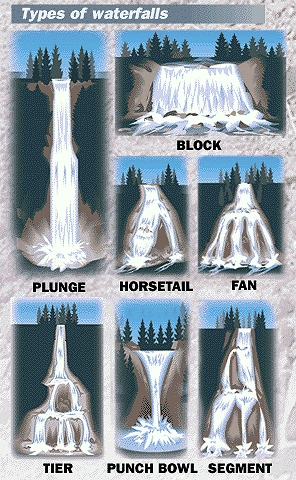 Some Of The Types
The Logging Requirements...
1) How high or tall do you estimate the waterfall to be?
2) How wide do you estimate the waterfall to be?
3) Using the waterfall classification guide above, what
classification of waterfall do you believe the waterfall is?
4) Take a picture of yourself and your GPS with the waterfall in
the picture