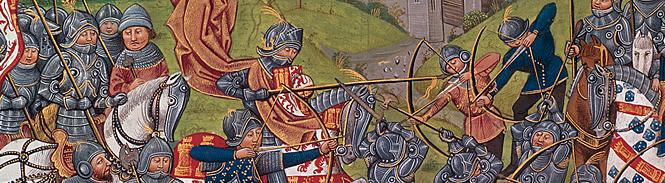
Pt: O Campo Militar de S. Jorge testemunha o local onde se travou, a 14 de Agosto de 1385, umas das raras grandes batalhas campais da Idade Média entre dois exércitos régios e um dos acontecimentos mais decisivos na história de Portugal.
À escala medieval, considera-se um aconteceimento da maior importância política, diplomática e militar.
No campo militar significou uma inovação táctica, onde os homens de armas apeados foram capazes de vencer a poderosa cavalaria medieval.
No campo diplomático; permitiu a aliança entre Portugal e Inglaterra, que perdura atá aos dias de hoje.
No aspecto político, resolveu a disputa que dividia o Reino de Portugal do Reino de Castela e Leão, permitindo a afirmação de Portugal como reino independente. Tornou possível também que se iniciasse uma das épocas mais grandiosas da história de Portugal, a Época dos Descobrimentos.
A 14 de Agosto de 1385, no planalto onde hoje se situa a aldeia de S. Jorge, concelho de Porto de Mós, distrito de Leiria, confrontaram-se dois pretendentes ao trono de Portugal: D. João I de Castela e Leão, e o D. João I, Mestre de Avis que, quatro meses antes nas Cortes de Coimbra, fora aclamado Rei de Portugal.
O exército castelhano era numérica e militarmente superior ao português. D.Nuno Álvares Pereira, com o seu pequeno grupo de cavaleiros e peões, implementou um sistema táctico antes e durante o confronto que levou Portugal à vitória.
É das únicas batalhas em Portugal, e mesmo na Europa,onde é possível reconstituir o posicionamento relativo dos exércitos.
Aljubarrota configura um dos marcos mais representativos da evolução dos sistemas e dispositivos tácticos utilizados na guerra praticada no Ocidente europeu, nos finais de Idade Média.
A Fundação Batalha de Aljubarrota convida-o a visitar o CIBA - Centro de Intrepretação da Batalha de Aljubarrota, onde pode saber mais sobre esta importante Batalha.
_______________
En: The Military Camp of São Jorge bears witness to the site where, on August 14, 1385, one of the rare great pitched battles of the Middle Ages took place between two royal armies and one of the most decisive events in the history of Portugal.
On a medieval scale, it is considered an event of the greatest political, diplomatic, and military importance.
Militaryly, it represented a tactical innovation, where dismounted soldiers were able to defeat the powerful medieval cavalry.
Diplomatically, it allowed for the alliance between Portugal and England, which endures to this day.
Politically, it resolved the dispute that divided the Kingdom of Portugal from the Kingdom of Castile and León, allowing Portugal to assert itself as an independent kingdom. It also made possible the beginning of one of the most glorious periods in Portuguese history, the Age of Discoveries.
On August 14, 1385, on the plateau where the village of São Jorge is located today, in the municipality of Porto de Mós, district of Leiria, two claimants to the throne of Portugal clashed: John I of Castile and León, and John I, Master of Avis, who, four months earlier in the Cortes of Coimbra, had been acclaimed King of Portugal.
The Castilian army was numerically and militarily superior to the Portuguese. Nuno Álvares Pereira, with his small group of knights and foot soldiers, implemented a tactical system before and during the confrontation that led Portugal to victory.
It is one of the only battles in Portugal, and even in Europe, where it is possible to reconstruct the relative positioning of the armies.
Aljubarrota represents one of the most significant landmarks in the evolution of tactical systems and devices used in warfare in Western Europe at the end of the Middle Ages.
The Fundação Batalha de Aljubarrota invites you to visit the CIBA - Aljubarrota Battle Interpretation Centre, where you can learn more about this important battle.