As a former pilot, I’ve always been interested in airplanes and airplane crashes. Unfortunately, the beautiful mountains along the Wasatch Front have been the site of several tragic airline disasters. This cache is a memorial to one of them.
The year was 1940. It was November 4; two days before America would re-elect Franklin D. Roosevelt as President. Hitler was already waging war in Europe, but the United States was still a year away from having to join the conflict. The cost of daily newspaper service in Salt Lake City was 18¢ per week.
On Sunday evening at 10:20 p.m. in Oakland, California, seven passengers boarded United Flight 16 bound for Salt Lake City. It would be the last trip they would ever take.
The Douglas DC-3 airliner (NC16086) flew westward through the night, piloted by Captain Howard Fey and Copilot Thomas Sandegren. Evelyn Sandino, one of United’s youngest stewardesses, took care of the seven passengers. Intermediate stops were made without incident in San Francisco, Sacramento, Reno and Elko. It was a route Captain Fey had flown for several years. The plane arrived over the Salt Lake Valley to find fog and a heavy snow storm, which required flying by instruments. Radio communications were difficult because of heavy static caused by the snow. The visibility was only about 3/4 mile. The plane circled around over the Salt Lake City area at 14,000 feet for nearly an hour as it tried to find a break in the clouds for a landing. At 4:25 a.m. Captain Fey radioed: “I don’t know whether we can get in or not. Unless we can pick up the field will have to get out of here.” The airport dispatcher began making arrangements for the plane to return to Elko for a landing.
In the 1940’s, instrument landings were made by following a directional radio signal beam from the airport, commonly called the radio “range.” The range beam, when functioning properly, allowed pilots to know they were on a specific bearing. The north and south legs of the range were used for alignment to approach the north/south runway of the Salt Lake Airport.
At 4:37 a.m., the dispatcher advised Captain Fey that another United flight was due to arrive in the area in about 10 minutes, and that Captain Fey should vacate the area and return to Elko if he could not land in Salt Lake. Captain Fey responded that he was at an altitude of 9,000 feet on the north leg of the range. “There are breaks in the clouds out here. It is quite a bit thinner. Think we can come down out here . . . .”
Following standard landing procedures, the plane, heading north, began a broad U-turn to the east for a final southern approach to the Salt Lake City airport. But about 2 miles northeast of Centerville – just 15 miles short of the airport – something went terribly wrong. The plane veered off course in the dark and crashed into the mountainside near Bountiful Peak, on the west side of the Wasatch Mountains, traveling at 165 mph. The pilot’s last radio transmission, at 4:40 a.m., was: “We are over Layton at 8,000 feet now. Stuff broken out here much better.” All efforts to communicate with the plane after that were unsuccessful.
 Having lost contact with Flight 16, an air search was immediately commenced by United Air Lines and the Civil Aeronautics Administration. The wreckage was found that morning by a United pilot (and friend of copilot Sandegren), J.W. Haws, who had a hunch that local early-rising farmers might have heard the plane. Haws set out by automobile to contact Davis County farmers and found several who remembered hearing a plane heading east at about the time of the crash. Haws concluded the plane might have crashed in the mountains to the east of Farmington or Centerville. Returning to the airport, Haws flew a small search plane to that area. Flying at 8,000 feet and scanning the canyons to the east, he spotted United Flight 16 on the mountainside at 11:55 a.m. Monday morning. He observed that the plane was largely intact and had not burned. He notified authorities and a rescue party was immediately organized.
Centerville Marshall William McIlrath was ordered to take 20 men and a physician to the scene. McIlrath and six others left at once. The rest of the group was lead by Art Pettit. With snowshoes, skis, blankets, food and horses, the rescue party started up the trail in Barnard Canyon but eventually had to break a new trail through the dense scrub oak and a foot of snow. At some points they scaled the sides of ridges bordering on the vertical, often falling when rocks hidden by snow gave way and sent the searchers tumbling backward. Small planes circled the wreck site so the searchers would know where to go. The first searchers arrived shortly after 2:00 p.m. on Monday afternoon. The silver and blue plane was resting upright, facing uphill and to the southeast. It appeared the pilot had tried to nose the plane up as he saw, too late, the ridge in front of him. The fuselage was buckled at a point just forward of the rudder. The left wing was sheared off and turned back parallel with the fuselage. The right wing was broken off and turned slightly toward the rear. Both engines had been ripped off and twisted parts were scattered at each side of the plane. A 60-foot long swath was cut in the oak brush from the plane’s impact. The two pilots, still strapped into their seats, were thrown from the plane. The others were still inside. All 10 were deceased. A clock on the instrument panel said 4:42 a.m.
The passengers consisted of two couples and three other men. Killed in the crash were Mr. and Mrs. Howard C. Muir of Detroit, Michigan (see additional information below); Mr. and Mrs. L. Wilson of Maywood, Illinois, who were returning home from a visit to California (Mr. Wilson worked for United Airlines in Chicago); Joseph Cassero of Oakland, California, who was traveling to Detroit to buy new cars for the agency he operated; Elland Dybdahl of Fergus Falls, Minnesota, an inspector for the Minnesota State Railroad and Warehouse Commission, en route home after visiting three sons in California; and Dr. George L. Stevenson of Sacramento, California, formerly of Salt Lake City. Also killed were the pilot, Howard N. Fey of Oakland, California; copilot Thomas E. Sandegren of Tacoma, Washington; and stewardess Evelyn Sandino of Alameda, California.
Dr. Stevenson, a former resident of Salt Lake City, was rushing home to see his elderly father, William H. Stevenson, who was gravely ill. William died that afternoon, nine hours after his son, without knowing his son had died. A joint funeral was held for both men at the Ninth Ward Chapel in Salt Lake City, and both were buried in the Farmington City Cemetery. Dr. Stevenson was survived by his wife of 23 years, Miriam. The other bodies were claimed by relatives and taken home for burial.

Searchers reported that if the plane had another 150 feet of altitude it could have cleared the ridge and turned safely into the Salt Lake Valley. The plane had enough fuel to fly until 9:17 a.m., had the crew chosen to wait for the weather to clear or for daylight at 7:04 a.m.
The bodies, along with 24 sacks of airmail, were taken down the mountain by a pack train of 15 horses on Tuesday morning. A path had to be cut through the trees for ¾ of a mile as the pack train headed down Barnard Canyon. Rocks, mud and snow slowed the descent. The bodies were transferred to hearses at the I.P. Hallman ranch at Chase Lane near the foot of the trail in Centerville. (Ironically, I.P. Hallman’s son, Hugh, would be killed five years later in a midair collision near Ontario, California.) The mail was re-shipped on an eastbound plane that same afternoon.
Other local residents who helped in the rescue/recovery effort were Davis County Sheriff Joseph Holbrook, Deputy Sheriff Jack Steed, Waynard Bennett, Bill Clawson, Bill Evans, Eldon Duncan, Reggie Coles, Wilford Sparks, DeWaine Randall, Athen Rollins, Harry Pledger and Charles Weymeyer. Several of the men were deputized by the Centerville Marshal to guard the plane during the night to protect the U.S. mail, to keep the curious away, to prevent souvenir hunting, and to preserve the evidence until federal authorities could investigate the scene.
A coroner’s jury of three Centerville residents met at the Union Mortuary in Bountiful the day after the crash and concluded that all 10 persons on board were killed instantly from broken necks, fractured skulls, or both.
The crash was determined to have been caused primarily by malfunctioning of the radio range beam from the Salt Lake airport, probably due to snow accumulations on the transmitting equipment. Snow and other factors could occasionally cause the beams to shift, leading the pilot to think he was on a certain bearing when in fact he was off course on a different bearing. To guard against this problem, the government used “range monitors” -- persons in strategic locations who would listen to the radio signals for at least three minutes every hour to make sure they were operating properly. For the Salt Lake airport, range monitoring stations were located in Plymouth to the north, Tintic to the south, and Wendover to the west. A fourth person monitored the signal at the Salt Lake Airport. The range monitors were required to keep a written log of their monitoring. If the signal was misaligned or defective in any way, they were to immediately report the problem so that pilots could be alerted.
After the crash, the Salt Lake monitor, who was working an extended shift because his replacement overslept by 5 hours, claimed all radio signals had been regularly checked and were normal. The Tintic operator likewise claimed that all hourly monitorings were normal, until a special check was made at 7:03 a.m. after the plane was known to be missing. At that time, the range was out of adjustment such that the wrong radio signals were being sent. The Wendover monitor also testified he took readings at the proper intervals and all signals were normal. The Plymouth monitor station, which because of its location on the north leg of the range was the most critical for southern landings, was manned by Thomas Sessions. Sessions testified he performed the proper monitoring and that all signals were normal until 6:37 a.m. when the signal was found to be swinging from one direction to another. However, his written log entries were found to contradict automatically time-stamped teletype entries by one hour. Sessions explained he kept an unofficial “scratch” log, from which he made formal log entries at the end of his shift, and that he must have made errors in transcribing. Sessions then destroyed his scratch log even though he knew a plane was missing, all of which led investigators to suspect he had not made proper monitorings. Other pilots stated their belief that the range was not working properly based on signals they had heard while flying in the area shortly after the crash.
It was ultimately concluded that, at the time of the crash, the north leg of the range was displaced by perhaps 12 degrees to the east of the published alignment, probably because of the wet snowfall on transmitting equipment. As a result, when Captain Fey started his eastern U-turn north of the airport for a landing to the south, he was significantly further east than the radio signal indicated. He believed he was safely on the west side of the north/south radio beam, over the Great Salt Lake, when in fact he started the turn roughly over Kaysville on the east side of the beam. He then proceeded on a magnetic bearing of 127 degrees (SSE, 145 degrees true) expecting to intersect the north/south beam and follow it into the airport, but intersected the flanks of Bountiful Peak instead.
The investigative report concluded, “on the basis of the overwhelming weight of the evidence,” that the northern leg of the range was misaligned, “notwithstanding the fact that the reports and testimony of the operators responsible for monitoring the Salt Lake range indicate no misalignments of the range until 5:37 a.m.” The report singled out, in particular, the Plymouth operator, Thomas Sessions, who should have observed the misalignment of the critical north leg by at least 3:10 a.m., well before Flight 16 arrived over Salt Lake. Likewise, the Salt Lake monitor was deemed to have misdiagnosed the reading he took minutes before the crash, and the Tintic readings were also judged to be incorrect. The monitoring mistakes may have been due to snow static, poor training, and/or inattentiveness, or perhaps in the case of Mr. Sessions, fabricated monitoring.
Because of the dangerous mountain terrain, the Salt Lake radio range was the most thoroughly monitored range in the country, with four remote monitoring sites to provide four checks every hour and one continuous monitoring station at the airport. Nevertheless, it is clear that the range monitors had little appreciation for the practical significance of their duties on airline safety. The official probable cause of the crash was malfunctioning of the Salt Lake radio range, and the failure of the range monitors at Tintic, Plymouth and Salt Lake to detect and report the malfunction. Captain Fey, however, was also found to be at fault for not performing available checks to ensure that the radio range was in proper alignment before attempting to land.
Fortunately, today we have much more sophisticated and reliable methods for navigating airplanes and avoiding mountains.
THIS CACHE IS A MEMORIAL TO THE 10 SOULS WHO LOST THEIR LIVES 1.74 MILES WEST OF THIS SPOT IN THE EARLY MORNING HOURS OF NOVEMBER 4, 1940. INSIDE THE CACHE YOU WILL FIND A COPY OF THE FRONT PAGE NEWS ARTICLES FROM THE SALT LAKE TRIBUNE, DESERET NEWS AND DAVIS COUNTY CLIPPER, INCLUDING PICTURES OF THE VICTIMS AND THE WRECKAGE. (PLEASE LEAVE ALL NEWS ARTICLES IN THE CACHE.) AS YOU LOG THIS CACHE, PLEASE PAUSE FOR A MOMENT OF REFLECTION AND RESPECT FOR THE MEN AND WOMEN WHO PERISHED THERE ON A DARK NOVEMBER NIGHT IN THE PRIME OF THEIR LIVES.
 I have placed a separate memorial at what I believe to be the actual crash site (based on the Civil Aeronautics Board accident report, newspaper photos and news accounts). The crash site is on the northwest face of the ridge between Ricks Creek (Ford Canyon) and Barnard Creek that extends westward downhill from this cache. From this cache site, it is on the far side of the last visible knoll as you look straight toward the middle of Farmington Bay on a magnetic bearing of 250 degrees. There is no remaining wreckage at the site. I have no information on when or how the wreckage was removed. Access to the crash site is extremely difficult. There is no trail and it entails a good four miles of bushwhacking through dense vegetation and steep terrain (1.74 miles from the cache site to the crash site “as the crow flies,” but a lot longer “as the cacher hikes”). The coordinates for the crash site memorial are N40-56.609 W111-50.798. There you will find the cross pictured here and a log container hanging in the bush just southwest of the cross. IF YOU LOG A VISIT AT THE CRASH SITE, PLEASE MAKE NOTE OF IT HERE. Be aware that hiking to the crash site is very difficult – every bit of 5 stars. I’ve done it twice, and both times it was an all day affair that left me exhausted (although much of that time was spent hiking around the mountainside looking for the crash site). Both times I ran out of water and both times I ended up hiking the last 1.5 hours in the dark. (I didn’t learn very well from the first experience.) On both occasions I started from the top at Skyline Drive, near this cache, where the elevation is about 8,600 feet (the second time with a foot of snow and the Skyline Drive road locked shut for the winter for an extra 2 miles). The first time I hiked down to the site (about half way down to the valley at 6,800 feet) and then back up. The second time I decided to avoid the 1,800 vertical foot return climb and just go downhill another 2,200 vertical feet to the Bonneville Shoreline Trail at about 4,600 feet on the Centerville bench. Both routes were equally hard. One kills your lungs, and the other your knees. In either case, your shins will get hashed from breaking through the brush unless you are very careful. I wore long-johns the second time for extra protection and it helped a lot. (I did learn my lesson on that point.) I think starting in Centerville and hiking up and then back down (as the Flight 16 rescuers did) would be the worst of both worlds, but I haven’t tried it. Another lesson I learned: the bush has a way of pulling things out of your pockets and pack, like maps, cache printouts, water bottles, etc. I even lost the sweatshirt tied around my waist for a while and had to backtrack to find it tangled in a bush. So secure all your stuff carefully!
Listed below are waypoints for the route I have used, which essentially follows the ridgeline westward down the mountain:
Start at this cache or nearby at N40-56.814 W111-48.751.
Head for N40-56.726 W11148.823, where there is a bit of a trail. You can use some of the erosion-control terraces as trails to get to this point.
Head west to N40-56.784 W111-49.153 (a large white outcropping of rock). The nearby stand of large pine trees in the meadow is a great spot for a break.
Go to N40-56.735 W111-49.363 to start down the ridge. No trail here, just dense vegetation.
Head downhill for N40-56.702 W111-49.707, which is a small saddle with large pines.
Continue downhill to N40-56.742 W111-50.004, which is a bigger saddle with large pines.
Go uphill along the ridge top to the high point at N40-56.721 W111-50.305.
 From there, follow the ridgeline downhill until you are south of the crash site, then head north to the crash site at N40-56.609 W111-50.798.
You can either head back the same way you came, or continue down the ridge for a very steep drop off to the Bonneville Shoreline Trail in Centerville. I found a few segments of nice trail along the ridge top on the way down to Centerville, but they disappeared (or I lost them in the dark) by the time of the steep drop off to Centerville, so count on a whole lot of bushwhacking.
This cache, at 8,600 feet elevation, is about half way along the Skyline Drive road (about 12 road miles whether you start from Bountiful or from Farmington). It is passable (but not in the winter) even in a car if you are careful. Oddly, the roughest part of the Skyline Drive road is always the very first part near the B in Bountiful. NOTE, HOWEVER, that portions of the road are CLOSED during the winter once the snow falls. Currently, the Bountiful route is closed as soon as you get to the top (at the Morgan overlook) and you will have to hike on Skyline Drive about 2 miles from the gate (with about 500 feet elevation gain) and two miles out. Likewise, the road is closed from the Farmington side, but I’m not sure where. The cache container will be very hard, if not impossible, to find in the snow. In the non-winter, you can drive on the main road to within 50 feet of the cache, and the difficulty ratings here are for non-winter conditions.
Have fun and be careful.
THE FOLLOWING CACHERS HAVE VISITED THE CRASH SITE:
Rockmanesq
(No others yet)
ADDITIONAL INFORMATION
In 2012, I was contacted by a granddaughter of Howard Muir, one of the crash victims. Her elderly father Richard (Howard's son) happened upon this cache listing during an internet search for info regarding the crash that killed his parents. Richard was 13 years old at the time of the crash and had one younger brother. His parents, Howard and Virginia Muir, who lived in Detroit, had been on a frequently postponed working vacation in California. Howard, age 41, was a mechanical engineer for Briggs Manufacturing Co. and was in California to learn how to manufacture parts for WWII planes. His wife Virginia accompanied him. Here is a picture of Howard and Virginia with Richard as a baby in about 1929, at a much happier time.

Howard and Virginia took a train from Detroit to California because Virginia had a fear of flying. She had never been on an airplane. They were scheduled to spend three weeks working and vacationing in California. Richard and his younger brother stayed home with friends in Detroit. It was the Muirs' first extended trip away from their children. Here is a picture of Howard taken in California just days before the fatal accident.

And here is a picture of Virginia also taken in California just before the accident.

While the Muirs were away in California, Richard became gravely ill from appendicitis. The Muirs were contacted by telephone and told that Richard needed an emergency appendectomy. They cut short their vacation and boarded the first plane they could find--ill-fated United Flight 16--in an effort to hurry home to Richard. A mother's concern for her son prevailed over a fear of flying, and Virginia thus took her first and last airline flight.
Here are some news reports from the Detroit News discussing the plane crash and the Muirs, including a picture of young Richard and an additional photo of the crash. Happily, Richard survived the surgery and now lives in Missouri.


Thank you Richard and Wendi for sharing these photos and for the information about your family. It will surely help all geocachers to give this cache the respect it deserves. We're very glad to see that Howard and Virginia's posterity are doing well, and all of us here in Utah pay our humble respects to you and your family.
* * *
In 2021, I was contacted by Mr. Joe Sandegren, the nephew of copilot Thomas E. Sandegren. Captain Sandegren was the younger brother of Joe’s father. Joe was born seven years after his uncle’s death so he never knew Captain Sandegren, but Joe did share some interesting Sandegren family history.
Three days after the crash, on November 7, 1940, a group of Sandegren relatives gathered to mourn together in Tacoma, Washington. They met at the home of a family member near the Tacoma Narrows Bridge. Most people (as I did in a college Physics class) have heard of the beautiful but ill-fated Tacoma Narrows Bridge over the Puget Sound. The day of the family gathering was the day the virtually brand-new bridge collapsed from mechanical resonance in a windstorm. From the gathering place, the family could hear the grating noises from the bridge as it swayed rhythmically in the wind. Everyone was aware the bridge could fall at any time and most of the family went to watch it. However, one of the women in the group was concerned that she wasn’t dressed to go out in public, and had to change her clothes. Joe’s dad, being the gentleman that he was, stayed behind with her. By the time she had changed her clothes, the bridge had gone down. Ironically, Joe’s dad was in the newspaper business his entire career, but thus missed seeing the biggest event in Tacoma history!
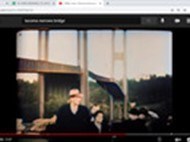
The following picture shows another of Joe’s uncles (Ray Sandegren, one of Captain Sandegren’s brothers) walking away from the bridge just before the collapse.
Joe also explained that Captain Sandegren had a baby daughter, Susan, who was born April 6, 1940. She was just 7 months old when her father died in the crash. But the circumstances of his death didn’t cause her to fear flying. She became a stewardess on international flights, and also became a licensed pilot and owned her own plane! Sadly, Susan passed away July 3, 2013.
Thank you, Joe, for sharing this family history with the Geocaching community! All of us here in Utah offer our much-delayed condolences to you and the Sandegren family.