The cache is placed alongside one of the trails in Bristoe
Station Battlefield Heritage Park. Please do not describe the cache
container or include images of it in log entries - Thank You.
There are three events that took place in the vicinity. The
first was an encampment by Confederate troops in late summer of
1861; fighting that took place in 1862 and the Battle of Bristoe
Station on October 13, 1863.
There is a County Historical Marker at the Park's Parking lot.
It states the following:
CONFEDERATE
CEMETERIES
During the late summer of 1861,
Confederate troops from Alabama, Mississippi, North Carolina,
Tennessee and Virginia camped in the vicinity of Bristoe Station.
Typhoid, measles and other contagious diseases quickly swept
through these camps decimating many of the regiments. The colonel
of the 6th North Carolina wrote that his regiment averaged about
one per day in deaths. Each regiment established its own separate
burial ground. Military homage was paid by comrades discharging a
musketry volley over the grave of the deceased at the interment and
this could be heard daily through the camping grounds of the entire
brigade. The following spring Union troops passing through the area
counted nearly 75 graves in the 10th Alabama cemetary and 128
graves in two enclosures for Mississippi soldiers. With the
exception of the 10th Alabama cemetary, more permanently marked
with stones after the war by veyerans of the unit, the remaining
1861 burials plus the graves of Southerners killed in fighting here
in August 1862 and October 1863 are mostly unmarked and defy
identtification.. |
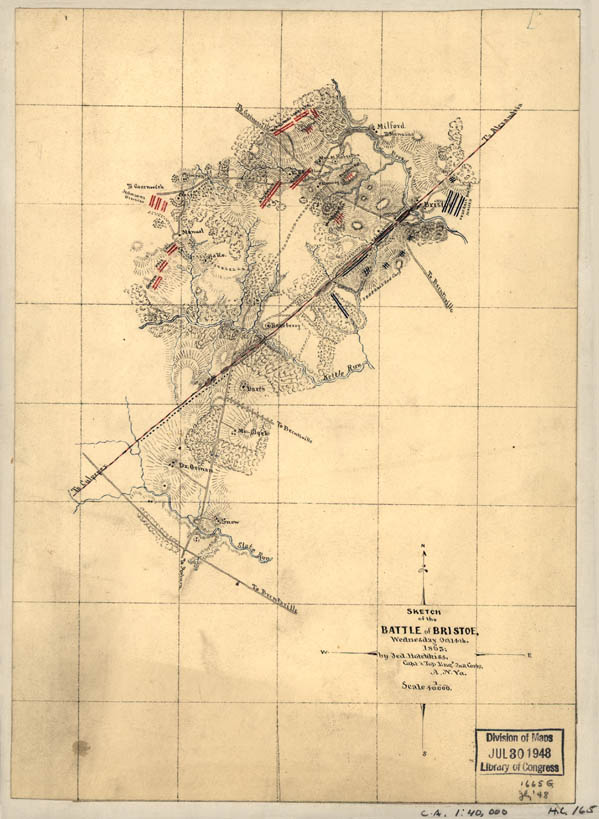
The Library of Congress has a sketched map of the battle from a
manuscript by Jedediah Hotchkiss. The larger free image is in JPEG
2000 format. Clicking on the image below will take you to the
download page.
So far I do not have any information regarding the fighting that
took place in this area in 1862.
Below is an excerpt from a National Park Service brochure that
describes the campaign and the Battle of Bristoe Station.
It was an "ill-judged attack," a "rash enterprise," as "gross
blunder." Such were the terms used by participants brigades dashed
to pieces against a well-protected Federal corps. It was the fall
of 1863. A few months earlier the Union and Confederate armies had
engaged in a three-way epic struggle at the town of Gettysburg,
Pennsylvania. Both armies had been badly battered in the battle;
neither would be in fighting trim for weeks to come. In the
interim, the armies rested and reorganized on the rolling hills
between Madison Court House and Culpeper, Virginia. General Robert
E. Lee took advantage of the lull in the fighting to dispatch
Lieutenant General James Longstreet's First Corps to reinforce
General Braxton Bragg in Tennessee. Meade countered by sending the
Army of the Potomac's Eleventh and Twelfth Corps to reinforce
Bragg's opponent, Major General William S. Rosecrans. In order to
prevent Meade from making any additional detachments, Lee decided
to resume the offensive in Virginia.
On October 9 Lee led his army across the Rapidan River and moved
toward Culpeper in an effort to turn Meade's right flank and impose
himself between the Union army and its supply base at Centreville.
Meade discerned his opponent's strategy in time, however, and
ordered a hasty retreat. Lee took up pursuit of Meade's army and
finally caught up with it on October 14 at Bristoe Station, a stop
on the Orange and Alexandria Railroad.
Lieutenant General A.P. Hill led the Confederate march. At 1:30
p.m. Hill encountered what he believed to be the tail of Meade's
army at Broad Run, about a mile north of Bristoe Station. He
decided to attack immediately with his leading division, commanded
by Brigadier General Henry Heth. As Heth advanced to attack the
Federals along Broad Run, another large body of Union troops
appeared on his right, moving parallel with the railroad. With
Hill's approval, Heth wheeled his division to the right to meet
this new and more dangerous foe.
The troops had suddenly appeared on Heth's flank belonged to
Brigadier General Alexander Webb's division of Major General
Gouverneur K. Warren's Second Corps. As soon as he became aware of
the Confederate presence, Webb threw his men into line of battle
behind the railroad embankment, his right flank anchored on Broad
Run, his left flank extending across the Brentsville Road. Shortly
after the battle began, two other Second Corps divisions, command
by Brigadier Generals Alexander Hays and John C. Caldwell, arrived
and took position behind the railroad to Webb's left. Artillery
batteries posted on the high ground south of the railroad
strengthened the center and right of the Union line.
Heth launched his attack shortly after 3 p.m. Two North Carolina
brigades, together numbering approximately 4,000 men, charged
headlong into Webb's line of waiting rifles. Despite heavy losses,
Heth's division seized a portion of the railroad on Webb's right,
near the run. Success was temporary. Union cannon posted on hills
behind the embankment blasted the Confederates who had made it past
the railroad and effectively sealed the breach in the line. Stunned
and demoralized by their defeat, Heth's men retreated back up the
shell-torn slope or simply threw down their arms in surrender.
While Heth's attack was in progress, Major general Richard H.
Anderson's division arrived on the field. Anderson ordered two
brigades into action west of the Brentsville Road, while at the
same time his artillery chief, Major David McIntosh, opened with
seven guns from a ridge just 500 yards from the Federal line. When
Heth's division fell back in retreat, McIntosh's guns were left
unsupported and were captured by Webb's men, who successfully
hauled five of hem safely back to their lines.
As the afternoon wore on, additional Confederate reinforcements
reached the field. At 4 p.m. Lee arrived with leading elements of
Lieutenant General Richard S. Ewell's Second Corps. As Ewell moved
into position opposite Warren's left, artillery on both sides
engaged in a stubborn, but indecisive duel. The last fighting of
the day occurred at dusk when Major General Robert E. Rodes'
Confederate division attacked Caldwell's division near the bridge
over Kettle Run.
After dark Warren crossed Broad Run and continued his eastward
march, leaving the Confederate army master of the field. For Lee it
had been a costly battle. His army had lost more than 1,300 men in
the short, furious fight without any corresponding strategic gain.
Federal losses, by contrast, numbered only 546. Responsibility for
the disaster lay squarely on the shoulders of A.P. Hill, who had
impetuously attacked the Federals without first pausing to
reconnoiter the ground. The following day, as Lee and Hill rode
together over the corps-strewn battlefield, Hill sought to explain
the previous day's misfortunes. Lee listened quietly, the sad
expression on his face clearly showing his disappointment. "Well,
well, General," he said, when the younger officer had finished,
"bury these poor men and let us say no more about it."
--------------------------------------------------------------------
Thanks go to Prince William County Historic Preservation for
permission to place the cache here and for their efforts to make
this heritage park available to the public.
Congratulations to BeauBackus on being FTF!
|
NOTICE: Please be respectful of the posted site hours - sunrise to
sunset. If you enter the site after hours you are trespassing. If
you are stopped you can be ticketed or arrested and will put the
future of geocaching at/on historical sites in
jeopardy. |