
Neil
Peart
(The Professor)
Neil Peart (born September 12,
1952) is a Canadian musician and author. He is best-known as the
drummer and lyricist for the rock band Rush.
Peart grew up in Port Dalhousie, Ontario, Canada (now part of St.
Catharines) working the occasional odd job. However, his true
ambition was to become a professional musician. During adolescence,
he floated from regional band to regional band and dropped out of
high school to pursue a career as a full-time drummer. After a
discouraging stint in England to concentrate on his music, Peart
returned home, where he joined a local Toronto band, Rush, in the
summer of 1974.
Early in his career, Peart's performance style was deeply rooted in
hard rock. He drew most of his inspiration from drummers such as
Keith Moon and John Bonham, players who were at the forefront of
the British hard rock scene. As time progressed, however, he began
to emulate jazz and big band musicians Gene Krupa and Buddy Rich.
In 1994, Peart became a friend and pupil of jazz instructor Freddie
Gruber. It was during this time that Peart decided to revamp and
reinvent his playing style by incorporating jazz and swing
components. Gruber was also responsible for introducing him to the
products of Drum Workshop, the company whose products Peart
currently endorses.
Peart has received many awards for his musical performances and is
known for his technical proficiency and stamina.
In addition to being a musician, Peart is also a prolific
writer, having published several memoirs about his travels. Peart
is also Rush's primary lyricist. In writing lyrics for Rush, Peart
addresses universal themes and diverse subject matter including
science fiction, fantasy, and philosophy, as well as secular,
humanitarian and libertarian themes. In contrast, his books have
been focused on his personal experiences.
Peart currently resides in Santa Monica, California with his wife,
photographer Carrie Nuttall, but also has a home in the Laurentian
Mountains of Quebec and spends time in Toronto for recording
purposes. He and his wife are expecting a child sometime in
September.
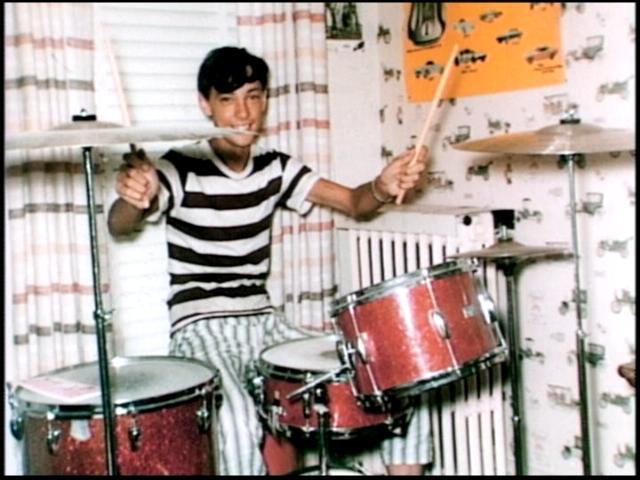
Early
Life
Peart was born on his
family's farm in Hagersville, on the outskirts of Hamilton. The
first child of four, his brother Danny and sisters Judy and Nancy
were born after the family moved to St. Catharines when Peart was
two. At this time his father became parts manager for Dalziel
Equipment, a farm machinery supplier. In 1956 the family moved to
the Port Dalhousie area of the town. Peart attended Gracefield
School, and describes his childhood as happy and says he
experienced a warm family life. By early adolescence he became
interested in music and acquired a transistor radio, which he would
use to tune into pop music stations broadcasting from Toronto,
Hamilton, Welland and Buffalo.
His first exposure to musical training came in the form of piano
lessons, which he later said in his instructional video A Work in
Progress did not have much impact on him. He had a penchant for
drumming on various objects around the house with a pair of
chopsticks, so for his 13th birthday, his parents bought him a pair
of drum sticks, a practice pad and some lessons, with the promise
that if he stuck with it for a year, they would buy him a
kit.
His parents bought him a drum kit for his 14th birthday and he
began taking lessons from Don George at the Peninsula Conservatory
of Music. His stage debut took place that year at the school's
Christmas pageant in St. Johns Anglican Church Hall in Port
Dalhousie. His next appearance was at Lakeport High School with his
first group, The Eternal Triangle. This performance contained an
original number entitled "LSD Forever". At this show he performed
his first solo.
Peart got a job in Lakeside Park, a fairground on the shores of
Lake Ontario, which later inspired a song of the same name on the
Rush album Caress of Steel. He worked on the Bubble Game and Ball
Toss, but his tendency to take it easy when business was slack
resulted in his termination. By his late teens, Peart had played in
local bands such as Mumblin’ Sumpthin’, the Majority, and JR Flood.
These bands practiced in basement recreation rooms and garages and
played church halls, high schools and roller rinks in towns across
Southern Ontario such as Mitchell, Seaforth, and Elmira. They also
played in the northern Ontario city of Timmins. Tuesday nights were
filled with jam sessions at the Niagara Theatre Centre.
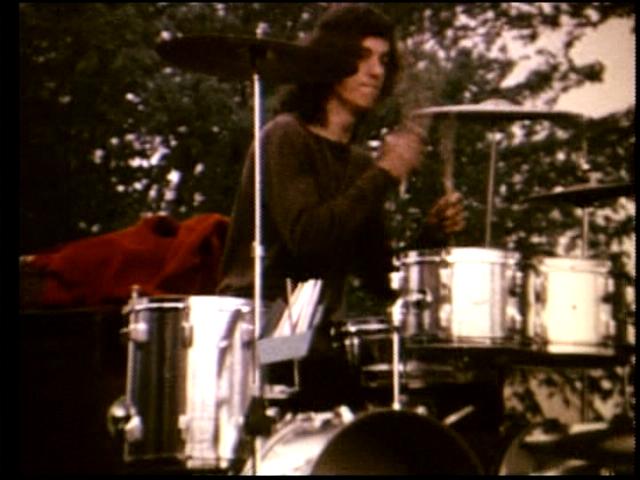
Career before joining
Rush
At
eighteen years of age, after struggling to achieve success as a
drummer in Canada, Peart traveled to London hoping to further his
career as a professional musician. Despite playing in several bands
and picking up occasional session work, he was forced to support
himself by selling trinkets to tourists in a souvenir shop called
The Great Frog on Carnaby Street.
While in London he came across the writings of novelist and
objectivist Ayn Rand. Rand's writings became a significant
philosophical influence on Peart, as he found many of her treatises
to individualism and Objectivism inspiring. References to Rand's
philosophy can be found in his lyrics, most notably "Anthem" from
1975's Fly By Night album, "Freewill" from 1980's Permanent Waves,
and "2112" from 1976's 2112.
After eighteen months of dead-end musical gigs, and disillusioned
by his lack of progress in the music business, Peart placed his
aspiration of becoming a professional musician on hold and returned
to Canada. Upon returning to St. Catharines, he worked for his
father selling tractor parts at Dalziel Equipment.

Joining Rush
After returning to
Canada, Peart was recruited to play drums for the St. Catharines
band Hush, who played on the South Ontario bar circuit. Soon after,
a mutual acquaintance convinced Peart to audition for the
Toronto-based band Rush, which needed a replacement for its
original drummer John Rutsey. Geddy Lee and Alex Lifeson oversaw
the audition. His future band mates describe his arrival that day
as somewhat humorous, as he arrived in shorts, driving a battered
old car with his drums stored in trashcans. Peart felt the entire
audition was a complete disaster. While Lee and Peart hit it off on
a personal level (both sharing similar tastes in books and music),
Lifeson had a less than favorable impression of Peart. After some
discussion, Lee convinced Lifeson that Peart's maniacal British
style of drumming, reminiscent of The Who's Keith Moon, was what
the band needed.
Peart officially joined the band on July 29, 1974, two weeks before
the group's first US tour. Peart procured a silver Slingerland kit
which he played at his first gig with the band, opening for Uriah
Heep and Manfred Mann in front of over 11,000 people
at the Civic Arena, Pittsburgh, Pennsylvania on August 14,
1974.

Early career with Rush
Peart
soon settled into his new position, also becoming the band's
primary lyricist. Before joining Rush, he had written few songs,
but, with the other members largely uninterested in writing lyrics,
Peart's previously underutilized writing became as noticed as his
musicianship. The band was still finding its feet as a recording
act, and Peart, along with the rest of the band, now had to learn
to live from a suitcase.
His first recording with the band, 1975's Fly by Night, was fairly
successful, winning the Juno Award for most promising new act, but,
the follow up, Caress of Steel, for which the band had high hopes,
was greeted with hostility by both fans and critics. In response to
this negative reception, most of which was aimed at the B side
spanning epic "The Fountain of Lamneth", Peart responded by penning
"2112" on their next album of the same name in 1976. The album,
despite record company indifference, became their breakthrough and
gained a following in the United States. The supporting tour
culminated in a three night stand at Massey Hall in Toronto, a
venue Peart had dreamed of playing in his days on the Southern
Ontario bar circuit and where he was now introduced as "The
Professor on the drum kit" by Lee.
Peart returned to England for Rush's Northern European Tour and the
band stayed in the United Kingdom to record the next album, 1977's
A Farewell to Kings in Rockfield Studios in Wales. They returned to
Rockfield to record the follow up, Hemispheres, in 1978, which they
wrote entirely in the studio. The recording of five studio albums
in four years, coupled with as many as 300 gigs a year, convinced
the band to take a different approach thereafter. Peart has
described his time in the band up to this point as "a dark
tunnel."
From this point on, Peart's career was near exclusively with
Rush:

Play style reinvention
In
1992, Peart was invited by Buddy Rich's daughter, Cathy Rich, to
play at the Buddy Rich Memorial Scholarship Concert in New York
City. Though initially intimidated by the request, Peart accepted
the offer and performed for the first time with the Buddy Rich Big
Band. Feeling that his performance left much to be desired, Peart
decided to produce and play on two Buddy Rich tribute albums titled
Burning for Buddy: A Tribute to the Music of Buddy Rich in 1994 and
1997 in order to regain his aplomb.
Peart wrote on his personal website that "And yet...I still had a
nagging feeling that when I played in that style, I was just
imitating it, not really feeling it properly. As the old Duke
Ellington standard goes, 'It don’t mean a thing, if it ain’t got
that swing', and I didn’t think I did."
In early 2007, Peart and Cathy Rich again began discussing
yet another Buddy tribute concert. In response, Peart decided to
once again augment his swing style with formal drum lessons, this
time under the tutelage of another pupil of Freddie Gruber, Peter
Erskine, himself an instructor of drummer Steve Gadd. On October
18, 2008, Peart once again performed at the Buddy Rich Memorial
Concert at New York's Hammerstein Ballroom.
Family Tragedy & Continuing
On
Soon
after the culmination of Rush's Test For Echo Tour on July 4, 1997,
Peart's daughter and only child, 19-year-old Selena Taylor, was
killed in a single-car accident on Highway 401 near the town of
Brighton, Ontario on August 10. His common-law wife of 22 years,
Jacqueline Taylor, succumbed to cancer only 10 months later on June
20, 1998. Peart, however, maintains that her death was the result
of a "broken heart" and called it "a slow suicide by apathy. She
just didn't care."
In his book Ghost Rider: Travels on the Healing Road, Peart
writes of how he had told his bandmates at Selena's funeral,
"consider me retired." Peart took a hiatus to mourn and reflect,
during which time he traveled extensively throughout North America
on his BMW motorcycle, covering 88,000 km (55,000 miles).
After his journey ended, Peart decided to return to the band. Peart
wrote Ghost Rider: Travels on the Healing Road as a chronicle of
his geographical and emotional journey.
While Peart was visiting long-time Rush photographer Andrew
MacNaughtan in Los Angeles, MacNaughtan introduced Peart to his
future wife, photographer Carrie Nuttall. They married on September
9, 2000. In the June 2009 edition of Peart's News, Weather, and
Sports, entitled "Under the Marine Layer", he announced that he and
Nuttall are expecting their first child.
In early 2001, Peart announced to his bandmates that he was ready
to return to recording and performing. The product of the band's
return was the 2002 album Vapor Trails. At the start of the ensuing
tour in support of the album, it was decided amongst the band
members that Peart would not take part in the daily grind of press
interviews and "Meet and Greet" sessions upon their arrival in a
new city that typically monopolize a touring band's daily schedule.
While Peart has always shied away from these types of in-person
encounters, it was decided that having to needlessly expose him to
an endless stream of questions about the tragic events of his life
was quite unnecessary. Since the release of Vapor Trails and
reuniting with his fellow band mates, Peart has returned to work as
a full-time musician. Rush has since released a cover EP, Feedback
in June 2004 and their 18th studio album Snakes & Arrows in May
2007, which were supported by three additional tours in 2004, 2007,
and 2008.
Now the
puzzle:
You will have to do a
little research to find the answers for these questions. All your
answers can be found on the internet.
A. Neil produce a couple Buddy Rich tribute albums,
on Vol. 1 the song "Milestones" occupies what track?
B. Neils ranking of best drummers on
Total-Drums.com
C. Neil won Modern Drummer Magazines "Best All
Around Drummer" in 198_?
D. What month was Neil born?
E. How many times did Mr. Peart win "Best
Multi-Percussionist" in Modern Drummer Magazines readers poll?
F. Neil was made an officer of the Order Of Canada
during what month in 1996_?
G. How many letters are in Neil's middle name?
H. Neil was inducted into Modern Drummer Magazine's
Hall of Fame in 198_?
I. Won Modern Drummer Magazine's Best Percussion
Instrumentalist in 198_?
North E-I-H-I-G-C-B
West A-I-F-D-C-G-D
Good Luck
&
Rock On!!!!