
Geddy
Lee
Geddy Lee (born Gary Lee Weinrib; July 29,
1953) is a Canadian musician best known as the lead vocalist,
bassist, and keyboardist for the Canadian rock group Rush. Lee
joined Rush in September 1968 at the request of his childhood
friend, Alex Lifeson in order to replace frontman Jeff Jones.
An award-winning musician, Lee's style, technique, and skill on the
bass guitar have proven very influential in the rock and heavy
metal genres, inspiring such players as Steve Harris of Iron
Maiden, John Myung of Dream Theater, Les Claypool of Primus, and
Cliff Burton of Metallica.
In addition to his composing, arranging, and performing duties for
Rush, Lee has produced albums for various other bands, including
Rocket Science. Lee's first solo effort, My Favourite Headache, was
released in 2000.
Along with his Rush bandmates—Lifeson and drummer Neil Peart—Lee
was made an Officer of the Order of Canada on May 9, 1996. The trio
was the first rock band to be so honored, as a group.
On May 1, 2007, Rush released Snakes & Arrows, their eighteenth
full-length studio album. Lee and the rest of the band recently
toured in support of Snakes & Arrows across North America,
which began in Atlanta, GA on June 13, 2007 and ended its second
leg on July 24, 2008.

Early life
Geddy Lee was born Gary Lee Weinrib on July 29, 1953 in Willowdale,
Toronto. Lee's stage name, Geddy, was inspired by his mother's
heavily-accented pronunciation of his given first name, Gary, and
it later became his highschool nickname before he adopted it as his
stage name. Lee's parents were Jewish refugees from Poland
who had been survivors of Nazi concentration camps Dachau and
Bergen-Belsen during World War II. In 2004, Canadian Jewish News
featured Lee's reflections on his mother's experiences as a
refugee, and of his own Jewish heritage.
Lee married Nancy Young in 1976. They have a son named Julian and a
daughter named Kyla Avril. Lee attended primary school with the
well-known comedian Rick Moranis, of SCTV fame.
Body of
work
The bulk of Lee's work in music has been with Rush (see Rush
discography). However, Lee has also contributed to a body of work
outside of his involvement with the band through guest appearances
and album production. In 1981, Lee was the featured guest for the
hit song "Take Off" and its included comedic commentary with Bob
and Doug McKenzie (played by Rick Moranis and Dave Thomas,
respectively) for the McKenzie Brothers' comedy album Great White
North. The following year, Lee produced the debut (and only) album
from Toronto new wave band Boys Brigade. On the 1985 album We Are
the World, by humanitarian consortium USA for Africa, Lee recorded
guest vocals for the song "Tears Are Not Enough". Apart from band
contributions, Lee sang the Canadian National Anthem in front of a
full crowd at Camden Yards for the 1993 All-Star Game.
Another version of "O Canada" in rock format was recorded by Lee
and Lifeson on the accompanying soundtrack CD for the Trey Parker
and Matt Stone film South Park: Bigger, Longer, and Uncut released
in 1999.
My Favourite Headache, Lee's first solo album, was released in
November 2000 while Rush was on a hiatus due to tragedies in
drummer Neil Peart's life. Lee appeared in Broken Social Scene's
music video for their 2006 single "Fire Eye'd Boy", judging the
band while they perform various musical tasks, and in 2006, Lee
joined Lifeson's supergroup the Big Dirty Band, to provide songs
accompanying Trailer Park Boys: The Movie.

Vocal style
Lee's voice has been referred to as a high tenor. During Rush's
early period, Lee's voice was described as a "Robert Plant-esque
wail." By the recording of the Permanent Waves album in 1979, Lee
gradually changed his vocal style to a more restrained sound. Lee
as of late, still has much of his range left, though the song
"2112" ("Overture" and "The Temples of Syrinx") is played one whole
step (two semitones) lower.
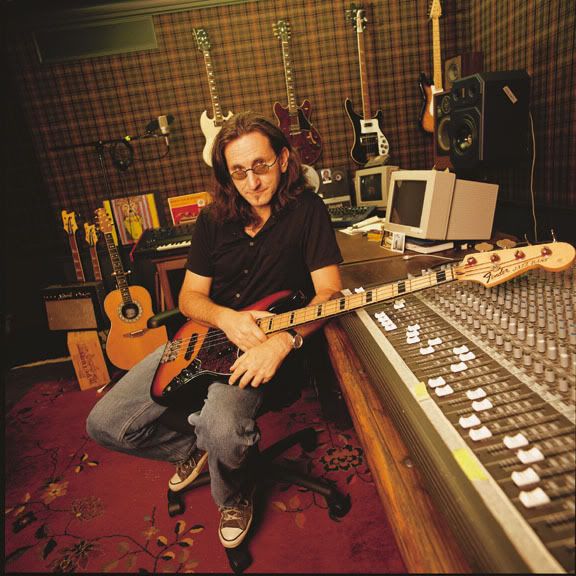
Equipment used
Lee has varied his equipment list continually throughout his
career.

Bass guitars
For his first local gigs in the early 1970s and Rush's debut album,
Lee used a Fender Precision Bass. From Fly By Night onward, Lee
favored Rickenbacker basses, particularly the 4001 model, and a
Fender Jazz Bass which is heard on Permanent Waves, Moving Pictures
and Signals and supporting tours. In 1981, Lee began using the
compact, headless Steinberger bass, which he used occasionally on
the supporting tour for Signals and for many tracks on their
follow-up, Grace Under Pressure and Power Windows. From 1985 to
1992, Lee used British Wal basses. He switched back to Fender Jazz
Basses for the recording of Counterparts in 1993, and has been
using them virtually exclusively since, heard on albums Test For
Echo, Vapor Trails, Feedback and Snakes & Arrows. However, he
used a Fender Jaco Pastorius Tribute fretless replica bass for the
song "Malignant Narcissism" on Snakes & Arrows, and a Fender
Custom Shop Jazz with an Alder Body and a Flamed Maple top in
Transparent Red for songs in an alternate tuning during the last
several tours. In 1998, Fender released the Geddy Lee Jazz Bass,
available in Black and 3-Colour Sunburst (as of 2009). This
signature model is a recreation of Lee's favorite bass, a 1973
Fender Jazz that he bought in a pawn shop in Kalamazoo, Michigan.
On all of his basses, Lee uses Rotosound Swing Bass 66 Stainless
Steel round-wound strings. Lee once again used his Rickenbacker
4001 for the performance of "A Passage To Bangkok" on the 2007 and
2008 Snakes & Arrows Tour.

Bass guitar amplification
Lee's amps in the early days were arena-ready Sunn and/or Ampeg
models. By the late seventies, his backline had evolved into a
configuration of Ashly preamps and BGW power amps, which were run
in stereo with his 4001 bass. The neck pickup was sent to one amp
and set for a clean, bass-heavy tone, while the bridge pickup was
sent to the other amp which was set with an exaggerated treble
boost, and extra gain in the preamp. This defined Lee's bass sound
from 1977 to 1982. Though he would change basses, the amplifier
setup remained constant through 1991. For the Roll the Bones tour
(1991–1992), Lee switched to Gallien-Krueger amps, and later to
Trace Elliots.
Beginning in 2002, Lee dispensed with using a single bass guitar
amplifier in favor of a chain of amplifiers and DI units, which
allow the bass guitar to be connected directly to the stage and
front-of-house mixers without involving microphones. Lee began
using in-ear monitors at this point.
At the beginning of the 2002 Vapor trails tour, Lee revised his
previous setup. His bass signal is sent via a Samson wireless unit
to an Avalon U5 DI. From there it is split between a Trace Elliot
Quadravalve all-tube power amplifier and a SansAmp RBI
rackmountable preamp. The speaker-level signal from the Quadravalve
is sent to a Palmer PD-05 speaker emulator, which provides adequate
load for the tube amplifier and attenuates the signal down to line
level. The signals from the U5, Quadravalve/PD-05, and RBI are all
sent to the monitor and front-of-house mixers and blends of the
signals are changed on a song-by-song basis. Typically the
Quadravalve/PD-05 signal makes up the low end while a balance of
the U5 and RBI make up the high end, with the RBI providing the
"top end" distortion in Lee's sound.
For the 2007 Snakes and Arrows tour, Lee swapped the SansAmp RBI
for a new unit by Sansamp, the RPM. During preparation for this
tour a feature on bassplayer.tv with his live bass tech, Russ Ryan,
was filmed which detailed Lee's live signal path.
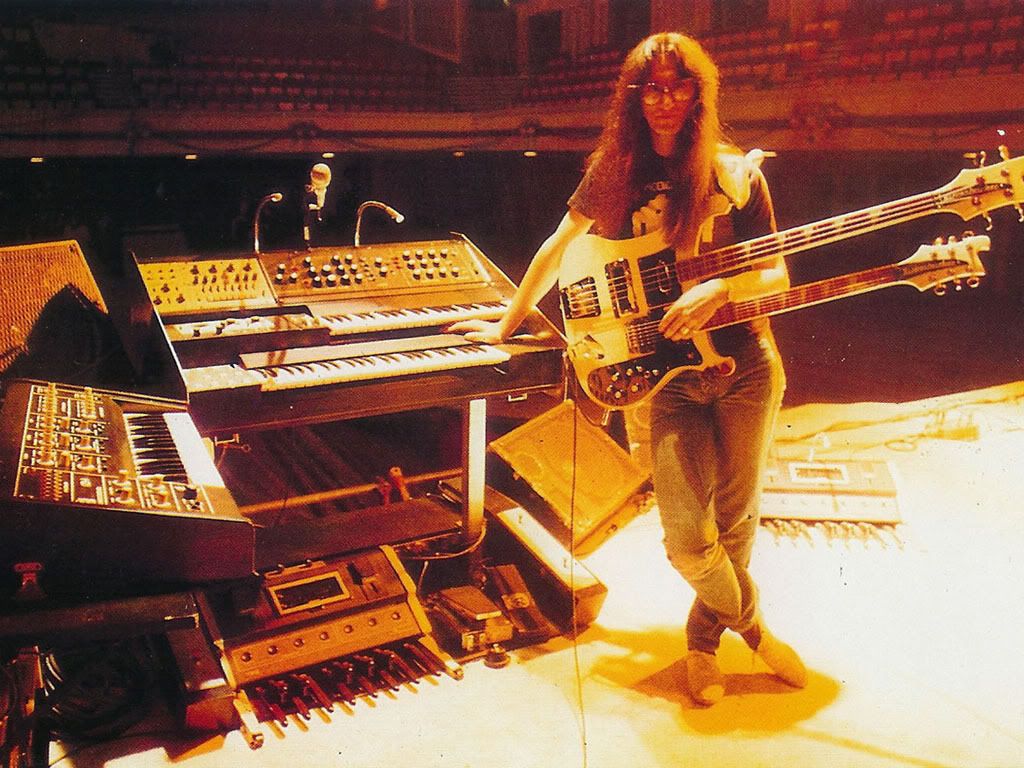
Keyboards and synthesizers
Over the years, Lee's keyboards have featured synthesizers from
Oberheim (Eight-voice, OB-1, OB-X, OB-Xa), PPG (Wave 2.2 and 2.3),
Roland (Jupiter 8, D-50, XV-5080, and most recently a Fantom X7 on
the Snakes and Arrows tour), Moog (Minimoog, Taurus bass pedals,
Moog Little Phatty), and Yamaha (DX7, Yamaha KX76). Lee used
sequencers early in their development and has continued to use
similar innovations as they have developed over the years. Lee has
also made use of digital samplers. Combined, these electronic
devices have supplied many memorable keyboard sounds, such as the
"growl" in "Tom Sawyer" and the melody featured in the chorus of
"The Spirit of Radio".
With 1993's Counterparts, Rush reduced most keyboard- and
synthesizer-derived sounds in their compositions, and they
continued to do so with each successive album. In 2002, the band
produced an album—Vapor Trails—that was completely free of
keyboards and synthesizers, featuring only voice, guitar, bass
guitar, drums and percussion. With the release of 2007's Snakes
& Arrows, Lee sparingly adds a Mellotron to the instrument
line-up. However, it does not mark a return to a "synth" sound for
the band. Much like Vapor Trails, the music is primarily recorded
with multiple layers of guitars, bass, drums and percussion.
Live performances: special
equipment

Recreating unique sounds
Newer advances in synthesizer and sampler technology have allowed
Lee to store familiar sounds from his old synthesizers alongside
new ones in combination synthesizer/samplers, such as the Roland
XV-5080. For live shows in 2002 and 2004, Lee and his keyboard
technician used the playback capabilities of the XV-5080 to
generate virtually all of Rush's keyboard sounds to date, as well
as additional complex sound passages that previously required
several machines at once to produce.
When playing live, Lee and his bandmates recreate their songs as
accurately as possible with digital samplers. Using these samplers,
the band members are able to recreate, in real-time, the sounds of
non-traditional instruments, accompaniments, vocal harmonies, and
other sound "events" that are familiar to those who have heard Rush
songs from their albums.
To trigger these sounds in real-time, Lee uses MIDI controllers,
placed at the locations on the stage where he has a microphone
stand. Lee uses two types of MIDI controllers: one type resembles a
traditional synthesizer keyboard on a stand (Yamaha KX76). The
second type is a large foot-pedal keyboard, placed on the stage
floor (Korg MPK-130, Roland PK-5). Combined, they enable Lee to use
his free hands and feet to trigger sounds in electronic equipment
that has been placed off-stage. It is with this technology
that Lee and his bandmates are able to present their arrangements
in a live setting with the level of complexity and fidelity that
fans have come to expect, and without the need to resort to the use
of backing tracks or employing an additional band member.
Lee's (and his bandmates') use of MIDI controllers to trigger
sampled instruments and audio events is visible throughout the R30:
30th Anniversary World Tour concert DVD (2005).
In the Snakes and Arrows tour, Lee used a Roland Fantom X7 and a
Moog Little Phatty synthesizer.

Unique stage equipment
As of 1996, Lee no longer uses traditional bass amplifiers on
stage, as he prefers to go direct into the venue's FOH console
which helps the sound reinforcement during their concerts. Faced
with the dilemma of what to do with the empty space left behind by
the lack of large amplifier cabinets, Lee chose to fill the space
in a unique way. For the 2002 Vapor Trails tour, Lee lined his side
of the stage with three coin-operated Maytag dryers. Other large
appliances would appear later in the same space. (Lee had earlier
decorated his side of the stage with unusual items. For the
1996-1997 Test for Echo tour, Lee's side sported a fully-stocked
old-fashioned household refrigerator.)
For every concert that featured the dryers, Rush's crew would load
them with specially-designed Rush-themed T-shirts, different from
the shirts on sale to the general public. At the close of each
show, Lee and Lifeson would then toss these special T-shirts into
the arms of lucky audience members.
For the band's R30 tour, one dryer was replaced with a rotating
shelf-style vending machine. It too was fully stocked and
operational during shows.
When asked about the purpose of the dryers in interviews, Lee was
purposefully vague. The irony and non sequitur of placing such
unusual items on a concert stage were Lee's way of expressing his
sense of humor. He fed the mystery by responding to one interview
question about the dryers, saying he chose to use them for their
"warm, dry tone". The dryers can be seen on the Rush in Rio DVD and
the R30 DVD. The vending machine can be seen on the R30 DVD.
To add to the humorous effect, Lee's dryers were, purely for visual
effect "miked" by the sound crew, just as a real amplifier would
be.
In interviews dated May 2007, Lee has stated that he is considering
entirely new non-musical equipment to further his established comic
effect for Rush's Snakes & Arrows tour. The tour commenced June
13, 2007, with a show at the Hi-Fi Buys Amphitheatre in Atlanta,
Georgia. The show prominently featured 3 Henhouse brand rotisserie
chicken ovens on stage complete with an attendant in a chef's hat
and apron to "tend" the chickens during the show. Such unorthodox
stage equipment has been continuously seen thereafter.

Baseball fan
On June 5, 2008, Lee donated his entire collection of nearly 200
autographed Negro League baseballs to the Negro Leagues Baseball
Museum in Kansas City, Missouri. Bob Kendrick, a director at the
museum stated "Some of these guys have been dead for some time, and
we could not get these (signatures) before no matter what their
significance was in the Negro Leagues". At the time, Lee's gift was
one of the largest single donations the NLBM had ever received.

And now the puzzle:
A - On June ?, 2008, Lee donated his entire
collection of nearly 200 autographed Negro League baseballs to the
Negro Leagues Baseball Museum in Kansas City, Missouri.
B - Rush inducted into the Juno Hall of Fame
199?
C - In 198?, Lee was the featured guest for the hit
song "Take Off" and its included comedic commentary with Bob and
Doug McKenzie (played by Rick Moranis and Dave Thomas,
respectively) for the McKenzie Brothers' comedy album Great White
North.
D - For the 200? Vapor Trails tour, Lee lined his
side of the stage with three coin-operated Maytag dryers
E - Guitar Player Magazine "Best Rock Bass" winner
how many times?
F - Reciever "Officer of the Order of Canada" in
19?6
G - Lee joined Rush in September 196?
North
B-D-D-F-C-E-B
West
G-D-A-G-E-D-B