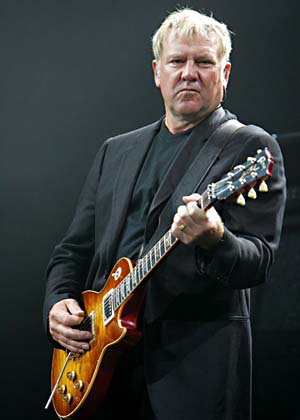
Alex
Lifeson
Alex Lifeson (born Aleksandar Živojinovi?;
August 27, 1953) is a Canadian musician, best known for his work as
the guitarist of the Canadian rock band Rush. Lifeson founded Rush
in the summer of 1968, and has been an integral member of the
three-piece band ever since.
For Rush, Lifeson plays electric and acoustic guitars as well as
other stringed instruments such as mandola, mandolin and bouzouki.
He also performs backing vocals in live performances, and
occasionally plays keyboards and bass pedal synthesizers. During
live performances, Lifeson, like the other members of Rush,
performs real-time triggering of sampled instruments, concurrently
with his guitar playing. The bulk of Lifeson's work in music has
been with Rush, although Lifeson has contributed to a body of work
outside of the band as well. Aside from music, Lifeson is part
owner of the Toronto restaurant The Orbit Room, and is a licensed
aircraft pilot, motorcycle rider, and gourmet cook.
Along with his bandmates Geddy Lee and Neil Peart, Lifeson was made
an Officer of the Order of Canada on May 9, 1996. The trio was the
first rock band to be so honored, as a group. On May 1, 2007, Rush
released Snakes & Arrows, their eighteenth full-length studio
album. Lifeson and the band followed up the album with the Snakes
& Arrows Tour.

Early life
Lifeson was born in Fernie, British Columbia to Serbian
immigrants, Nenad and Milka Zivojinovich and raised in Toronto,
Ontario. His assumed stage name of "Lifeson" is a semi-literal
translation of the name "Zivojinovich", which means "son of life"
in Serbian. His first exposure to formal music training came in the
form of the viola which he renounced for the guitar at the age of
12. His first guitar was a Christmas gift from his father, a
six-string Kent classical acoustic which was later upgraded to an
electric Japanese model. During adolescence, Lifeson was primarily
influenced by Eric Clapton, Jeff Beck, Jimi Hendrix, Jimmy Page,
and Pete Townshend. In 1963 Lifeson met future Rush drummer John
Rutsey in school. Both interested in music, they decided to form a
band. Lifeson was primarily a self-taught guitarist with the only
formal instruction coming from a high school friend in 1971 who
taught classical guitar lessons. This training lasted for roughly a
year and a half.
Lifeson recalls what inspired him to play guitar in a 2008
interview:
“My brother-in-law played flamenco guitar. He lent his
guitar to me and I grew to like it. When you're a kid, you don't
want to play an accordion because it would be too boring. But your
parents might want you to play one, especially if you're from a
Yugoslavian family like me.”
Lifeson's first girlfriend, Charlene, gave birth to their eldest
son, Justin, in October 1970, and they married in 1975. As of
September 2008, they are still married, and have a 2nd son, Adrian,
who is also involved in music and performed on two tracks from
Lifeson's 1996 solo project, Victor.

Body of work
While the bulk of Lifeson's work in music has been with Rush (See
Rush Discography), he has also contributed to a body of work
outside of his involvement with the band in the form of movie/tv
appearances, as well as instrumental contributions for other
musical outfits. Lifeson's first major outside work was his solo
project, Victor released in 1996. Victor (the album) was attributed
as a self-titled work (i.e. Victor is attributed as the artist as
well as the album title). This was done deliberately as an
alternative to issuing the album explicitly under Lifeson's
name.
Lifeson made a guest appearance on the Platinum Blonde album Alien
Shores (1985) performing guitar solos on the songs "Crying Over
You" and "Holy Water". Later, in 1990, he appeared on Lawrence
Gowan's album, Lost Brotherhood to play guitar. In 2006, Lifeson
founded The Big Dirty Band, which he created for the purpose of
providing original soundtrack material for Trailer Park Boys: The
Movie. Lifeson jammed regularly with The Dexters (The Orbit Room
house band from 1994-2004). Recently, Lifeson made a guest
appearance on the 2007 album Fear of a Blank Planet by UK
progressive rock band, Porcupine Tree, as well as the 2008 album
Fly Paper by Detroit progressive rockers, Tiles. He plays on the
track "Sacred and Mundane". Outside of band related endeavors,
Lifeson composed the theme for the first season of the
science-fiction TV series Andromeda. He also produced 3 songs from
the album Away from the Sun by 3 Doors Down.

Guitar equipment
In Rush's early career, Lifeson used a Gibson ES-335 for the first
single and the first four Rush studio albums. For the 2112 tour, he
used a 1974 Gibson Les Paul and Marshall amplification. For the A
Farewell to Kings sessions, Lifeson began using a Gibson EDS-1275
for songs like Xanadu and his main guitar became a cream-colored
Gibson ES-355. During this period Lifeson used Hiwatt amplifiers.
For effects Lifeson used various phaser and flanger pedals, a Cry
Baby Wah Wah, along with Marshall 100 watt Super Lead amplifiers
and 4x12 cabinets. Beginning in the late 1970s, he increasingly
incorporated twelve-string guitar (acoustic and electric) and used
a Boss CE-1 Chorus Ensemble and later, the Boss Dimension C. By
1982 Lifeson's primary guitar was a modified Fender Stratocaster
with a Bill Lawrence high-output humbucker L-500 in the bridge
position and a Floyd Rose vibrato bridge. Lifeson increasingly
relied on a selection of four identically modified Stratocasters
from 1980 to 1986, all of them equipped with the Floyd Rose bridge.
For the Moving Pictures and Signals albums, and on concurrent
tours, Lifeson used up to four rare Marshall 4140 Club &
Country 100W combo amps. In the mid 1980s Lifeson switched from
passive to active pickups in his guitars, and from vacuum tube to
solid-state amplification, all with an increasingly thick layer of
digital signal processing. He became an endorser of Gallien-Krueger
and Dean Markley solid-state guitar amplifier lines and Dean
Markley Blue Steel strings respectively, gauges .009-.046. In the
late 1980s he switched to Carvin amplifiers in the studio and his
short-lived Signature Guitar Co brand guitars onstage and in the
studio. Alex also was using custom Lado guitars built in Toronto
Canada.
Lifeson primarily used PRS guitars during the recording of Roll The
Bones in 1990/1991. When recording 1993's Counterparts, Lifeson
continued to use PRS Guitars and Marshall amplifiers to record the
album, and for the subsequent tour. Lifeson continued to use PRS
along with Fender and Gibson guitars, Hughes & Kettner Triamp
MK II and zenTera amplifiers and cabinets. In 2005, Hughes &
Kettner introduced an Alex Lifeson signature series amplifier with
$50 from each amplifier sold will be donated to UNICEF.
For the 2007 Snakes & Arrows Tour, Lifeson replaced his PRS
Guitars with Gibson Les Pauls. In a 2007 interview for Guitarist
magazine, Lifeson states "I hear PRS on everything these days and I
wanted a little bit of a change ... I love them [PRS] but they have
a smaller sound than the bigger heavier Gibsons ... I just wanted
to be more traditional. He has Fishman Aura piezoelectric
pickup systems installed into his Les Pauls to model acoustic
guitar sounds without changing guitars. As of July 2008, Lifeson
uses Floyd Rose tremolos on his main Les Pauls. He has also
replaced his Hughes & Kettner zenTera amp heads with
Switchblade heads (which, like the zenTeras, include built-in
programmable digital effects, such as chorus and delay, but are
valve-powered instead of transistor-powered), while retaining his
signature series H&K Triamp heads. His effects for the 2007
tour include a TC Electronics G-Force rack multi-FX, a TC
Electronics 1210 spatial expander and a Loft 440 Delay
Line/Flanger, as well as the effects built into his Switchblade
heads.

Other instruments played
In addition to traditional stringed instruments such as acoustic
and electric guitars, Lifeson has also played mandola, mandolin and
bouzouki on recent Rush studio albums, including Test For Echo,
Vapor Trails and Snakes & Arrows. During live Rush
performances, Lifeson uses a MIDI controller that enables him to
use his feet to trigger sounds from digital samplers, without
taking his hands off his guitar. (Prior to this, Lifeson used Moog
Taurus Bass Pedals before they were obsolesced and replaced by Korg
MIDI pedals in the 1980s.) Lifeson and his bandmates share a desire
to accurately depict songs from their albums when playing live
performances. Toward this goal, beginning in the late 1980s the
band equipped their live performances with a capacious rack of
samplers. The band members use these samplers in real-time to
recreate the sounds of non-traditional instruments, accompaniments,
vocal harmonies, and other sound "events" that are familiarly heard
on the studio versions of the songs. In live performances, the band
members share duties throughout most songs, with each member
triggering certain sounds with his available limbs, while playing
his primary instrument(s). It is with this technology that Lifeson
and his bandmates are able to present their arrangements in a live
setting with the level of complexity and fidelity that fans have
come to expect, and without the need to resort to the use of
backing tracks or employing an additional band member.

Television and film
appearances
In a 2003 episode of the Canadian mockumentary Trailer Park Boys,
titled "Closer to the Heart", Lifeson plays a partly-fictional
version of himself. In the story, he is kidnapped by Ricky and held
as punishment for his inability (or refusal) to provide the main
characters with free tickets to a Rush concert. In the end of the
episode, Alex reconciles with the characters, and performs a duet
of Closer to the Heart with Bubbles at the trailer park.
In 2008, Lifeson and the rest of Rush was invited to play the full
version of their song "Tom Sawyer" at the end of the TV show The
Colbert Report. According to Stephen Colbert, the host of the TV
show, this was their first appearance on American television, as a
band, in 33 years.
Lifeson appears in Trailer Park Boys: The Movie, as a traffic cop
in the opening scene. He made his film debut as himself under his
birth name in the 1972 Canadian documentary film Come on Children.
In 2009, he and the rest of the band appeared as themselves in the
comedy I Love You, Man.

And now the puzzle:
A - Born Aleksandar Živojinovi?; August ?7,
1953
B -
"Best Article" for "Different Strings" in Guitar Player which
month?
C -
"Best Rock Talent" by Guitar for the Practicing Musician in
198?
D - Most Ferociously
Brilliant Guitar Album (Snakes & Arrows) - Guitar Player
Magazine, May 200?
E
- "Best
Rock Guitarist" by Guitar Player Magazine in 198? and May
2008
F - Reciever "Officer of the Order of
Canada" in 199?
G -
Runner-up for "Best Rock Guitarist" in Guitar Player in 1982, 1983,
198?, 1986
North
E-A-C-A-E-C-D
West
D-A-G-B-F-D-E