Garden State Park opened in 1942 after delays caused by raw
material rationing at the United States' entry into World War II.
Due to the seizure of 30,000 tons of structural steel by war
authorities, developer Eugene Mori mostly constructed Garden State
Park's ornate Georgian-style grandstand of wood. Limited amounts of
steel came from the demolition of New York City's elevated
railways. Despite this inauspicious start, 'the Garden,' as it was
known, was officially 'out of the gate.'
In its heyday, it would host some of the finest thoroughbred
racehorses in the nation at the signature Jersey Derby. Its
Garden State Stakes for
two-year-olds offered one of the largest purses available to
juveniles. Legendary horses raced at Garden State Park included
Whirlaway, Citation, and the great Secretariat on a cold, rainy
Saturday afternoon in early 1972 in the Garden State Futurity.
Garden State Park's success sparked a wave of
entertainment-oriented growth and development in the formerly rural
community of Delaware Township, New Jersey (now Cherry Hill
Township). Mori followed his achievement at the racetrack with the
construction of the Cherry Hill Inn on the
site of Abraham Browning's Cherry Hill Farm (at
Route 38 and Haddonfield Road);
and in 1967 the Cherry Hill Lodge, also on Route 38 to the east of
the Cherry Hill Mall. Soon to
follow in 1961 was the Cherry Hill Shopping Center (today's
Cherry Hill Mall, the first
enclosed shopping mall on the East Coast) and the super-luxurious
Rickshaw Inn with its legendary gold-plated roof, which was
situated on Route 70 opposite
Garden State Park.
Diagonally across Route 70 on the map in then-Delaware Township
was the Latin Casino, adjacent to the Rickshaw and the Garden. This
dinner nightclub hosted legendary acts like Frank Sinatra, Dean
Martin, Liberace, Cherry Hill Estates neighbors Al Martino &
Frankie Avalon and more; before closing due to competition from
casinos in Atlantic City, New Jersey.
Followed later by Atlantic City Race Course and Monmouth Park
Racetrack (1946), Garden State Park became a crucial part of what
was called the "Golden Triangle" of New Jersey racing.
Fire
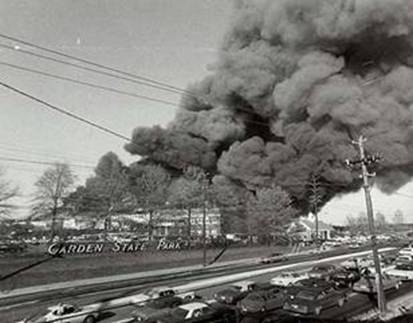
This triangle would lose a leg on
April 14, 1977, when a fire raged
undetected at Garden State Park in the Colonial Room restaurant's
kitchen during a racing program. Despite no functional firefighting
system, the wooden grandstand would last long enough to allow more
than 11,000 patrons and employees to escape the inferno. At 4:45
p.m., the walls and massive roof overhang of the grandstand gave
way to the flames and reduced the structure to a smoking ruin.
Despite the flying embers very nearly igniting The Rickshaw Inn
across the street and the wooden barns & stables on the
backstretch, the damage was contained to the massive grandstand
complex. Three lives were lost in the fire- one patron and one
employee were later found in the rubble- and one fire officer
(McWilliams) died of a heart attack on-scene. But, the very next
day, the vault with the previous days' "take" was opened, with the
money intact; while outside on the track, horses continued to
train.

Rebuilding
Despite the stables on the east side of the track remaining open
for training, Garden State Park no longer held races until
securities trader Robert Brennan
financed construction of a new $178,000,000 steel and glass
grandstand which opened on April 1, 1985. The first race that day
followed the schedule from the day the original track burned. The
track, running night programs, would provide racing for
standardbred harness racing as well as
thoroughbred racing. The
grandstand also had on the Clubhouse level The
Phoenix Room, which was a large banquet hall that hosted
events year-round.
On May 27, 1985,
Eclipse Award for Horse of the
Year winner Spend A Buck won the first Jersey Derby at the
new Garden State Park, having earlier the same year won the Cherry
Hill Mile and the Garden State Stakes, both at Garden State Park,
and also the Kentucky Derby. The $2.6 million purse, including a $2
million bonus put up by Brennan for winning the four races, was the
largest single purse in American racing history up to that
point.
One of the more infamous tax breaks the facility enjoyed was an
(all-but) exemption from the onerous county property taxes, because
it was categorized as a "farm:" It qualified for this special
exemption because it "produced over $500 per year in agricultural
products"... Horse manure!
Despite a welcomed return, Garden State Park never re-acquired
its glamorous past. Over 16 years, the track suffered from the
apathy of New Jersey horsemen and New Jersey state officials, and
unrestrained competition from the Atlantic City casinos. The final
straw came when Governor of New Jersey Christine Todd Whitman
vetoed legislation that would have permitted slot machines at New
Jersey racetracks, a measure that possibly could have saved the
Cherry Hill landmark.

Demolition
On May 3, 2001, 2,000 fans came to see the
last racing program at Garden State Park. After 58 years, the
Garden ran its last race.
On October 30, 2003, with the property
sold to Realen-Turnberry for a mixed-use 'town center'
redevelopment, demolition started on the grandstand often referred
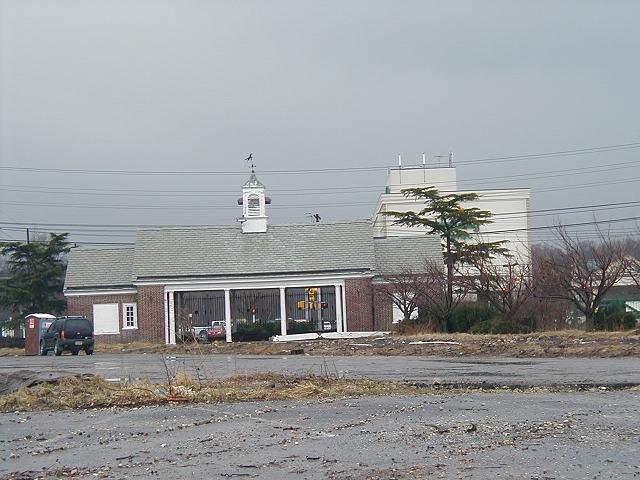
to as a masterpiece. By late March 2004, all that remained of the
racecourse was the original 1942 gatehouse on
Route 70. The gatehouse still
stands and is slated to be renovated as part of a planned off-track
betting facility at the site.
Congratulations!
FTF TulipGirls