Petits grans
molins
E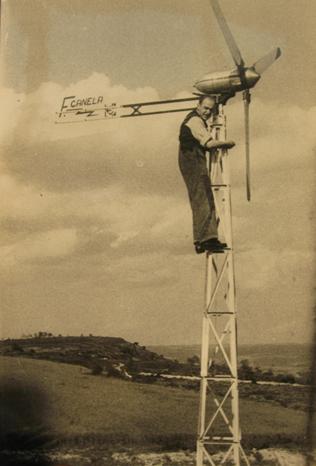 n
a
quest catxé podrem observar un abans i un després en
l’evolució de la tecnologia eòlica, doncs només fent un cop d’ull
al nostre voltant ens permetrà fer un petit viatge en el temps
d’aquets petits grans molins.
n
a
quest catxé podrem observar un abans i un després en
l’evolució de la tecnologia eòlica, doncs només fent un cop d’ull
al nostre voltant ens permetrà fer un petit viatge en el temps
d’aquets petits grans molins.
Una cosa que no us puc assegurar és qui va ser l’inventor
d’aquestes màquines de produir energia amb el moviment de l’aire.
El que sí que es pot assegurar és que Magí Canela i Joan Canela
foren un dels pioners amb els orígens de la seva evolució i
fabricació.
Magí Canela, un veí de Sant Guim de Freixenet, grandíssim mecànic i
inventor, un bon dia va pensar que podria aprofitar l’energia del
moviment de l’aire per oferir energia elèctrica a algunes masies i
llocs aïllats, on aquest recurs, era molt difícil fer arribar en
aquells temps.
Un dels seus primers molins, va consistir en adaptar tres aspes a
un alternador de cotxe, el qual anava endollat a una bateria
igualment de cotxe. Aquest sistema el posaven a dalt de petits
turons o sobre de les teulades, i permetia als seus propietaris
poder escoltar un aparell de ràdio o encendre una petita bombeta.
Una nota molt característica era que inicialment el molins
disposaven de dues aspes. Més endavant, la seva evolució va anar
augmentant, i els molins que fabricaven ja eren d’unes dimensions
superiors, i es col·locaven sobre unes estructures metàl·liques de
majors dimensions (semblants als que es poden observar al catxé),
els quan oferien una major quantitat d’energia elèctrica. Una de
les innovacions més destacades que va treballar en Magí fou la part
aerodinàmica de les aspes, doncs fins aleshores, eren unes peces
estretes i rectangulars que es posaven amb un petita inclinació.
Aquestes noves aspes, ja mostraven un aspecte aerodinàmic més
modern , doncs eren més amples de la base, i estretes de la punta.
D’aquesta manera treien pes a la punta de la aspa i reduïen la
força que necessitava el vent per fer-les moure. Aquestes novedoses
aspes, van ser dissenyades per Magí, i fabricades pel que aleshores
era el fuster del poble. Més endavant aquestes aspes foren provades
a túnels d’aire per a ser millorades, tot i que aleshores el túnel
d’aire més proper era a Madrid, fent així més meritòria la seva
investigació
.
Aquest catxé es un agraïment a totes aquelles persones que, gràcies
a la seva dedicació i perseverança, ens permeten avui, gaudir d’una
tecnologia que ens fa la vida mes fàcil.
Per trobar aquest catxé, des de Sant
Guim de Freixenet, haureu d’agafar la carretera BV-1001, en
direcció a Calaf, i a pocs quilometres, trobarem el el punt:
N 41º 39.918’ E
001º26.226’. El qual serà
un bon lloc per aparcar el cotxe. Des d’aquí tindrem únicament
1.2km per arribar al catxé. Si disposeu d’un 4x4 o no sou massa
meticulosos amb el vostre cotxe, no tindreu cap problema per seguir
el camí, i arribar a peu de catxé.
ATENCIÓ!!!!!!!!
Recordeu aquestes
preguntes!!! ... son
la
clau
del catxé!!!!!!!!!
-
Quantes aspes
tenen el molis del catxé?
-
Quants molins hi
ha al turó on es troba el catxé?
-
En total, quants
cargols subjecten un moli a la base de
formigo?
--------------------------------------------------------------------------------------------------------------------------------------------------------------------------------------------------------------------
I
English
In this caxe you can observe the green wind power evolution, from
the past to nowadays; By just taking a look around, it would allow
us to travel through windmills history.
One thing i cannot assure is the
name of the inventor of the wind mills, but what is true its that
Magí Canela and Joan Canela were pioneers in the beginning of their
evolution.
Magí Canela was Sant Guim de
Freixenet neighbour, a great mechanic and inventor. One day he
thought of using wind blow in order to provide electric power to
country houses and remote places. At that time, it was very
difficult to reach those distant places.
One of the first windmills
consisted in adapting three sails to a car battery charge
alternator which was pluged to another battery. This sistem was
placed on low hills and house roofs so the residents could listen
to the radio and light up a bulb.
A caractheristic issue it´s that
initially, the windmill had two sails. Further, due to the fast
evolution, they had increased the size and where installed on top
of tall metalic structures (similar to those that you can apreciate
in the caxe), which helped to increase the electric power
production.
One of the greatest innovations
that Magi developed were the aerodinamic sails. Until that time,
the sails where just a rectangular wood piece with a little
inclination. The new sails where more aerodinamic because they were
more wider on the bottom and thiner on the top what helped to
reduce the power needed to make them move.
Further these sails where tested
in wind tunnels with the aim of improve their aerodinamics but the
laboratory was in Madrid, fact that slow down their
evolution.
This caxe thanks the people whose
efford and dedication permited the windmills
evolution.
To find this caxe, you need to
take the BV-100 from Sant Guim de Freixenet to Calaf. Some
kilomters ahead you will reach
N 41º 39.918’ E
001º26.226’. You
will find a car park 1,2km away from the caxe. If you have an
allroad you can reach the caxe easily.
Atention!!!!!!!
You should
remind these questions. It is the
key
of the caxe.
-How many sails
do the caxe windmills have?
-How many
windmills are on the low hill where the caxe is
used?
-Overall, how
many screws hold the windmill with the
concrete