Cellular Biology
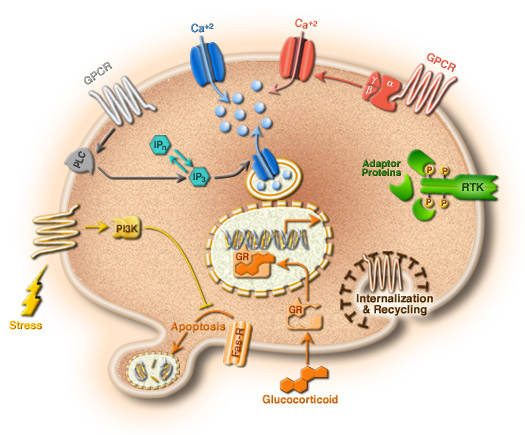 Cellular biology (formerly
cytology, from the Greek kytos, "container") is an academic
discipline that studies cells – their physiological
properties, their structure, the organelles they contain,
interactions with their environment, their life cycle, division and
death. This is done both on a microscopic and molecular level.
Cellular biology research encompasses both the great diversity of
single-celled organisms like bacteria and protozoa, as well as the
many specialized cells in multicellular organisms like
humans.
Cellular biology (formerly
cytology, from the Greek kytos, "container") is an academic
discipline that studies cells – their physiological
properties, their structure, the organelles they contain,
interactions with their environment, their life cycle, division and
death. This is done both on a microscopic and molecular level.
Cellular biology research encompasses both the great diversity of
single-celled organisms like bacteria and protozoa, as well as the
many specialized cells in multicellular organisms like
humans.
Knowing the components of cells and how cells work is fundamental
to all biological sciences. Appreciating the similarities and
differences between cell types is particularly important to the
fields of cellular and molecular biology as well as to biomedical
fields such as cancer research and developmental biology. These
fundamental similarities and differences provide a unifying theme,
sometimes allowing the principles learned from studying one cell
type to be extrapolated and generalized to other cell types. Hence,
research in cellular biology is closely related to genetics,
biochemistry, molecular biology, Immunology, and developmental
biology.
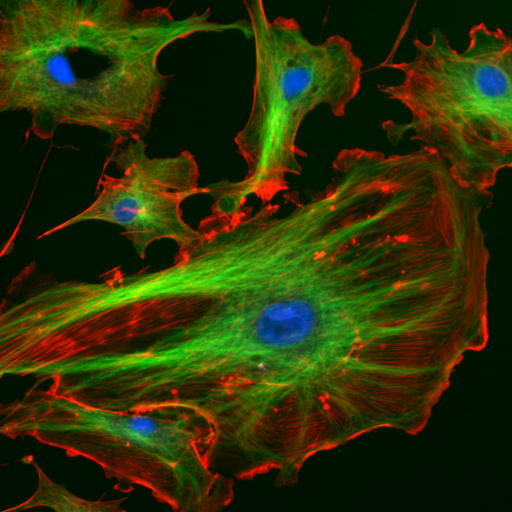 Each type of protein is
usually sent to a particular part of the cell. An important part of
cellular biology is the investigation of molecular mechanisms by
which proteins are moved to different places inside cells or
secreted from cells. Most proteins are synthesized by ribosomes in
the cytoplasm. This process is also known as protein biosynthesis
or simply protein translation. Some proteins, such as those to be
incorporated in membranes (known as membrane proteins), are
transported into the "rough" endoplasmic reticulum (ER) during
synthesis. This process can be followed by transportation and
processing in the Golgi apparatus. From the Golgi, membrane
proteins can move to the plasma membrane, to other subcellular
compartments, or they can be secreted from the cell. The ER and
Golgi can be thought of as the "membrane protein synthesis
compartment" and the "membrane protein processing compartment",
respectively. There is a semi-constant flux of proteins through
these compartments. ER and Golgi-resident proteins associate with
other proteins but remain in their respective compartments. Other
proteins "flow" through the ER and Golgi to the plasma membrane.
Motor proteins transport membrane protein-containing vesicles along
cytoskeletal tracks to distant parts of cells such as axon
terminals. Some proteins that are made in the cytoplasm contain
structural features that target them for transport into
mitochondria or the nucleus. Some mitochondrial proteins are made
inside mitochondria and are coded for by mitochondrial DNA. In
plants, chloroplasts also make some cellular proteins.
Extracellular and cellular surface proteins destined to be degraded
can move back into intracellular compartments upon being
incorporated into endocytosed vesicles. Some of these vesicles fuse
with lysosomes where the proteins are broken down to their
individual amino acids.
Each type of protein is
usually sent to a particular part of the cell. An important part of
cellular biology is the investigation of molecular mechanisms by
which proteins are moved to different places inside cells or
secreted from cells. Most proteins are synthesized by ribosomes in
the cytoplasm. This process is also known as protein biosynthesis
or simply protein translation. Some proteins, such as those to be
incorporated in membranes (known as membrane proteins), are
transported into the "rough" endoplasmic reticulum (ER) during
synthesis. This process can be followed by transportation and
processing in the Golgi apparatus. From the Golgi, membrane
proteins can move to the plasma membrane, to other subcellular
compartments, or they can be secreted from the cell. The ER and
Golgi can be thought of as the "membrane protein synthesis
compartment" and the "membrane protein processing compartment",
respectively. There is a semi-constant flux of proteins through
these compartments. ER and Golgi-resident proteins associate with
other proteins but remain in their respective compartments. Other
proteins "flow" through the ER and Golgi to the plasma membrane.
Motor proteins transport membrane protein-containing vesicles along
cytoskeletal tracks to distant parts of cells such as axon
terminals. Some proteins that are made in the cytoplasm contain
structural features that target them for transport into
mitochondria or the nucleus. Some mitochondrial proteins are made
inside mitochondria and are coded for by mitochondrial DNA. In
plants, chloroplasts also make some cellular proteins.
Extracellular and cellular surface proteins destined to be degraded
can move back into intracellular compartments upon being
incorporated into endocytosed vesicles. Some of these vesicles fuse
with lysosomes where the proteins are broken down to their
individual amino acids.
Now that
you have a better understanding of Cellular Biology, you are
prepared to solve the puzzle below and uncover the coordinates of
this cache.
The
cache is located at the following coordinates:
66783 8734682 74383 8737 24626 74383 24626 6246
63783
7383682 74383 367 6246 282876 7347 282876
Good Luck!