History of Neabsco Creek
Neabsco Creek was first mapped by John Smith in 1608. The name is a legacy of the Indian residents from the Monohoac Tribe: the translation of Neabsco is “at a point of rock”. Neabsco has also been shown on some charts (1657) Niobsco.
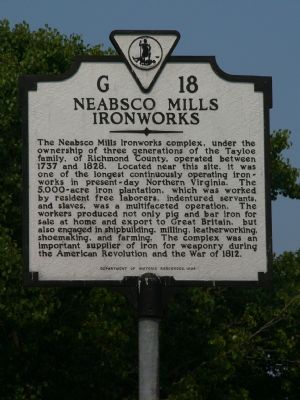
Since the early 1700’s, Neabsco Creek has served as a waterway for trade and commerce. Approximately one and one-half miles upstream from this site is the location of John Tayloe’s iron surface mine and foundry called Neabsco Iron Furnaces. Local iron deposits, combined with the availability of water power, provided the resources for this industry to develop. However, the low grade ore had to be combined with a higher grade ore for efficient iron smelting, prompting the import of ore from Maryland by way of the Potomac River and Neabsco Creek.
Muniitions were cast as the foundry for the patriot armies during the Revolutionary War. These iron works were considered so important that in August of 1814 the English Naval War Concil ordered the ironworks to be destroyed, but the operation failed. The mine was closed sometime thereafter, but was reopened in 1889 and was operated until 1920 when strikes caused its abandonment.
In addition to the commerce on Neabsco Creek generated by the iron works, shipyards and wharves were developed to accommodate the mineral, timber and agrilcultural resources of this area. Review of old charts of Neabsco Creek indicate that the Willis Saw Mill was probably located in the wetland areas of this site.
Commencing in 1881 the U.S. Army Corps of Engineers was authorized to maintain a channel seven feet deep and 100 feet wide from the Potomac River to Atkinson’s Upper Landing. Atkinson’s Upper Landing is only a few hundred feet from the northernmost corner of the property. River traffic, consisting of barges and lighters, proceeded upstream of this point through the site and west to serve the iron works and a slate mine. Barges continued moving upstream to serve the slate mine up until the 1930’s when the U.S. Route 1 bridge was constructed. Until then the main highway crossed Neabsco Creek further west of U.S. 1 and was called the Richmond-Washington Highway.
Neabsco Creek’s character was changed significantly by the deposition of silt due to uncontrolled runoff from tobacco farming (as has been documented with respect to the Port of Dumfries) that followed the extensive timbering of this area. Poor forestry practices utilized in providing timber to local mills such as Willis Saw Mill also contributed to this siltation process.
The area on the north shore of Neabsco was called “Smoketown” (hence the name Smoketown Road) because a cloud of smoke caused by continuous burning of brush from intensive logging operations hung over the valley.
Historical research suggests that in the late 1800’s this entire site was clear cut for timber, and that the lower areas were open water. Subsequently siltation occurred that developed significant areas of emergent and shrub/scrub wetlands. Possibly, this siltation also contributed to an increase in water levels that converted adjacent low lying areas to welands as well.
Sources:
R. Jackson Ratcliffe, This Was Prince William (Manassas: REF Typesetting Publishing, 1978)
Frederick Tilp, This was Potomac River (Alexandria: Frederick Tilp, 1978)

Find the answer to these questions to find the final coordinates to this cache. I decided to give this other option for those that may not be able to go to the other locations and are just planning to visit Leesylvania State Park. If you are a local or looking for an adventure I advise going to the other caches located along Neabsco Creek as you will gain a greater appreciation for the history and how the creek affects our community today.
Use the link below or visit the kiosk at the park entrance to find the answers.
Leesylvania State Park history
You need to fill in the following coordinates: N 38* 36.ABC W 077* 16.DEF
A = 1st digit in the year Leesylvania State Park opened full time.
B = Light Horse Harry's real name is Henry Lee ___ (Roman Numerals).
C = Henry Lee II lived on the property from 17_7 until his death.
D = Number of years Robert E. Lee lived here. (Trick question).
E = The Fairfax house burned in 191_.
F = In 1_25 the property was sold to Henry Fairfax.
You can check your answers for this puzzle on Geochecker.com.
| NOTICE: Please be respectful of the posted park hours. If you enter the park after hours you are trespassing. If you are stopped you can be ticketed or arrested and will put the future of geocaching in the parks in jeopardy. |
Congratulations to rufnredy and BAJA Clan for co-FTF!!