

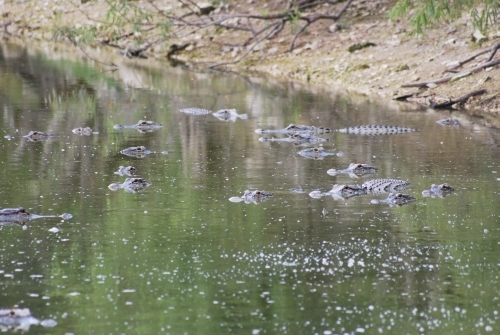
Habitat American alligators are mostly found in the Southeastern United States, from Great Dismal Swamp in Virginia/North Carolina south to Everglades National Park in Florida and west to the southern tip of Texas. They are found in the U.S. states of North Carolina, South Carolina, Georgia, Florida, Louisiana,Alabama, Mississippi, Arkansas, Texas, Virginia and Oklahoma. Florida and Louisiana currently have the largest population of alligators. Florida has an estimated population of 1 to 1.5 million while Louisiana has an estimated population of 1.5 to 2 million. Although primarily freshwater animals, alligators will occasionally venture into brackish water. Alligators live in wetlands and this is the vital habitat that holds the key to their continued long-term survival. Alligators depend on the wetlands, and in some ways the wetlands depend on them. As apex predators, they help control the population of rodents and other animals that might overtax the marshland vegetation. American alligators are less susceptible to cold than American Crocodiles. Unlike the American Crocodile, which would quickly succumb to the cold and drown in water of 45 °F (7.2 °C), an alligator can survive in such temperatures for some time without apparent discomfort.[10] It is thought that this adaptiveness is the reason why American alligators spread farther north than the American Crocodile. In fact, the American alligator is found farther from the equator and is more equipped to deal with cooler conditions than any other crocodilian In Florida, alligators face ambient temperature patterns unlike elsewhere in their range. The consistently high temperatures lead to increased metabolic cost. Alligators in the Everglades have reduced length to weight ratio, reduced total length, and delayed onset of sexual maturity compared with other parts of their range. The reason for this poor condition is currently suspected to be a combination of low food availability and sustained high temperatures.
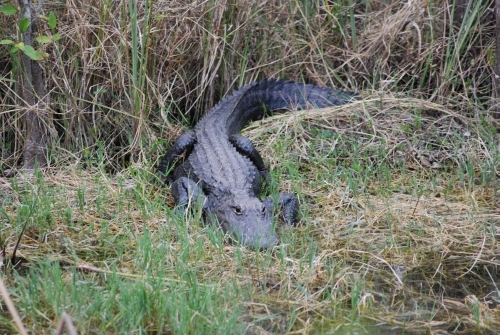
Diet Alligators are apex predators capable of killing large terrestrial prey. This large American alligator has caught an adult deer. Alligators eat fish, birds, turtles, snakes, mammals, and amphibians. Hatchlings are restricted to smaller prey items like invertebrates. Insects and larvae,snails, spiders, and worms make up a big portion of a hatchling's diet. They will also eat small fish at any opportunity. As they grow, they gradually move on to larger fish, mollusks, frogs and small mammals like rats, and mice. Some adult alligators take a larger variety of prey ranging from a snake or turtle to abird and moderate sized mammals like a raccoon or deer. Once an alligator reaches adulthood, any animal living in the water or coming to the water to drink is potential prey. Adult alligators will eat wild boars, deer,dogs of all sizes, livestock including cattle and sheep, and are often known to kill and eat smaller alligators. In rare instances, large male alligators have been known to take down a Florida panther and an American Black Bear, making the American alligator the apex predator throughout its distribution. The American alligator is known as King of the Everglades, although the American Crocodile, which shares parts of the Everglades with the alligator, is capable of growing larger (over 5 meters), mostly in warmer regions like Central America, Mexico, and the Caribbean. The gizzards (stomachs) of alligators often contain gastroliths. The function of these stones is to grind up food in the stomach and help with digestion. This is important because gators swallow their food whole. These gastroliths are also used in buoyancy control. In 2002, the bite force on a 12 foot alligator was measured to be about 2100 pounds-force (9.3 kilonewtons). American alligators cruise through water at just over 1 mph (0.4 m/s); in pursuit of prey they can swim much faster over short distances.
Reproduction
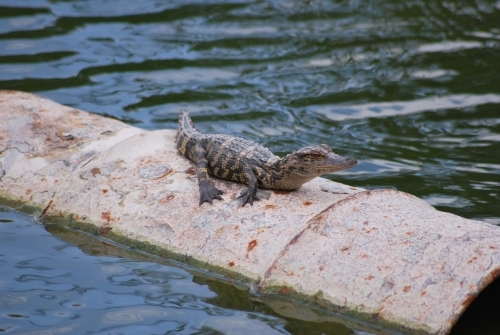
Young American alligator swimming, showing the distinctive yellow striping found on juveniles The breeding season begins in the spring. Although alligators have no vocal cords, males bellow loudly to attract mates and warn off other males during this time by sucking air into their lungs and blowing it out in intermittent, deep-toned roars. Male alligators are also known to use infrasound during their mating behavior, as one of their routines is to engage in bellowing in infrasound while their head and tail is above the water, with their midsection very slightly submerged, making the surface of the water that is directly over their back literally "sprinkle" from their infrasound bellowing, in a so-called "water dance". Young American Alligators basking The female builds a nest of vegetation, sticks, leaves, and mud in a sheltered spot in or near the water. After she lays her 20 to 50 white, goose-egg-sized eggs, she covers them under more vegetation, which, like mulch, heats as it decays, helping to keep the eggs warm. This differs from Nile crocodiles who lay their eggs in pits. The temperature at which alligator eggs develop determines their sex. Those eggs which are hatched in temperatures ranging from 90 to 93 degrees Fahrenheit (32 to 34 °C) turn out to be male, while those in temperatures from 82 to 86 °F (23 to 30 °C) end up being female. Intermediate temperature ranges have proven to yield a mix of both male and females. The female will remain near the nest throughout the 65-day incubation period, protecting the nest from intruders. When the young begin to hatch they emit a high-pitched croaking noise, and the mother then quickly digs them out. The young, which are tiny replicas of adult alligators with a series of yellow bands around their bodies, then find their way to water. For several days they continue to live on yolk masses within their bellies. The baby spends about five months with the mother before leaving her. Animals that eat the young includesnapping turtles, snakes, raccoons, largemouth bass and American black bears. The full grown gator grows up to hunt these same animals for food. Alligators reach breeding maturity at about 8 to 13 years of age, at which time they are about 6 to 7 feet (1.8–2.1 m) long. From then on, growth continues at a slower rate. The oldest males may grow to be 16 feet (4.85 m) long and weigh up to 1,200 pounds (510 kg) during a lifespan of 30 or more years. A recent study by scientists from the Savannah River Ecology Laboratory in South Carolina reveals that up to 70 percent of A. mississippiensis females chose to remain with their partner, often for many years.


 FTF HONORS TO JunglePete