The First Steps
This EarthCache will bring you to the Valentia Tetrapod Trackway in the northern part of Valentia Island. It shows one of the first major steps in the evolution from fish to land-dwelling animals, preserved in the rocks.
The Geology of Valentia Island
Several million years ago, Ireland did not exist as we know it today. Ireland was not even located in its present position, but lay south of the Equator bordering a warm tropical sea. Since then, movement of the Earth's crust has brought it to its current location. The province of Munster was at this time part of a huge coastal plain with mountains in the northern part. Great rivers flowing through these mountains carried enormous amounts of sand and silt to the ocean. All the rocks you can see near the Trackway originated from these sediments.
When the rivers flooded, layers of silt were deposited on the coastal plains. Ripple marks (see the rock samples on the wall display) formed in shallow pools which later dried out but were repeatedly covered by new deposits of silt from further flooding. Over time, the silt was subjected to enormous pressure and became solid rock. Today, erosion has once again exposed these ripple marks, which were created 300–400 million years ago.
The Valentia Tetrapod Trackway
The impressions on the rocks at the given coordinates are petrified footprints of one of the first animals to walk on land. This lizard-like animal was about one metre long and did not only leave footprints. Here and there you can also see faint traces of a "tail drag". These were created when the animal pulled itself out of the water and moved across the wet mud. The footprints were quickly filled with mud, which later hardened into rock..

Tetrapod |
This trackway is one of the oldest known examples in the world of a vertebrate (an animal with a backbone) walking on land. Before this, all known vertebrates were fish. Some of these had already begun to live in shallow water near the edges of rivers.
Over time, fins evolved into primitive legs. In addition, these animals developed the ability to breathe air instead of relying only on oxygen from water. They were the first tetrapods (four-limbed animals). Over millions of years, they became more complex and evolved into mammals and eventually humans.

Tetrapod Trackway overview |

The Tetrapod Trackway |
Valentia Island
Valentia Island is one of the westernmost permanently inhabited locations in Europe, with a population of around 650 people. The island is approximately 11 kilometres long and almost 3 kilometres wide. It can be reached either by ferry, which operates from Reenard Point to Knightstown (from April 1st to September 30th), or by the Maurice O’Neill Memorial Bridge at Portmagee.
On Valentia Island, you can visit several other interesting places. The island was the eastern terminal of the first commercially viable transatlantic telegraph cable. This cable was laid between Valentia Island and Heart's Content, Newfoundland, in 1866.
Several additional cables followed, making County Kerry a major centre for global communications until the carrier ended its cable operations in 1966. Today, you can see a very interesting memorial stone with samples of some submarine cables along the road leading to the Tetrapod Trackway if you arrive via the bridge. Near the Valentia Tetrapod Trackway, you can visit the (archived) cache "Mogh Roith" (GCY4DB), which features a nice grotto and a great view over Valentia Island.
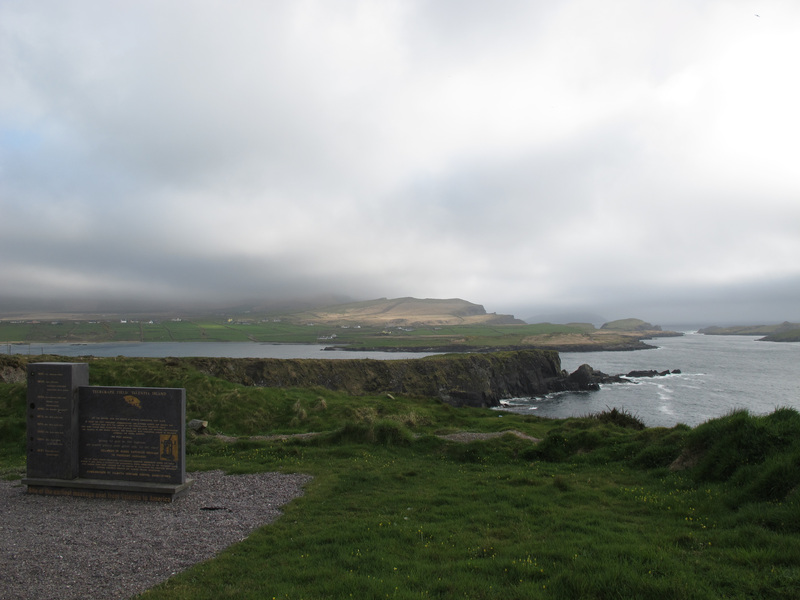
The Valentia Telegraph Field memorial stone |

Overview from the Cache "Mogh Roith" |
Logging requirement
To log this EarthCache, please answer the following questions:
- How old is the Tetrapod Trackway? (ABC million years)
- When was the track discovered? (DEFG)
- How many Tetrapods can you see on the "Valentia Tetrapod Trackway" information board? (H)
Please send me an email with GC2CD0T in the subject line and your nickname and the answers in the form "ABCDEFGH" (checksum = 39) in the email body to the email address earthcache[-at-]geochief.de.
If the answers are correct, you will automatically receive a confirmation. You can log the EarthCache directly. Should there be any problem with your solution or if you have any questions, I will get back to you.