The Forest Service had blocked access to the old road leading to
the mine. This will add about 100 yards to your hike to the
cashe.
There is an old trail that leads to the mine and the coordinates
of this "trail head" are listed below. The cache is within 25' of
the entrance.
Trail head. N 34° 18.573
W 116° 53.679
THIS IS SNAKE COUNTRY. SNAKES LIKE SHADE ON HOT
DAYS JUST LIKE WE DO. A GOOD HIDING PLACE FOR A CACHE MAY ALSO BE
INVITING TO A SNAKE. BRING A STICK TO USE IN PLACE OF YOUR HAND
WHEN CHECKING UNDER ROCKS, BUSHES, ETC.
The Southern Pacific Rattlesnake, also called Black
Diamond Rattlesnake, Mountain Rattler, Western Rattlesnake, is the
most common rattlesnake in this area. While they can reach a length
of 4.5 feet, 2.5 to 3.5 feet is common. They range in color, from
gray, olive, to brown. Populations living at higher altitudes are
often almost black with very faint markings. Juveniles have a
bright yellow-green tail. Young are born live from August to
October. Ready to go when born, they are about 10 inches long, have
fangs, venom, but no rattle (pre-button). A button, as the segments
of the rattles are called, is formed each time they shed their
skin. It takes at least two buttons to rattle. If the rattle
absorbs enough water in wet weather, it will not make noise. They
can shed their skin several times in a year. Frequency of shedding
depends on their food supply and particular growth rate. They also
shed and replace their fangs about every 60 days.
It is a myth that rattlesnakes are deaf. They have the
same basic inner ear structure as other reptiles. They lack an
external ear. Sound, vibrations in the air or ground, are
transmitted to the ear via other body structures. It is not known
how the brain of the rattlesnake translates the vibrations received
by the inner ear. Maybe it is similar to having your fingers in
your ears.
 |
 |
|
An
adult Southern Pacific Rattlesnake in a classic defensive pose.
From this position a snake can strike out approximately one-third
to one-half of it’s body length. While the strike is not as
fast or accurate as generally believed, the strike is very swift.
Too fast to be fully followed by the human eye.
(click on photo to hear it's warning)
|
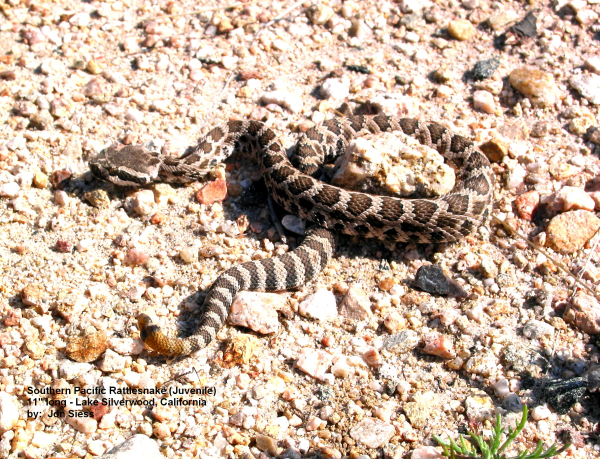
This
photo of an 11" long juvenile was taken at Silverwood Lake. Note
the yellow color at the tip of the tail and the absence of a
rattle. You can see the "pre-button" at the tip of the tail.
Juveniles are quicker to strike than adults and will usually inject
all their venom when they strike.
|