OVER 400 MILLION YEARS AGO......
At the spot where you are standing (believe it or not) was a coral reef. A vast tropical sea populated with an abundance of creatures would have stretched as far as eye can see and past the horizon. Among these, the highly adaptable arthropod known today as the trilobite. Its closest relative living today is the pill bug, aka "rolly-polly" bug.

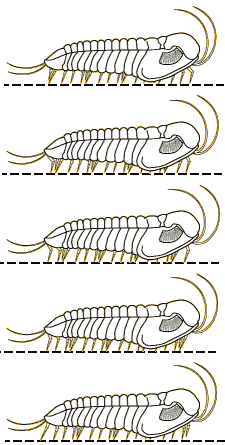
Try to imagine a creature not unlike a pill bug. The average size of the trilobite during the Devonian period was about 4 inches long. It had a pair of antennae about 3 inches long, with which it constantly probed the sea bed for un-eaten algae or other material to scavenge on. The thorax, or body, was usually made up of eight segments.

If you look closely at the limestone, you might be able to spot the tiny tracks of trilobites, made when they were roaming, in search of food. The site at the coordinates is Devonian. Note that the "rip rap" rocks coving the area are not part of the outcrop and were dumped here in an effort to check the progress of river bank erosion and most of the "outcrop" has been unfortunately buried. Nevertheless, the underlying rock is from the Beechwood Limestone, and is one of the youngest Devonian fossil-bearing rocks that were formed.
The two main species of trilobites that can be found here are:
Phacops rana
Calymene
The Devonian trilobite was made up of three segments:
Cephalon (head)
Thorax (body)
Pygidium (tail)
The type of rock that is deposited depends on the type of environment in which it was formed. For example, in a deep, muddy lagoon, black mud will coagulate to form dark, carbon-rich shale. In a clear, warm sea, the Calcium Carbonate in animals' hard parts and bones will break down and be deposited, forming soft, acidic limestone. Why is this?-The chemical composition of the deposited sediment will determine the classification of the rock formed. Also, if deposited sediment is formed into rock, but shortly afterwards exposed to high heat and pressure in the earth's mantle, it will become a completely different rock.
FOSSIL COLLECTION AT THIS SITE:
PLEASE, RESPECT THIS SITE. PLEASE DO NOT COLLECT FOSSILS HERE. EVEN THOUGH IT IS NOT PROTECTED, PLEASE LEAVE THE SITE THE WAY YOU FOUND IT FOR THE NEXT CACHER. Every time you take a fossil from this site, the chances that another cacher will be able to find one decreases. Remember: take only pictures, leave only foot prints, and abide by the Outdoor Code:
The Outdoor Code
As an American, I will do my best to -
Be clean in my outdoor manners.
I will treat the outdoors as a heritage.
I will take care of it for myself and others
I will keep my trash and garbage out of lakes, streams, fields, woods, and
roadways.
Be careful with fire.
I will prevent wildfire.
I will build my fires only where they are appropriate.
When I have finished using a fire, I will make sure it is cold out.
I will leave a clean fire ring, or remove all evidence of my fire.
Be considerate in the outdoors.
I will treat public and private property with respect.
I will use low-impact methods of hiking and camping.
and
Be conservation minded
I will learn how to practice good conservation of soil, waters, forests, minerals, grasslands, wildlife, and energy.
I will urge others to do the same.
TO LOG THIS EARTH CACHE AS A FIND, YOU MUST:
-Take a picture of you and your GPSr (or just your GPSr) at the outcrop.
-***OPTIONAL****----Find and photograph at least one trilobite. In your log, describe the trilobite's color, texture, size, dementions, etc. (Please see red text above.)
AND, TO DEMONSTRATE THE EDUCATIONAL VALUE OF THIS EARTH CACHE, EMAIL ME THE ANSWERS TO THE FOLLOWING QUESTIONS VIA MY PROFILE:
1. Take a sample of the rock at the outcrop and describe it. What is it's texture?hard? soft? what color? Is is grainy or smooth? length?
2. Using your data from question number 1, draw a conclusion and explain in your opinion what kind of environment you think this rock was formed in. Was this a deep, muddy lagoon? Or a shallow sea with islands dotting it?
3. Name the three parts of a trilobite.
4. What is the closest living relative of the trilobite?
5. What geologic period is this outcrop from?
6. What formation is the outcrop from?
Good Luck and Happy Hunting!!!