
I was fascinated to find a number of farm windpumps still standing in what is now developed suburbia. Through geocaching, I share my fascination with you.
This particular Windpump has been modified to look like a sunflower! Incidentally, the sunflower is one of my favourite flowers. It is the epitome of happiness and sunshine.
Due to the other cache which is close to this Windpump, I had to choose a spot which was further away but still close enough to view the Windpump itself.
These Windpumps are a reminder of our farming days of yesteryear.
From South African photographer Chris Myburgh's website:
"The first records found of a windpump in South Africa, is from a painting drawn in 1848. Records were found of windpumps as from 1869 and the first import was in 1874. These were wooden constructions. The first all steel windpump was patented in 1855 in England."
There are a number of types of windpumps manufactured both locally and abroad. Each manufacturer has its own style and branding. You'll notice the Manufacturer's branding on the Wind Vane.
Windpumps (Windmills) are fondly referred to as "steel flowers" especially in the Karoo area where they can be found in abundance, providing much needed water to the farms.
Taken from the website: http://www.dwa.gov.za/groundwater/NORADToolkit/7.2%20Introductory%20Guide%20to%20Appropriate%20Solutions%20for%20Water%20and%20Sanitation.pdf
"What is a wind powered pump and how does it work?
Wind powered pumps use the energy generated by wind to lift groundwater to the surface. A rotor is mounted on top of a tower. The action of the wind turns the rotor, which through a gearbox drives a reciprocating shaft. This in turn drives the pump in the borehole.
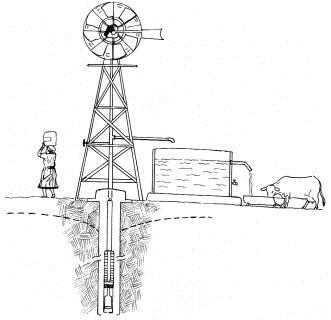
Wind pump adaptations
The air-lift groundwater pump was developed to provide a low-cost pump for use in informal and rural settlements. This pump system can be operated with tyre pumps. It has a wind pack compressor, capable of storing wind energy as compressed air. This provides supplementary power to the pump. All the working parts of this pump are located above ground, making maintenance easy.
Wind pump requirements
The pump requires sufficient wind speeds for significant lengths of time. The wind pump must therefore be placed where there is a clear sweep of wind. Also, the borehole should provide enough water so that continuous pumping does not result in excessive drawdown. Storage for several days must be provided to cater for calm periods when there is insufficient wind speeds to pump water. Further, someone must be delegated to apply the manual brake to avoid damage during storms.