
Cold War Caching Series #2
This cache series will take you on a journey through Cold War history. This is the second in our Cold War Cache (CWC) series. The first caches in this series will concentrate on the Nuclear Missile Defense Network surrounding Washington DC, and Baltimore Maryland.
It’s interesting to see how these once highly secret sites have now been incorporated back into the surrounding communities, and in some cases, reclaimed by nature.
Wait . . . what? Nuclear missiles in Maryland? Yup, and not just one or two either, but hundreds of them. From the 1950’s all the way through the 1970’s Washington DC, and Baltimore were ringed by high altitude, high speed, missile batteries. These batteries were equipped with the Nike nuclear tipped missile and were classified top secret. Their sole purpose in life was to intercept and kill the expected waves of Soviet long range nuclear bombers. Some of you may be finding out about these sites for the first time via this cache series. Perhaps, like us, you might be surprised to find out you were growing up less than five or ten miles from a nuclear missile site.
Please understand most, if not all, of these sites are currently contaminated with all sorts of really nasty chemicals, and who knows what else. These caches are NOT placed in contaminated areas. If you decide to explore the bases “up close” you do so at your own risk. We take no responsibility for the stupidity of others.
The Cold War produced sweeping changes in the United States' military establishment and society at large. For more than 40 years the nation prepared to fight a war that never came. In the process, the United States reversed its longstanding tradition against maintaining a large peacetime military establishment, and at the same time harnessed the nation's industrial might and scientific genius to fashion the world’s most sophisticated weapons of war. High technology became the ultimate arbiter of military power, and nowhere was the impact of new technology more evident than on the nation's guided missile program. Armed with nuclear warheads, guided missiles quickly became the defining weapons technology of the Cold War.
The Cold War missile program was born of technologies invented during World War II and nurtured by the arms race. Immediately after World War II the United States rapidly demobilized, and the military curtailed its missile research and development (R&D) programs. But by 1950 the world had changed: the Soviet Union had developed atomic weapons and the United States became embroiled in the Korean conflict, which many thought to be a direct provocation by the Soviet Union and China. Confronted with those challenges, in 1950 America began to re-arm.
The 1950’s were a tumultuous decade for the U.S. missile program. One persistent problem was interservice rivalry: the Army and the Air Force squabbled over which service would develop surface-to-air missiles, and all three services fought for the right to develop long-range ballistic missiles. There were also internal disputes within the services. The Air Force was notably reluctant to develop long-range ballistic missiles, and it took a considerable amount of external pressure to convince Air Force leadership to develop the ICBM.
Despite fierce interservice rivalries, the missile program grew rapidly during the 1950s and 1960s. The Army won primary responsibility for developing surface-to-air missiles, and by 1958 it had deployed 200 Nike missile batteries across the country. The Air Force's long-range BOMARC air defense missile program was slower taking shape, but by the early 1960s seven squadrons were based along the nation's eastern and northern borders. In addition, the Army also sought to establish a nationwide antiballistic missile defense system, but after 15 years of controversy, the program was canceled in 1972 as a result of the Anti-Ballistic Missile Treaty signed with the Soviet Union. The missile program also brought the Cold War home to many Americans. The Army's Nike missile sites provided a striking reminder: many of these batteries were located near the most densely populated areas in the nation, and they provided graphic testimony to the severity of the conflict between the United States and Soviet Union. The Cold War missile program left behind a large and diverse collection of artifacts and structures. Today, hundreds of Nike batteries still dot the countryside. These launch sites, however, reflect only a fraction of the massive U.S. investment in the Cold War missile program. Behind the launch facilities stood hundreds of research laboratories, test sites, production facilities, training centers, and logistics and maintenance facilities. Many of these sites are still in use, but many others have been closed down, put to other use, or simply abandoned.
 Davidsonville Nike Missile Battery
Whiskey-25 (W-25)
Davidsonville Nike Missile Battery
Whiskey-25 (W-25)
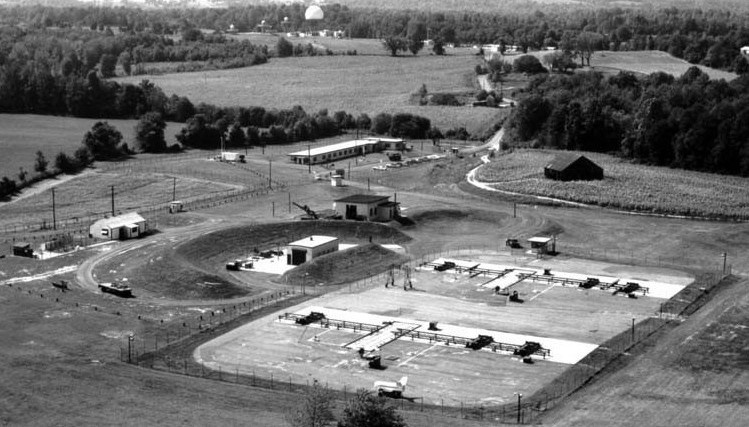 Aerial view of W-25 launch area, Dec. 5, 1956. (NARA photo 111-SC-549340)
Davidsonville Nike Site - Today
The former Davidsonville Nike Missile Battery (W-25) is the current site of the Anne Arundel Police Training Academy, and the Davidsonville Family Recreation Center. The Recreation Center houses the Davidsonville Dance Club, the South County Pre-K Co-Op, the Amateur Radio Club and the Boy Scouts.
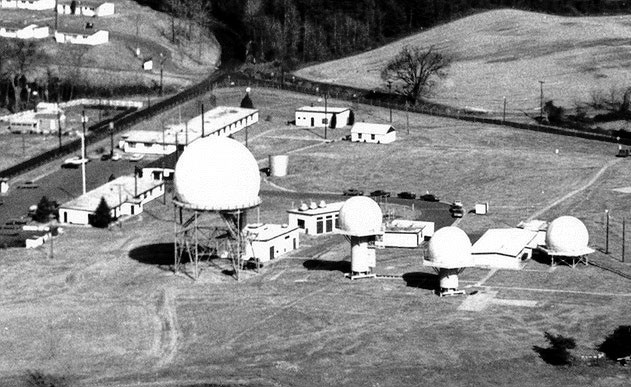 Missile Guidance Radar Towers at W-25
Davidsonville Nike Site (1954 – 1970)
In 1954, the site opened, housing personnel and the subterranean surface-to-air guided missiles. About 130 personnel were assigned to the site, which included the guidance center, housing and a mess. Davidsonville replaced Virginia's (W-64) Lorton site to become the "national site" in 1963, subjecting the facility to visits from many VIPs.
By the early 1970s, the site was designated, "stand down," and in 1975, the site decommissioned. After a series of transfers through the federal government, the land was eventually given to the Anne Arundel County government for use as police training and as a recreation and education facility for county residents.
The Land
Nearly 60 acres were acquired to fully develop the Davidsonville site. Extracting acreage for family housing, Site W-25 closely approximated the average for similar Nike installations. Most battery sites had to be located on privately-owned land. Very specific and restrictive standards had to be applied to the location. The general public, not knowing the necessity for interrelationship and topographic configuration of Control and Launcher Areas to assure both an effective defense ring and the proper functioning of the weapon system within the battery, often thought that site selections were made either arbitrarily or capriciously and, while almost everybody favored Nike, almost nobody wanted a unit located next door.
To partially ease public opposition, the Army Chief of Staff decided in late October 1953 that underground missile storage magazines would be installed at all sites, rather than relying on above-ground dispersal, as originally contemplated in project drawings. This change, coupled with an improved public relations campaign, did ease public acceptance, especially in more congested urban areas.
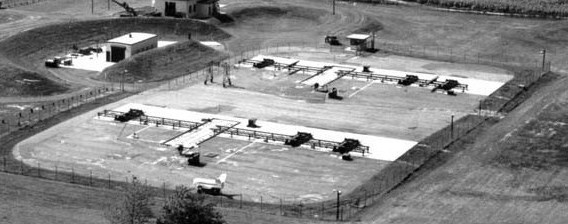 This close-up of the W-25 launch area shows the elevators on which missiles were raised from underground storage magazines for firing.
The Nike battery consisted of two 2 separate facilities: a Launch Area & an Integrated Fire Control Area. The layout of all Nike sites was characteristic in that the launch site was situated 1-3 miles “downrange” from its Integrated Fire Control Area, along the axis toward the anticipated targets, such that the radars at the IFCA would have a line-of-sight toward both the missiles & the target.
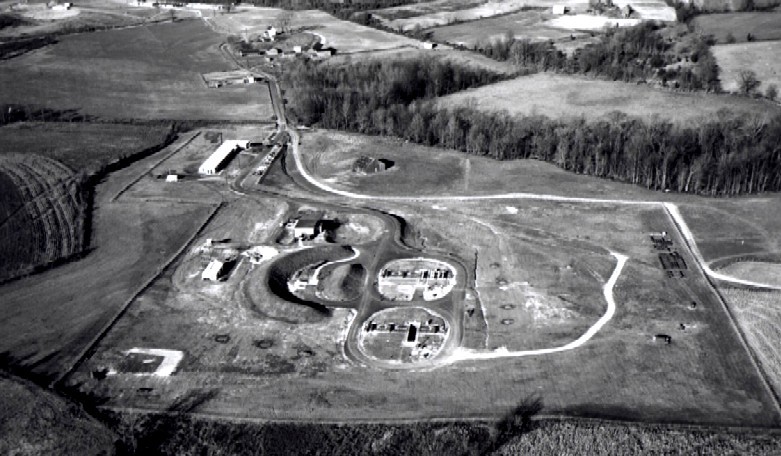
Looking northeast across the IFC area in 1972. Military family housing is at top left.

The Launch
Historian Merle T. Cole, in his description of a Nike installation in the Maryland air defense area [W-25: The Davidsonville Site and Maryland Air Defense, 1950-1974], described the order in which the missiles were fired:
During a fire mission the missile on the elevator-launcher of one launching section is fired, followed by the missile on the elevator-launcher on the [second and third sections]. Using this sequence each section can reload the elevator-launcher while the other two sections are firing, and consequently maintain the maximum rate of fire. This procedure is followed as long as missiles are available in the undergroond Imagazinesj. When these have been exhausted, the three missiles located on satellite launchers at each section are fired as desired by the commander.
When the battery control officer operated the "fire" button, the missile launched. Four seconds after "missile away," the computer ordered the missile to execute a 7g dive (1g is equal to 32.2 feet/second/second). At the same time, the computer modified this order, if necessary, to insure that the missile ground path was parallel to the line between the launcher and the intercept point. Steering orders were transmitted to the missile via the missile-tracking radar. At a predetermined interval before the time of intercept, the "burst" signal was transmitted to the missile, and an arming device detonated the warheads.
The Nike system could fire one missile per minute for one hour against targets at moderate ranges (approximately 25,000 yards) and, if required, two missiles per minute for short periods against short-range targets (approximately 15,000 yards). Actual rates, however, varied according to prevailing circumstances.
Nike crewmen needed a minimum of 36 seconds to launch the first missile. This included approximately 30 seconds to acquire, identify, designate, and track a target; four seconds for computer settle; and two seconds for the fixed time interval between the initial fire order command and missile launch. A new missile could be launched approximately 11 seconds after the bursting or abandonment of the previous missile. After the previous target has been tracked, the acquisition radar operator was free to examine and interrogate any new targets.
There were two situations in which a missile could be rejected. Either the missile-tracking radar failed to get an adequate signal response from the missile, or the missile did not fire within five seconds aRer the "fire" command signal. As soon as the red "reject" lamp lit, the elevator was lowered, and the rejected missile was removed; another missile was then loaded onto the elevator launcher.
The Cache
This is one of the few Nike sites in Southern Maryland where you can still walk around the Integrated Fire Control Facility. The IFC has been converted to a family recreation area but the buildings and radar stands are still there. We would not recommend attempting to access the launch facility since it has been converted to the Anne Arundel County Police Academy. We tried to access it once, and the police weren’t happy or nice at all.
This cache has two stages, the first will take you to the IFC, if the gates are open feel free to park and walk around. The second will take you to the launch facility. Again, don’t try breaching this particular fence (consider yourself warned. Stage 1 is searchable when the main gates are open. Weekdays are optimal times to search.