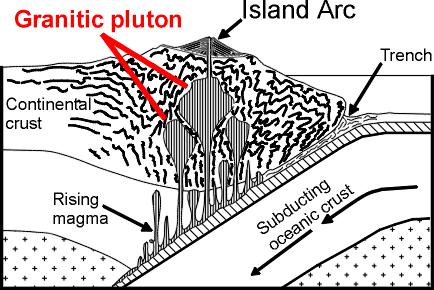
Granite rocks are plutonic igneous rocks, which were formed by slowly cooling pockets of magma trapped beneath the earth's surface. Granites are typically a hard rock with visible crystalline texture, rich in quartz and feldspar. Granite is the most common igneous rock of the Earth’s crust. An outcrop of granite on the earth's surface requires some kind of erosion to expose the buried material.
Two types of decay are occuring at this location. There is erosion and weathering causing reduction of the local landscape. There is also radioactive decay occuring within the granite under your feet.
Erosion is the process of transport of solids (sediment, soil, rock and other particles) in the natural environment by wind, water or ice, gravity, or by living organisms. Erosion is distinguished from weathering, which is the process of chemical or physical breakdown of the minerals in the rocks, although the two processes may occur concurrently. The landscape you see before you is a product of erosion and weathering.
Erosion and weathering rates are a function of the size of particles removed from the base rock and the time period to remove each particle. The larger the particle size the faster the erosion or weathering rate for a fixed period of time.
Granite is a natural source of radiation, like most natural stones. Some granites contain around 10 to 20 parts per million of uranium. Granite could be considered a potential natural radiological hazard as, for instance, villages located over granite may be susceptible to higher doses of radiation than other communities. Cellars and basements sunk into soils over granite can become a trap for radon gas, which is a duaghter product formed by the decay of uranium.
Uranium-238 decays through a series of steps to become a stable form of lead. Each step in the decay is a different nuclide. Uranium-238 has the longest half-life in the series and radon-222 the shortest. The last radionuclide in the chain, polonium-210 transforms to lead-210, and eventually the stable nuclide, lead-206.
So to the earth science you will need to conduct to log this Earthcache.
1. Identify the size of particles at GZ. Based on the size of particles estimate the period of time to go before the granite pillar falls. Describe your method to determine this period.
2. What do you consider to be the main cause of local rock decay. Erosion or Weathering? Describe your reasoning.
3. Identify the half life decay rates of the radio nuclides uranium-238 and radon-222.
4. Submit a picture of yourself by the pillar. (Optional)