ENIAC (Electronic Numerical
Integrator And Computer) was the first general-purpose
electronic computer. ENIAC was designed to calculate artillery
firing tables for the United States Army's Ballistic Research
Laboratory. For example, a skilled person with a desk calculator
could compute a 60-second trajectory in about 20 hours. The analog
differential analyzer produced the same result in 15 minutes. ENIAC
required 30 seconds; just half the time of the projectile's
flight.
When ENIAC was announced in 1946 it was heralded in the press as
a "Giant Brain". It boasted speeds one thousand times faster than
electro-mechanical machines, a leap in computing power that no
single machine has since matched. This mathematical power, coupled
with general-purpose programmability, excited scientists and
industrialists. The inventors promoted the spread of these new
ideas by teaching a series of lectures on computer
architecture.

The ENIAC's design and construction was financed by the United
States Army during World War II. The construction contract was
signed on June 5, 1943, and work on the computer began in secret by
the University of Pennsylvania's Moore School of Electrical
Engineering starting the following month under the code name
"Project PX". The completed machine was announced to the public the
evening of February 14, 1946 and formally dedicated the next day at
the University of Pennsylvania, having cost almost $500,000 at that
time.
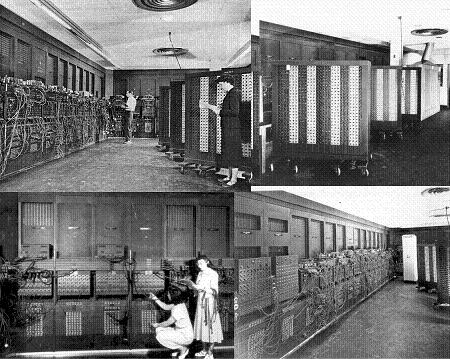
The ENIAC was a modular computer, composed of individual panels
to perform different functions. Twenty of these modules were
accumulators, which could not only add and subtract but hold a
ten-digit decimal number in memory. Numbers were passed between
these units across a number of general-purpose buses, or trays, as
they were called. In order to achieve its high speed, the panels
had to send and receive numbers, compute, save the answer, and
trigger the next operation—all without any moving parts.
Key to its versatility was the ability to branch; it could
trigger different operations that depended on the sign of a
computed result. Besides its speed, the most remarkable thing about
ENIAC was its size and complexity. ENIAC contained 17,468 vacuum
tubes, 7,200 crystal diodes, 1,500 relays, 70,000 resistors, 10,000
capacitors and around 5 million hand-welded joints. It weighed more
than 27 tons, was roughly 8 ft. x 3 ft. x 100 feet (2.4 m × 0.9 m ×
30 m), took up 1800 square feet (167 m2), and consumed 150 kW of
power.
Input was possible from an IBM card reader, and an IBM card
punch was used for output. These cards could be used to produce
printed output offline using an IBM accounting machine, such as the
IBM 405.
ENIAC will easily compute the coordinates to find this cache
from the following:

Happy Decoding !!!