Chilliwack: the "Heart of the Valley" is made up of 14 Villages - In this series of 14 caches we will introduce you to each of those Villages. When you have solved the puzzle for all 14 of the caches your smiley faces will produce the shape of a heart in the Eastern portion of Chilliwack. In each of the 14 caches you will find information which you must record in order to find the Final cache in this series, the "Heart of Hearts" cache.
We hope you enjoy your trip around the area and the cache locations we have selected for this series. Have fun and if possible involve the whole family in solving the puzzles and finding the caches, they are meant to be "family friendly".
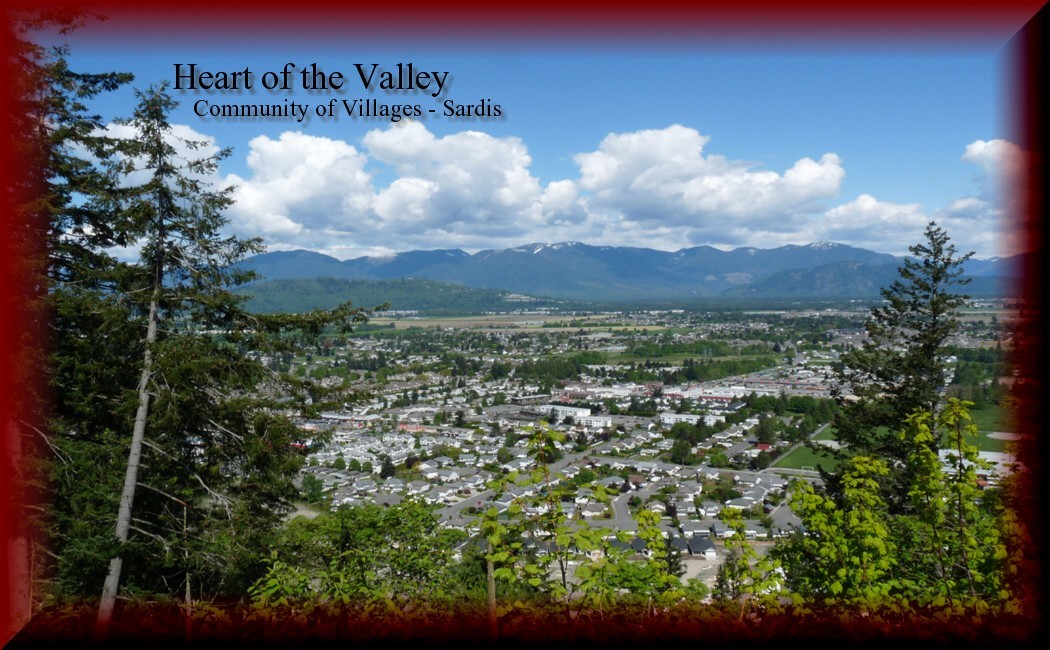
Following the 1858 gold rush there was an influx of people to the Chilliwack area. In Sardis, A.C. Wells, Adam Vedder and Jane Evans were amongst a group that pre-empted land in the 1860s in what became the Sardis corridor. Mrs. Adam Swart Vedder is credited for choosing the name Sardis when she randomly opened her Bible and found the name Sardis in the Book of Revelations 3.1.
In 1887, residents of Sardis petitioned the federal government for a post office. In documents supporting the application, E. H. Fletcher, Post Office Inspector for British Columbia, described Sardis; “There is no village properly speaking but the farmers houses are all situated within a reasonable distance of the proposed site….At least thirty families would make use of the office if established, as well as from thirty to forty unmarried settlers residing in the vicinity” (Coutts, Cecil C., Cancelled With Pride, A History of Chilliwack Area Post Offices, 1865-1993, Cecil C. Coutts Publishing, p. 71). Residents got their post office soon after this request.
The boom period for Sardis began in the 1890s. The Coqualeetza Residential School was established by the Methodist Church in 1888 but underwent substantial growth in 1894 when a large school building was constructed. The school became a tuberculosis hospital in 1941 and operated until 1969. Currently the Coqualeetza is now an administrative centre for a number of Stó:lō bands.
Henry Hulbert began growing hops on his Vedder Road in 1892. Hops was a labour intensive industry and attracted workers from many parts of the province. At the production during the 1940s, over 4,000 pickers would come to the hop fields located in Sardis to pick this essential ingredient that was used in the making of beer. For more than 100 years, hop growing and production was important to the economy of Sardis and helped define the character of the community. The last hop farm ceased production in 1997.
In 1896, A. C. Wells’ Edenbank Creamery that had operated for several years was reorganized and became the first co-operative creamery in British Columbia. The Wells’ farm continued to prosper during this period. The creamery continued to operate until it was absorbed by the Fraser Valley Milk Producers Association in 1917.
These developments ensured the success of a viable business centre. In 1891, Alex Campbell built the first store. Campbell’s business included dry goods and groceries and he accepted farm produce in exchange for goods. In succeeding years the store was owned by Joseph Ogle, John Henry Ashwell, Alan Langstaff and the Ernie and Clifford Pearson. Other businesses followed and located to the strategic intersection of Vedder and Knight Roads.
In 1910, construction of the British Columbia Electric Railway through Sardis added to the community's growth. Electricity, water and phone service arrived with the railway. Subdivisions began to appear. In 1910, one-acre lots were advertised for $500 in the local newspaper.
Carman Methodist Church opened in 1898 followed by St. John’s Anglican Church in 1912.
All information was obtained from the Chilliwack Museum and Archives Website- Visit them ""Here"
In order to find this cache you will have to seek information in the above text:
Cache located at: N49 0A.BCD W121 EF.GHI
A = Third number of the year land was pre-empted in what became the Sardis corridor.
B = First number of the amount of pickers that came to the hop fields.
C = Last number of the year the Edenbank Creamery became a Co-operative.
D = The last number of the year St John's Anglican Church was opened.
E = Subtract the third number from the second number in the date the Coqualeetza School became a tuberculosis hospital .
F = Last number of the year the boom period began in Sardis.
G = The year Alex Campbell built the first store in Sardis - minus 1886.
H = The last number of the year one-acre lots were advertised for $500.
I = Subtract the last number from second number of the year Henry Hulbert began growing hops on his Vedder Rd property.