You will need to download the cartridge to complete this cache.  The posted coordinate will start you at the entrance to the village. You'll pass the last remaining row house and head into the operations of a bog iron town.
Give yourself 40-60 minutes to complete the tour. The total walking distance is a little less than a mile and the tour through the village is probably a 1 star terrain and wheelchair accessible. However, the final cache is hidden behind a protective wall of briars and stickers. Regarding the Wherigo tour; There are nine locations to visit plus the final, three will have multiple choice questions, four open fill-in-the-blank questions, and two virtual/informative stages. While you are playing the cartridge you will be given the opportunity to pause and stop in to visit the Village Store, Blacksmith Shop and Bakery. There is a lot more history to learn at those location.
The Historic Village at Allaire is a re-created 1830’s Industrial town. James P. Allaire, a marine steamship engineer from New York City, joined friend and business associate Benjamin B. Howell to take over The Monmouth Furnace.
 Between the years of 1822 and 1836 the Allaire Works reached the peak of its production and Allaire was building over 50 percent of all steam boat engines and boilers in the country. During this period the Howell Works developed into a major industrial center. It employed, at its peak production, between 400 and 600 employees, both residents of the Works community and the surrounding neighborhood. While much of Monmouth County was devoted to farmland, the Howell Iron Works provided an industrial center to the area and was a bustling center of commerce and labor. Villagers would be employed in the four forges (only one still stands today), the casting shed, an on-site screw factory, trades shops, and the General Store. The Chapel was used as a one-room schoolhouse in which Mr. Allaire paid for all of his employees’ children to attend, including girls. The Howell Iron Works went bankrupt in the 1840’s and by 1846 had ceased production completely.Eventually the property was sold to Arthur Brisbane, the syndicated journalist who would open turn the land into a thriving community in the midst of the Great Depression.
The Heart of Allaire Village was the Blast Furnace.
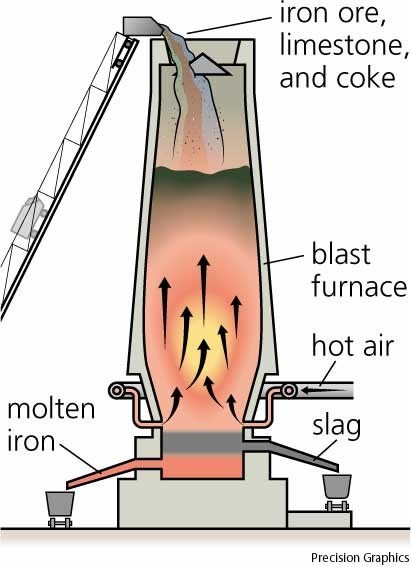 It was here that the ore was processed to produce pig iron. After the iron ore was gathered from the bogs and swamps along the Manasquan River, it was brought here to process.
Iron Ore, Limestone and Coke are poured into the top of the furnace. Hot air is pumped in from the wide part near the bottom. As the Iron Ore and Flux mixture burns, the component seperate out. Impurities in ore separate and react with limestone to produce slag. Molten iron would sink to the very bottom and would be removed. Slag floats on top of the molten iron and is easily drained off. Molten Iron is drained out to be formed into pig iron
Temperatures inside the Blast Furnace would typically reach 2500 degrees Fahrenheit. Early Bog Iron foundries would run for 12-16 weeks before the lining would need to be rebuilt and the walls reconditioned. The Blast Furnace at Allaire would operate for 7 to 8 months. After that time it would need to be cooled and the lining rebuilt. It is believed that the near the end of the iron works here, that the furnace would run for 20 months. This might have been a results of shorted production runs, better technology or negligence.

This cache is certified Central Jersey!


Enjoy and have fun.

Geocache Identification Permit Approval Number: ASP2015031911