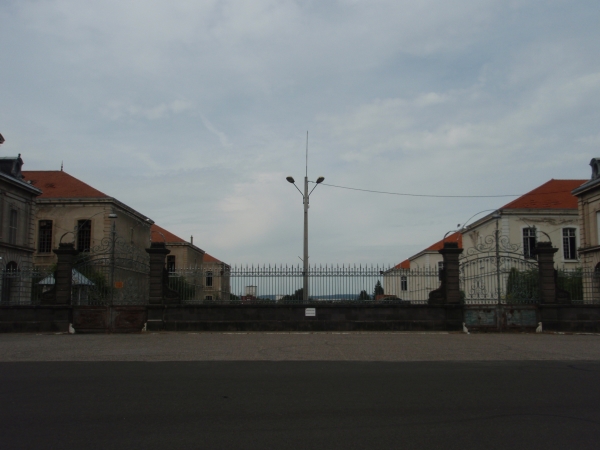
[FR] Pierres de caractère et belles bâtisses, cet endroit est l’ancienne entrée principale de la base militaire des Gravanches qui est l'héritière d'un siècle de présence militaire continue. En effet, elle fut créée en 1868 en tant qu'arsenal. A l’époque c’était un atelier de garnissage d’obus, qui grâce à sa proximité avec les chemins de fer (liaison Clermont-Paris) permettait d’expédier 2 à 3 trains chargés de munition. Elle employait environ 3000 personnes avant la guerre. En mai 1916 la production atteignit 60 000 obus par jour.
Le chargement consistait à introduire dans le corps du projectile une douille en cuivre contenant de la poudre, une fusée destinée à le faire éclater et une gaine-relais qui devait transmettre l'explosion de la fusée à la charge intérieure du projectile. Pour terminer une ogive était vissée sur le projectile.
Dès mars 1915, la fièvre typhoïde, appelée "fièvre des Gravanches", fit son apparition dù aux substances chimiques destinées à la fabrication des mélanges pour les obus.
N'ayant plus de place pour stocker les obus, les essais d'avions Breguet-Michelin qui avaient lieu sur le champ de manoeuvre, furent transférés à Aulnat en janvier 1917.
Le 1er juillet 1999, la 13e base de soutien du matériel est créée à partir des établissements du matériel de Clermont-Ferrand, de Moulins, de Fourchambault et de la 6e compagnie du 4e régiment du matériel. Moulins est reconstruit en 1920 comme atelier de chargement de munitions, Fourchambault, créé en 1917 et spécialisé dans la réparation et la reconstruction des matériels du génie et Clermont-Ferrand en tant qu'arsenal.
La 13e BSMAT intervient dans la maintenance de nombreux matériels de l'armée de terre (Pôle de compétence mobilité terrestre pour les engins blindés à roues), pourvoit à l'approvisionnement de l'ensemble des forces en France et en opérations, stocke des parcs de matériels complets dans le cadre de la politique d'emploi et de gestion des parcs, et réalise des études dans le domaine de l'ingénierie de maintenance.
Suite à la réorganisation de la chaine maintenance, elle est maintenant sous la coupe du service de la maintenance industrielle terrestre (SMITer) qui est en charge du maintien en condition opérationnel (MCO) des matériels terrestres de l'armée de terre depuis le 1er janvier 2010.
Les restrictions budgétaires ne semble malheureusement plus permettre l'entretien et l'exploitation des ces bâtiments historiques.
Ne cherchez pas à pénétrer dans la base, qui reste en activité la journée et gardée par des chiens la nuit.
[EN] Stones of character and beautiful buildings, this place is the old main entrance to the military base Gravanches who is heir to a century of military presence. Indeed, it was created in 1868 as Arsenal. At the time it was a workshop packed with shells, which thanks to its proximity to the railway (linking Clermont-Paris) allowed to ship 2-3 trains loaded with ammunition. It employed about 3,000 people before the war. In May 1916 the production reached 60,000 shells a day.
The loading was to introduce into the body of a projectile casing copper containing powder, a rocket intended to burst and a sheath-relay was to transmit the explosion of the rocket to the interior of the projectile charge. Finally a warhead was screwed to the projectile.
From March 1915, typhoid fever, called "fever Gravanches," appeared in the chemicals for the manufacture of mixtures for the shells.
Having more room to store shells, testing aircraft Breguet-Michelin taking place on the parade ground, were transferred to Aulnat in January 1917.
On 1 July 1999, the 13th base of support material is created from materials facilities in Clermont-Ferrand, mills, and Fourchambault the 6th Company of the 4th Regiment of the material. Mill was rebuilt in 1920 as a workshop loading ammunition, Fourchambault, established in 1917 and specializes in the repair and reconstruction materials engineering and Clermont-Ferrand as Arsenal.
The 13th BSMAT involved in the maintenance of many materials the Army (ground mobility center of excellence for wheeled armored vehicles) provides for the supply of all the forces and operations in France, stores parks materials complete as part of employment policy and park management, and conducts research in the field of maintenance engineering.
Following the reorganization of the chain maintenance, is now under the control of industrial maintenance service land (SMIT) that is responsible for operational maintenance (MCO) materials of the land army on 1 January 2010.
Budget cuts seems unfortunately to allow for maintenance and operation of these historic buildings.
Do not try to enter the base, which remains active during the day and guarded by dogs at night.