This was my 100th Geocaching Hide in 2011
Thanks to everyone for your support of my caches!
:-)
The Cemetery is what you will find at the Posted Coordinates, however,
The Cache itself is NOT there due to the limited access to the property.
This cache was designed to give you some history on a very interesting and hard-to-access place in Metro Detroit
MOST people living today do not know much about this place, but many usually find it very interesting.
You MUST solve the puzzle AND sign the log in order to claim the Smiley.
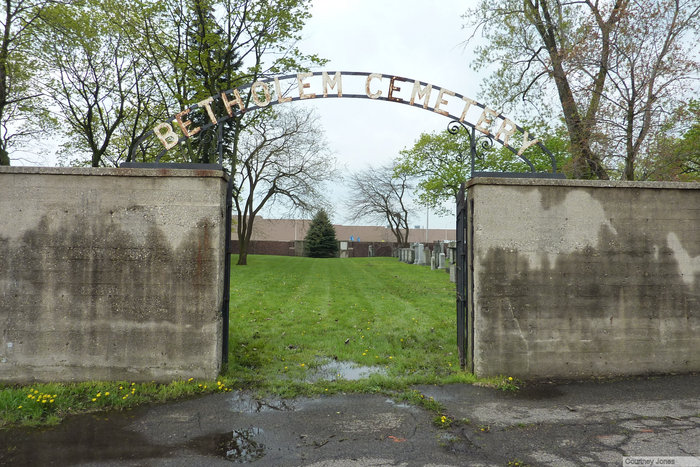
Beth Olem Cemetery front gate
One of the most interesting but least accessible graveyards in southeast Michigan is Beth Olem Cemetery, an area completely surrounded by an automobile manufacturing plant. The cemetery is also the only one within the City Limits of Hamtramck. With the cooperation of the cities of Detroit and Hamtramck, and the continuing support of General Motors Corp., Beth Olem Cemetery has retained the dignity and spirituality of the founders of the Jewish Community of Detroit. The Cemetery remains one of the oldest historic sites in the Greater Detroit Jewish community. It has also been known as the "Smith Street Cemetery" as well when Smith Street was here.
Today, the 2.2-acre site is minimally maintained, regularly floods, and is kept off-limits to the general public. However, it wasn't always like that.
Beth Olem - which means "house of the world" was established in 1862 during the Civil War-era to service Congregation Shaary Zedek. Two members of the Orthodox Detroit Congregation got in a buggy and drove three miles beyond the the outskirts of the City of Detroit to buy land from some German Farmers. At that time, the area was very-much rural. The plot was so far outside the city that the congregation figured Beth Olem would remain a pastoral site for years to come.
Most members of the Congregation were German and Polish Jews who settled on the near east side and worked as dry-goods peddlers. Beth Olem was the second Jewish burial ground established in Detroit, the first was a half-acre section established by Temple Beth El in a corner of Elmwood Cemetery in 1851.
In the 1870s, Polish Catholics began to displace the German farmers who had originally settled the area. Over time, Detroit’s Jewish community — concentrated close to downtown — struck a northwestward path of migration that largely missed Polish Detroit and Hamtramck. Some Eastern European Jews settled in and around Poletown, but Beth Olem was still out-of-the-way for most Detroit Jews, and those buried there were mostly poor. By the end of World War I, there were dozens of metro-area Jewish cemeteries to choose from, and Beth Olem was a bit run down, its wooden grave markers weather-worn and toppled. It had included a chapel built in the 1880s that was sagging with damage and was later removed.
The surrounding area had changed dramatically over the decades and many residences, small businesses, and industrial factories had sprung-up all around it including two major railroads that had built their tracks just-beyond the cemetery's walls. This easy access to transportation brought with it a clump of factories and in 1910, Dodge Brothers built one of the largest auto plants in the world a few hundred yards beyond Beth Olem's gates. Other auto companies would also grow up around Dodge Main.
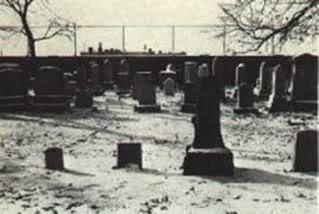
Beth Olem Cemetery with Dodge Main in the background, 1960's
In its prime, the Poletown neighborhood offered its residents tens of thousands of jobs, not only at Dodge Main but also at many of the auto manufacturers and suppliers. Grocery stores and bars grew up around the plants. Most of Poletown's residents lived in cheap two-story frame houses kept tidy by folks who washed the windows and swept the steps. The people that lived nearby didn't have much, but they kept the neighborhood spotless with their sweeping and cleaning every day.
The first blow to Poletown's prosperity and survival came in the 1950s with the building of the Edsel Ford Expressway (Interstate 94) and it physically divided the neighborhood north from south. The businesses up and down Chene, deprived of their customers farther north, shriveled and died. Many of the Jewish shop owners moved to the Metro Detroit suburbs north and west. But even in the late 1960s, when Detroit was torn by racial strife and many of its inhabitants fled, Poletown clung to life, and was home to the working-class families made up of a diverse group of Polish Catholics, African Americans, and Jewish people, amongst others.
In 1966, Chrysler bought two adjacent blocks to the cemetery to build a parking lot for its Dodge Main plant. Smith Street, which provided access to Beth Olem, was absorbed by the new construction. To permit visitors access to the cemetery, Chrysler built a ninety-foot driveway from the next block, Clay Avenue. The company also paid for property rights to the streets around Beth Olem, and in turn, the congregation spent the money from Chrysler on repairing the grounds which had become very rundown and in need of repairs. At that point, Beth Olem appeared to be "a green island in a vast sea of a concrete parking lot."
This would not be the only changes to the area surrounding Beth Olem.
In the late 1970's, GM purchased the land where the antiquated Dodge Main factory stood. This land had railroads conveniently placed to bring in supplies and move out cars. But this would not be enough space to accommodate what GM had planned for its future.
Around 1979-80, Dodge Main was demolished and then, against the residents wishes, GM began removing the buildings and relocating the families that lived in the neighborhood. 465 acres of the Poletown neighborhood began to be cleared to make way for the new, larger GM plant. Even Clay Avenue was swallowed up, leaving the cemetery imprisoned within the vast holdings of the auto company. Despite the protests and lawsuits, GM and the cities of Detroit and Hamtramck successfully used the principle of eminent domain to displace 1400 homes, 140 businesses, a hospital, and six churches...including the regal brick Immaculate Conception Parish, which had served as the house of worship for most of the Polish immigrants who lived around the plants. Many companies were leaving Detroit and the thought by the City of Detroit leaders at the time was if Detroit could keep GM here, maybe other companies would stay or move back.

Immaculate Conception Parish, Demolished in 1981.
The automaker was prevented by State Law from removing Beth Olem cemetery, which by then had been dormant for decades as Jewish families moved to other parts of Metro Detroit. Jewish leaders told the company, as well as City and State officials that Jewish law considered the removal of the bodies from their graves a form of desecration. The leaders said the cemetery probably also contained prayer shawls, Bibles, scrolls and paraphernalia which under Jewish law must be buried, not burned or otherwise destroyed. The Congregation Shaary Zedek retained the rights to a perpetual easement the width of a two-horse carriage leading from the cemetery to Joseph Campau Street in Hamtramck to the east. GM couldn't have built its plant without that strip of land. After three years of negotiations, the Jewish community agreed to give up the corridor in return for GM's promise to not disturb the graves and to allow the public access to the site.

During one of the more flooded days at the Cemetery.
Today, there are an estimated 1,400 people interred at Beth Olem Cemetery, with the oldest legible tombstone dating back to 1876 and the most recent burial occurring in 1948, after which the cemetery then was unattended-to for many years and allowed many of the early tombstones to crumble. Vandals and animals also took their toll on what remained.
Beth Olem is managed for Congregation Shaary Zedek by Clover Hill Cemetery in Royal Oak, and visitation is by permission-only. Even in the unlikely event that someone today would remember them and care enough to visit, the opportunities are extremely limited. In years past, the cemetery was usually opened twice per year for a total of four hours each time, from 10am to 2pm on the Sundays preceding Rosh Hashana and Passover. For those that are able to get permission and make the visit, entry to the factory complex is gained via the truck gate and Plant Security will usually assist in helping visitors with directions to the area as the facility is larger and more sprawling than many college campuses. Security is not allowed to escort visitors to the cemetery, but one might reach it on their own if you keep driving to the left.
Once past the security gate, one might drive along a road that snakes behind a gargantuan lot full of shipping containers, dumpsters, loading docks, and ramps. If you get this far, you will probably pass the looping, paved track on which GM tests the many vehicles it produces at this plant. A group of trees will rise incongruously in the distance. As you drive closer, you can see that the trees are surrounded by four brick walls, like animals in a zoo. Even at that point, you might not realize what lay beyond those walls, if you don't drive around to the other side, where there is provided space for a dozen cars and a caretaker in a pickup truck, who would probably keep a watchful eye on things and visitors during the short window of time that it's open.
A wrought-iron arch embroidered with BETH OLEM CEMETERY spans the entrance to the graves. Standing inside those walls, a visitor views the headstones against a backdrop of enormous above-ground pipes, the cars of a rusty freight train, a row of squat white fuel tanks, a red-and-white striped smokestack, a water tower, amongst other factory-related things.
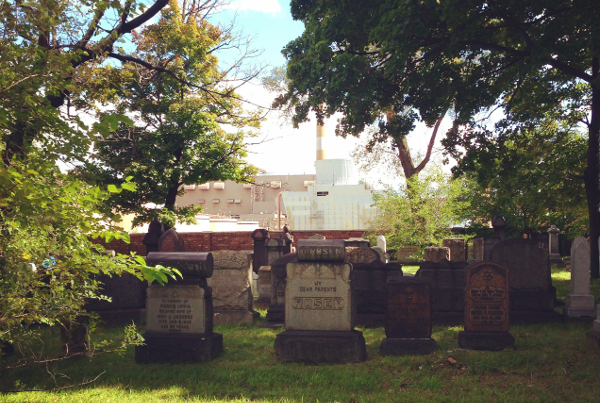
Headstones, with the GM factory in the Background.
According to Jewish tradition, Orthodox Jews must be buried beneath the earth, and so the cemetery is unadorned with mausoleums. Most of the monuments are modest granite slabs engraved with the person's name, his/her dates of birth and death, a brief inscription in Hebrew, maybe a star of David. Some have those splay-fingered hands that TV viewers of recent generations know as the Vulcan form of greeting offered by Mr. Spock on Star Trek. This gesture is hardly an accident since Leonard Nimoy, the actor who played Spock, "borrowed" the gesture from when he had witnessed Jewish men at his father's Shul (a Jewish house of prayer) greeting one-another.

An interesting Headstone inlay
A number of the stones have been worn smooth by time and the elements. Some have just a cracked ceramic portrait depicting the image of the person who was in the prime of their life. The "anonymity" of these markers invites the inevitable questions: Who were they? How did they live? How did they die? What could they tell us of everyday life in Detroit a century ago?

Porcelain portrait of Sadie Bratman. At least three other porcelain portraits were removed by vandals.
Some family members, when visiting, have followed the Jewish custom of setting pebbles on their family-members monuments to indicate that they've been there to visit. Some visitors are not family, but amateur historians that wander amongst the graves, trying to learn more about this unique and unusual cemetery.
The visitation-time here is usually very short, and some folks have equated it to a "Mission to Mars" because of the limitations placed to be able to get here and visit, even if for only a few minutes.
Maybe someday, if you are lucky, you may be able to visit as well, and enjoy this gem of a bygone era of Metro Detroit that will never be forgotten.

Aerial view of Beth Olem from the West.
Obviously, due to the limited access to the cemetery, this puzzle could not take you inside the cemetery.
However, it does involve the cemetery and this should be a fairly easy find once the puzzle is completed.
This puzzle can be completed on-the-fly or on-site.
It can also be completed from the comfort of your armchair.
HOWEVER...you MUST sign the log in order to claim the find!
: The Puzzle :
A: How many hours is the Cemetery open on the days it's open?
B: How many days annually has the cemetery been open?
C: How many blocks did Chrysler purchase around Beth Olem?
D: Last digit of the Cemetery Establishment Year.
E: Years of negotiations by the Jewish Leadership with GM, add to the digit of the year of the oldest legible tombstone.
F: Second digit of the year that Chrysler bought property around Beth Olem.
G: The year of the Last burial here: add the first two digits to the last two digits; answer = the 2nd (RH) of the two-digit sum.
Z: Last digit of the year that Dodge Main was built.
Y: Last digit of the year that the Last Burial took-place at Beth Olem.
X: Third digit of Beth Olem established year, divided by last digit of established year.
W: Last digit of the decade Polish Catholics began to displace the German farmers.
V: Original Miles beyond the outskirts.
U: Acreage that was cleared: 1st digit plus 2nd digit divided by 3rd digit.
T: Total number of gate openings (of the Cemetery itself, not the auto plant)
S: Last digit of the total of years after Dodge Main was built that Chrysler bought land around Beth Olem.
North AB CD.EFG
West ZYX WV.UTS
The final location is best accessed by a short
hike as it is approx 1/3 mile from closest parking.
BE AWARE OF YOUR SURROUNDINGS AS ALWAYS.
I've added this to verify your findings:

Enjoy the hunt and the puzzle as much as I've enjoyed creating this challenge.
**Aug 21 2019 update**
I've clarified some of the puzzle and fixed the photographs.
Any questions, please let me know.
thank you!