 |
Coastal Erosion |
 |
Sea Cliffs Darwin City and its suburbs are bounded along the western shore by sea cliffs, between 1-30 m in height, and shore platforms at the base of headlands along with small pocket beaches and some longer beaches up to 10 km in length. The low lying coastal cliffs at East Point consist sedimentary rock commonly known as Porcelainite which has been naturally eroded, largely by wave action from the ocean, to form horizontal to gently undulating bedded strata of varying colours.
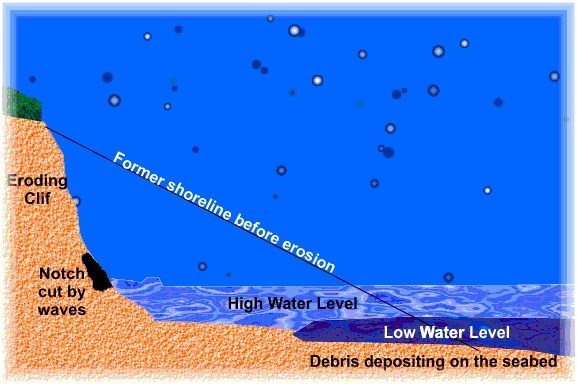
Cliff erosion Cliff erosion is a natural process which occurs in stages. Firstly, fresh water surface runoff, groundwater flows and seawater gradually erode the lower to mid cliff areas containing soft dolomitic-carbonate and siltstones forming fissures and cracks within the rock.
Sea Waves Energy Over a period of time the cracks become enlarged and break up large sections of rock from the parent material. At high tide the waves break on the lower cliff face which breaks the joints in the rock even further until eventually large sections of rock collapse onto the beach. The caves formed by this process then tend to concentrate the wave energy resulting in even greater cliff collapses and more erosion with larger embayments along the coast.
Freshwater Cliff erosion along the Darwin harbour coastline can also be increased by surface, stormwater and groundwater flows at particular points over the cliffs which also dissolve the fragile carbonate/silicate rocks leading to cliff instability. This process is enhanced by the acidic nature of the ground water in the Darwin region.
Nutrients and sewerage Nutrient rich stormwater and effluent discharging from sewerage outfalls near East Point are also the likely cause of algal staining and pitting of the dolomitic layers of the cliffs and are contributing to the bio-erosion occurring in these areas.
Source:”http://www.darwin.nt.gov.au”
The beaches are created by coastal sediment particles, loose sand, gravel or shells.
Sand: varies depending on the texture of the grain size (from 0.02 mm to 2 mm, larger is considered gravel) and is mostly composed of quartz (silica) of terrestrial origin and carbonated material of marine origin (from the weathering of shells skeletons of shellfish and other animals).
Gravel: is any rock that has at least two millimeters in its longest dimension and not more than 75 mm.
Shells: the remains of shellfish that by the action of ocean currents are deposited in the coastal zone.
Your picture is welcome

To log your find you have to send me a mail explaining, even if briefly:
1 - On the spot which is the main reason for the cliff erosion?
2 - According to Jonathan F. Nott in “The urban Geology of Darwin, Australia” it is possible to see exposed in the sea cliffs along Darwin’s foreshore two different geological times. Which are those Geological Times?
3 -At the spot what is the altitude from sea level?

