PETRIFIED by the TIDE!
The University of Alabama Arboretum maintains plant collections for botanical education and appreciation. The Arboretum features walking trails through a native woodland section, a wildflower garden, a collection of ornamental plants, an experimental garden, and a children’s garden. Most of the Arboretum’s land was donated by the federal government to help support the University’s goals of promoting research and providing public education and service. Today the Arboretum is part of a national network that shares plant information with scientists, students and the public. The Arboretum is sponsored by the Department of Biological Sciences.
The Arboretum is open daily from 8AM until sunset, except on New Year’s Day, Thanksgiving, and Christmas. There is no admission charge for entrance. Tours are available by reservation. Please contact the arboretum for more information.
Once you arrive at the site, please be respectful and take only photos and leave only footprints. To log this cache you must answer the following questions.
1. About how old do you think the ‘White Fossil’ log is?
2. How long is the ‘White Fossil’ log?
3. Where was the ‘White Fossil’ log found?
4. Who donated these pieces to the Arboretum?
5. Where do you think the petrifaction process occurs?
6. What colors (please identify at least three) do you see present and what contaminating element gives it this color?
7. What conditions do you think were present in order for this wood to petrify?
8. Photos are encouraged but not required. Please feel free to take a photo of you or your group at the site.
Answers for questions 1-4 can be found on site, questions 5-7 can be found by reading the cache page.
You need to bring a tape measure or long rope for measuring.
E-mail the above answers along with the GC number and cache name to the following e-mail address CLICK HERE. Any logs submitted without the above questions answered will be deleted. Please send your answers then log your find.
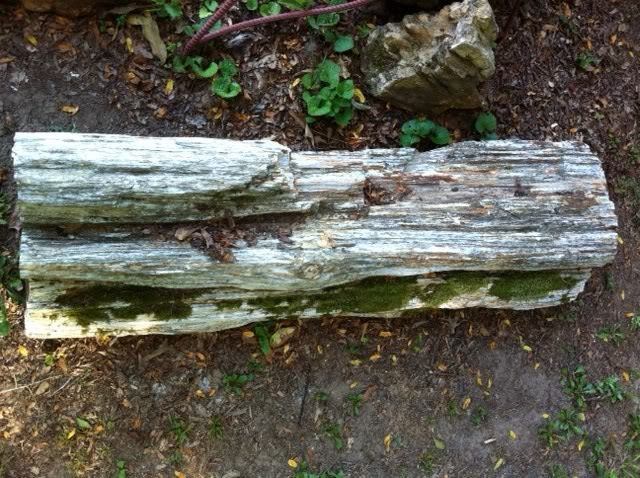
Petrified wood (from the Greek root petro meaning “rock” or “stone”; literally “wood turned into stone”) is the name given to a special type of fossilized remains of terrestrial vegetation. It is the result of a tree or tree-like plants having completely transitioned to stone by the process of permineralization. All the organic materials have been replaced with minerals (mostly a silicate, such as quartz), while retaining the original structure of the stem tissue. Unlike other types of fossils which are typically impressions or compressions, petrified wood is a three-dimensional representation of the original organic material. The petrifaction process occurs underground, when wood becomes buried under sediment and is initially preserved due to a lack of oxygen which inhibits aerobic decomposition. Mineral-laden water flowing through the sediment deposits minerals in the plant’s cells; as the plant’s lignin and cellulose decay, a stone mold forms in its place.
· Stem tissue takes less than 100 years to petrify.
· Organic matter needs to become petrified before it decomposes completely.
· A forest where such material has petrified becomes known as a Petrified Forest.
Elements such as manganese, iron and copper in the water/mud during the petrification process give petrified wood a variety of color ranges. Pure quartz crystals are colorless, but when contaminates are added to the process the crystals take on a yellow, red, or other tint.
Below is a list of contaminating elements and related color hues:
· Carbon – Black
· Cobalt – Green/Blue
· Chromium – Green/Blue
· Copper – Green/Blue
· Iron Oxides – Red, Brown and Yellow
· Manganese – Pink/Orange
· Manganese Oxides – Blackish/Yellow
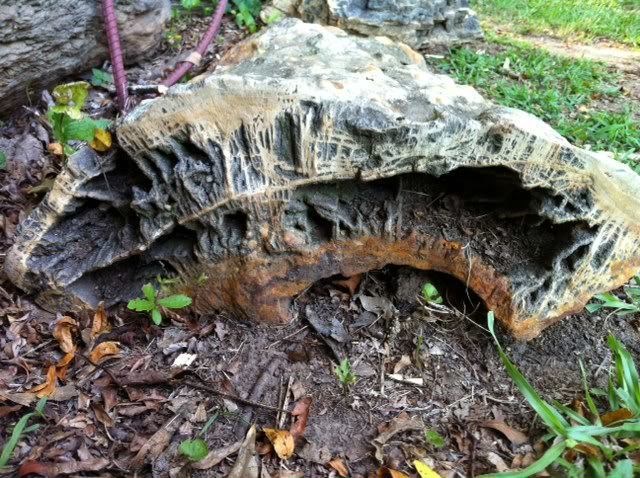
Petrified wood can preserve the original structure of the stem in all its detail, down to the microscopic level. Structures such as tree rings and the various tissues are often observed features.
Petrified Wood is a fossil in which the organic remains have been replaced by minerals in the slow process of being replaced with stone. This petrification process generally results in a Quartz Chalcedony mineralization. Special rare conditions must be met in order for the fallen stem to be transformed into Fossil Wood or Petrified Wood. In general, the fallen plants get buried in an environment free of oxygen (anaerobic environment), which preserves the original plant structure and general appearance. The other conditions include a regular access to mineral rich water flowing through the tissues, replacing the organic plant structure with inorganic stone. The end result is Petrified Wood, a plant, with its original basic structure in place, replaced by stone. This process could occur in less than one thousand years. Exotic minerals allow the rare red and green hues that can be seen in more rare specimens.