*** This cache is part of the Taking Flight GeoTour. Anyone can claim this cache, but to be eligible to receive a Taking Flight GeoTour prize tag, geocachers must complete the activities in this survey for at least 12 caches on the tour.***
One of southwest Florida’s most famous birds can often be seen here at this very spot in Emerson Point Preserve. This location is one of the best places in the preserve to catch a glimpse of the roseate spoonbill’s brilliant pink plumage.

Roseate spoonbill in flight. Photo by Bill Foxworthy
Once, these birds were found in great flocks all throughout southwest Florida. However, their beautiful coloring got them noticed and humans quickly saw the value in feathers that ranged from a soft light pink to a brilliant deep rose. Like many of Florida’s wading birds, including great white egrets and snowy egrets, roseate spoonbills soon became a target of the hat trade.

1800's hat with entire bird and feathers on it
In the 1800’s it became very fashionable to wear fancy hats that were decorated with great numbers of feathers, parts of the bird such as the wings and tail, and in some cases, the entire stuffed bird itself! The demand for feathered hats became so great that birds quickly disappeared, collected by hunters to meet the increasing requests for fancy hats. Soon other species such as bluebirds, terns, and even owls became fashionable and all across the nation bird populations began to drop. Feathers had always been a popular adornment for hats, but with the opening of trade routes throughout the United States and the world, and the ability to acquire unique and brilliantly colored birds, the demand skyrocketed.
By the late 1800’s the hat craze had caught the attention of scientists. They began to keep track of the birds on hats; one scientist counted the wings, feathers, heads, and bodies of birds on hats and found more than 170 birds representing 40 different species…all counted in only two days! A few years later, in 1896, two Boston socialites banded together in order to organize ladies teas to implore wealthy friends to stop wearing feathered hats. Harriet Lawrence Hemenway read an article about the feather trade and was so upset she decided she needed to take action. Together with her cousin, Minna B. Hall, she gathered over 900 Boston women together to boycott feathered hats and worked with scientists to help her found the Massachusetts Audubon Society. Massachusetts passed the first laws to outlaw the wild bird feather trade followed by similar laws in Florida in 1891 and 1901. In 1918, the federal government passed the Migratory Bird Treaty Act making it unlawful to pursue, hunt, take, capture, kill or sell birds listed in the act. The creation of this law along with state regulations helped insure that the birds threatened by the feather trade would have a far better chance of survival.
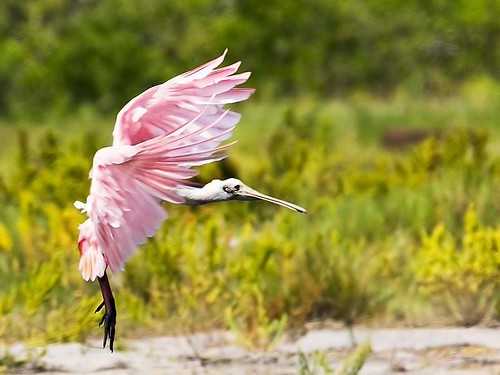
Roseate spoonbill at Emerson Point Preserve. Photo by Bill Foxworthy
The populations of the roseate spoonbill, once found throughout the Gulf of Mexico coastline and southward to South America, had dwindled but the new regulations protecting the birds made hunting illegal. Slowly the numbers began to climb but there was one last obstacle to face, however; the disappearance of the birds’ coastal and inland waterway habitat. Without a suitable place to nest, the small population of birds remaining would not be able to persist. The waters in which they fed must also be pollution free and filled with food. Spoonbills eat small fish and crustaceans, moving their sensitive bills through the water and grabbing the food when they “feel” it near their beak. Feeding in this way means the bird needs a lot of food concentrated in one place and that only happens when the habitat is healthy. Changes in the water flow patterns in the Everglades and Flamingo Bay, two of their primary nesting sites, has impacted the state's spoonbills too. The diversion of freshwater has caused higher salinity in the places where the spoonbills nest, changing the food resources and endangering the colony. While the pressures of the feather trade may have disappeared, there are still many environmental and manmade factors that can influence the success of the species.
The regulations protecting birds set the stage for the recovery of the spoonbill, but the work to clean Florida’s waterways and also to restore and protect Florida’s native habitat has also helped support the birds’ success. In fact, the very first national wildlife refuge, Pelican Island, was established right here in Florida in order to protect birds from the feather trade. The work of the National Estuary Programs to promote a clean healthy watershed has insured that the birds will have plenty of food and clean waters in which to find it. National, state, and local parks and preserves have been protected and restored to provide places for the birds to roost and reproduce. Here at Emerson Point, and at other locations throughout Manatee County, you may be lucky enough to catch a glimpse of a roseate spoonbill as it is feeding or resting before returning to its nesting site elsewhere in Tampa Bay.
Visit the sites along the Taking Flight GeoTour (TFGT) and learn about Manatee County's wild spaces and the amazing feathered friends that live in them. Along the way, you will be challenged to become a citizen scientist, a preserve ranger, a detective, a historian, an excellent geocacher. Caches are located in birding hot spots throughout Manatee County's publicly accessible conservation Preserves. Each one highlights a specific bird species or aspect of bird life providing you with opportunities to learn more about these creatures and what we can do to help them survive. Caches also focus on protecting the region's waterways, bays, natural watersheds, and habitat areas for many of our area's feathered friends.
The Taking Flight GeoTour launched August 20, 2012 and includes 18 caches within Manatee County.
To be eligible to receive a Taking Flight GeoTour prize tag, geocachers must complete the activities in this survey for at least 12 finds on the tour. Keep this survey open in your browser, only click submit when at least 12 finds have been completed. Survey responses will be automatically sent to Manatee County staff. Prize tags can be redeemed on Saturday mornings from 9am - 12pm at The NEST at Robinson Preserve located at 840 99th St NW, Bradenton, FL 34209. If you are unable to collect your prize tag in person, please contact ecoevents@mymanatee.org to arrange for your tag to be sent in the mail. Tags will be available while supplies last.
Thank you for assisting with the Taking Flight GeoTour: