
A painting of St Francis Xavier, held in the Kobe City Museum.
Francis Xavier, born Francisco de Jasso y Azpilicueta (7 April 1506 – 3 December 1552) was a pioneering Roman Catholic missionary born in the Kingdom of Navarre (now part of Spain) and co-founder of the Society of Jesus. He was a student of Ignatius of Loyola and one of the first seven Jesuits, dedicated at Montmartre in 1534. He led an extensive mission into Asia, mainly in the Portuguese Empire of the time. He was influential in the spreading and upkeep of Catholicism most notably in India, but also ventured into Japan, Borneo, the Moluccas, and other areas which had thus far not been visited by Christian missionaries. In these areas, being a pioneer and struggling to learn the local languages in the face of opposition, he had less success than he had enjoyed in India. It was a goal of Xavier to one day reach China.
St. Francis Xavier Cemetery is a prime example of a cemetery that began its existence far out in the country, but after years of Ecorse village and city growth, people and houses eventually surrounded it. Today it is a square of grass and grave markers in the middle of rows of houses and between two busy city arteries, Jefferson Avenue and Southfield Road.

This oil portrait of Fr. Gabriel Richard was unveiled at the State Historicial Museum in 1934.
The nearby St. Francis Xavier Parish was founded by Father Gabriel Richard as a mission of St. Anne's Church in Detroit for the early Catholics of the Downriver area. Father Richard was the only catholic priest in the Michigan territory from 1806 to 1821 and he pastored about 500 families along the eastern shores of the Detroit River, Lake St. Clair, and Lake Huron. This area was was quite large, going from Ecorse to Port Huron.
Father Richard was also one of the earliest explorers of Wayne County and also served as a US Congressman, a builder of roads and schools, publisher of books and newspapers and he even brought the first organ to Michigan.

Current photo of St. Francis Xavier Church.
For generations, the French settlers (who were the first European settlers) and Native Americans had called a small river flowing into the Detroit River, Ecorces, after the white birch and other bark of the trees along its banks. Ecorces means river of bark and soon the township and the small village adjoining the creek were called Ecorse. Another part of the Ecorces story says that the Huron Indians wrapped the bodies of their dead in white birch bark and set them adrift toward paradise in their bark canoes.
Michigan historical records show that Ecorse was established on a Wyandot (earlier called Huron by the French) Indian camping site and burial ground at the end of the War of 1812, but Father Richard’s records indicated that Ecorse began nearer to Cadillac’s founding of Detroit in 1701.
A walk through St. Francis Xavier cemetery reveals that there are many of those "original settler" family names here and many of those who have served in the military, either Michigan Cavalry or otherwise.
The history of St. Anne’s Parish in Detroit emphasized the intermingled American-Canadian nature of the settlements along the Detroit River. The settlers arriving after 1749 “were granted strips of land along both sides of the strait. There was no distinction then between the Canadian and American sides of “Le Detroit” at that time.
In a 1749 Proclamation, Governor Galissonniers of New France referred to the Canadian side as the south side and the American side as the north and the literature of the period reflects this distinction. Soon, Detroit began to resemble an agricultural community. The land grant terms and settlement prefigured the Homestead Act of the Civil War era in America by a century and was mostly responsible for the rise of Detroit’s population to about 500 by 1755.

An example of when Ribbon Farms were the main features along the river
By the mid-1770s, some 400 mostly French families lived on “French ribbon farms” extending Downriver to Ecorse and beyond. The farms were called ribbon farms because everyone’s land started at the Detroit River and extended back so that each farmer could take advantage of the water frontage. Ribbon farms also provided land owners mutual protection for the Indians and their raiding parties. When Father Richard took his census in 1808 and again in 1832, Ecorse was a thriving farm village. French descendants of Cadillac’s company lost their control of the fur trade, but these families – including the Labadies, Campaus, Rosseaus, Bondies, Goodells and Ripelles- remained the chief landlords and founding families of Ecorse.
The French land claims of Wayne County illustrate that many French and a few other ethnic pioneers were settling in Ecorse several years before the War of 1812. Andre Viger filed Claim 121 of 250.82 acres on June 8, 1808 in Ecorse.
Arthur Visger (b1891 - d1943), who is possibly the grandson of Andre, is buried in St. Francis Xavier Cemetery along with many others who were influential in the area many years ago.
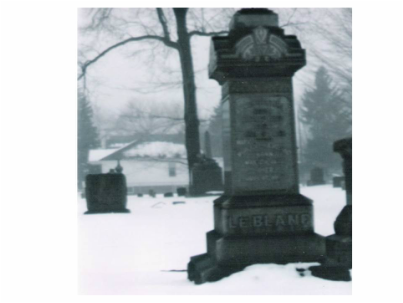
Wintertime in the Cemetery
The Puzzle:
N 42° 14 . A B C -- W 083° 09 . D E F
A: Day of month of Xavier's Birth
B: 3rd digit of the year of Cadillac’s founding of Detroit
C: Last digit of the year of Governor Galissonniers proclomation.
D: Father Richard was the only catholic priest in the Michigan territory from 18_D_6 and remained for 15 years
E: 3rd digit found at puzzle GZ added to last digit of Arthur Visger death year.
F: Francis Xavier passed on _F_ December 1552
This is not a difficult puzzle. You must read the history, visit the location,
and maybe learn something of this area to be able to solve the puzzle. Enjoy! :)