Burning Mountain was noted by the early settlers in 1829. Following that there was much conjecture about whether the feature was volcanic in origin, and it took some time until geologists were able to confirm that it was not volcanic, and that is was due to the underground burning of a coal seam.
But how did this coal seam get ignited and for how long has it been burning? It has been estimated that the burning front has been moving southward at a rate of approximately one metre every year and has moved about 6,000 metres to its present position. Thus, if the coal has burned in the past at the current rate, then the fire started probably at most about 6,000 years ago. Even allowing for variations in the rate, the evidence certainly indicates that it has been burning for a few thousand years, and not the millions of years that were proposed at one time.
Those prepared to hazard a guess have suggested that the coal seam may have been ignited naturally through a lightning strike, a forest fire, or more probably through spontaneous combustion, the latter phenomenon being known to occasionally occur in coal mines today. However, spontaneous combustion of coal seams today is not known to occur where a coal seam is weathering in an outcrop at the surface. On the contrary, spontaneous combustion occurs where coal has been freshly exposed in mine workings, whether in an open pit or in underground tunnels, the heat which ignites the coal being generated by a rapid drying out and oxidation of the coal constituents because they have been rapidly exposed to the elements by the mining process.
As for the other suggested mechanisms for igniting the coal, namely, a lightning strike or a forest fire, again simple reasoning exposes the improbability of these explanations. To begin with, any coal exposed at the land surface as outcrop would be highly weathered due to the way coal rapidly oxidizes and weathers when exposed to the elements at the earth’s surface. It is not that a lightning strike or a forest fire could not ignite an outcropping coal seam, but the weathered nature of the exposed coal would make ignition more difficult. But that is not the only problem. Once ignited at the surface the fire has to burn along the coal seam under the ground, having first to pass through the water table. There the seam would be saturated with water, so the fire would almost certainly be extinguished.
Added to that, as any fire moved along a coal seam down under the ground the supply of oxygen necessary for the burning process would continually decrease. Admittedly, if the fire became established under the ground, the rocks above the burnt-out coal would tend to fracture and collapse, thus allowing air down into the burning zone, as appears to be the case on Burning Mountain. But to achieve that situation any fire ignited at the surface has to overcome the other hurdles of passing through the weathered zone and the water table with a diminishing air supply initially.
It is easy to understand therefore that this phenomena is quite rare, and this site is the only occurrence in Australia.
The geology of the area consists of a thick base of larva flows known as the Werne Basalt, which was laid down in early Permian times about 300 million years ago.
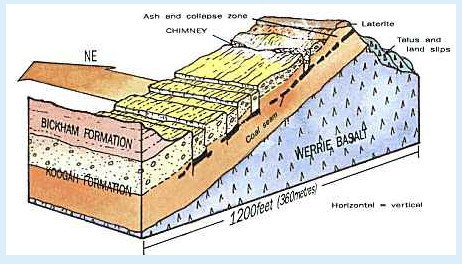
Above this and of only slightly younger age is the Koogah formation consisting of alternating layers of sandstones containing fossilised shellfish (brachiopods and pelecypods), and conglomeratic mudstones. These alternating layers are called the Bickham Formation and this is the structure containing the seam of coal.
The ‘burnt-out’ zone extends north-easterly for at least 6.5 kilometres from the present zone of burning at Burning Mountain. The land surface above the ‘burnt-out’ zone is characterized by subsidence features such as fractures, closely-spaced parallel faulting, small grabens (fault-bounded gullies) and open gash-like fissures, which appear to have been controlled by the jointing system in the rocks of the Koogah Formation.
Small, collapsed, chaotically broken areas containing highly altered and fused rocks act like ‘chimneys’ through which high-temperature burning gases escaped. Fused sandstones associated with these ‘chimneys’ contain rare high-temperature forms of the common mineral quartz and another high-temperature mineral in a rock glass of slaggy, vesicular (bubbly) appearance.
Elsewhere in the ‘burnt-out’ area the highly refractory (high-temperature) kaolinite-bearing claystones, which originally were underneath the unburnt coal layer, have been relatively little affected by the burning of the coal. A thin zone of the claystone just below the burnt coal layer has been converted to the mineral mullite, a very common refractory form of aluminium silicate. However, the kaolinite-bearing claystone above the burnt coal layer, which was subject to the full effects of burning gases, has been more extensively altered to the high-temperature forms of quartz and aluminium silicate (including mullite).
Experimental work, including laboratory ‘firing’ and fusion tests on the ‘natural starting materials’ suggests that temperatures of up to 1700°C must have been attained in the burning zones in order to account for these and other alteration effects due to thermal metamorphism.
The area on Burning Mountain which is presently burning is a highly fissured zone heated to red-white heat over an area of less than 100 square metres. Intake of air through the fissures appears to have resulted in a blast-furnace effect being added to the natural combustion of the coal and its gases 30 metres below the surface. Fissures are continuing to open in as yet unburnt ground immediately south of the present area of thermal activity as underground collapse occurs.
Heated aqueous fumes emanating from the burning area deposit a sinter composed of hematite (an iron oxide) and high-temperature forms of quartz, encrusted with elemental sulphur which has come from the sulphide minerals, chiefly pyrite (iron sulphide), found in the coal. It is for this reason that the fumes have a pungent sulphur smell, while condensate from these fumes is highly acidic and strongly sulphatic.
(Source: A Challenge to Evolutionary Time by Dr. Andrew A. Snelling on March 1, 1993)
Requirements to log a Find on this Earthcache
You can log online immediately, but logs not followed up with answers to the
questions below will be deleted after a reasonable time, say 10 to 14 days.
-
Around the edges of the fissures in the “hot” areas you will observe some tinges of colour. What colours do you see and what do you think is the source of these colours? (No need to be too specific)
- Look at the closest vegetation to the “hot” area. Can you draw any conclusions from what you see about the direction the fire is moving?
- NOW COMPULSORY
Please attach a non spoiler photo of the site, preferably with yourself or a personal itemincluded, to your found log.
- Please send your answers to me at earthcaches@jamieson.id.au It is important to use this email address as it goes to my phone and I can usually respond immediately. Emails sent to my geocaching.com default email address will become mixed into my watchlist email and I may not see it for days.