Be smart, be an EarthCacher - geology rulez! ;)
Credits: Polish Geological Institute / Państwowy Instytut Geologiczny // Heinrich Bahlburg, Christian Breitkreuz, "Grundlagen der Geologie" (book)
I dedicate this earthcache to Toczygroszek, a professional geomorphologist from our local community; to Mr.Box from BoxTeam PL, a professional earthcache-FTF-hunter and - of course - to our EC-Master, GeoawareCZ for his great reviewing commitment to Polish earthcaches ;)

Organy Wielisławskie to speklakularne odsłonięcie porfirów na zboczu góry Wielisławki (375 m n.p.m.), należącej do Pogórza Kaczawskiego. Porfirami określa się potocznie magmowe skały wulkaniczne przy ich wstępnym rozpoznaniu "w terenie". Kwaśne skały wylewne tworzące Organy są porfirami kwarcowymi, charakteryzującymi się występującymi w nich jasnymi prakryształami kwarcu: między innymi ryolitami. Po raz pierwszy ryolit opisany został naukowo w 1860 roku przez Ferdinanda von Richthofena, pochodzącego z Górnego Śląska "ojca" nowoczesnej geomorfologii.
Ryolit ma skład podobny do granitu, tak naprawdę jest jego wylewnym odpowiednikiem. Powstał z magmy o tym samym składzie chemicznym, z której powstaje granit. Z tą różnicą, że magma "ryolitowa" krzepła szybko w płytszych warstwach Ziemi lub na jej powierzchni, natomiast "granitowa" powoli i na dużej głębokości.
Ryolity tego earthcachea są starsze niż Alpy: powstały na skutek stygnięcia magmy w kominie wulkanicznym w dolnym permie. Geometryczna forma jaką utworzyły nyzywana jest ciosem termicznym. Pęknięcia tworzące charakterystyczne słupy powstały w końcowym etapie krzepnięcia magmy; w wyniku naprężeń rozciągających, które wywołała kurcząca się, stygnąca masa skalna.
Z okresu permu pochodzą również najbogatsze złoża naturalne Polski: wydobywane na monoklinie przedsudeckiej rudy miedzi.
Swoje odsłonięcie Organy zawdzięczają uskokom tektonicznym ale i działalności człowieka: na przełomie XIX-XX wieku istniał tu czynny kamieniołom. Dzisiaj Organy Wielisławskie stanowią pomnik przyrody nieożywionej.
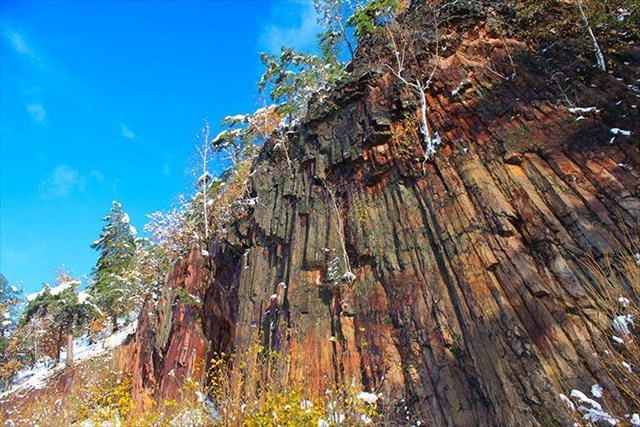
Organy Wielisławskie zimą / Wielisławskie Organs in winter
Photos & background photo: Hanbei
Odpowiedzi proszę wysyłać za pomocą mojego profilu. Nie trzeba czekać na odpowiedź, można od razu logować. Jeśli odpowiedź będzie niepoprawna, zgłoszę się sam. Pamiętajcie proszę, że logi bez podesłanych odpowiedzi będą kasowane.
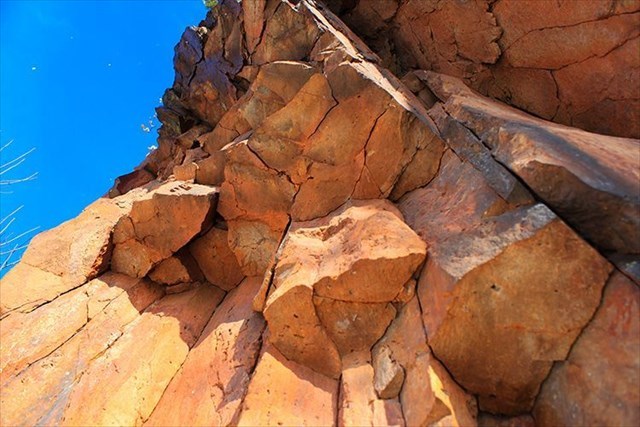 Detale ryolitu: jedno z twoich zadań / Rhyolites details: one of your tasks Photos & background photo: Hanbei
ZADANIA / Uwaga: ze ścian Organów regularnie spadają zwietrzałe kawałki skał mogące być zagrożeniem dla twojego zdrowia lub życia(!):
- Pod koordynatami earthcachea stoisz przed ścianą ryolitów. Na jakiej wysokości znajdują się widoczne na drugim zdjęciu "przewieszki"?
- Jakiej średnicy - w przybliżeniu - są cztero lub pięciokątne słupy magmy?
- Poszukaj luźnego kawałka porfiru lub zerknij na detale ściany. Czy tekstura tutejszej skały jest bezładna, masywna czy porowata?
- Jakie kryształy, lśniące delikatnie w słońcu, widać w kawałkach "wielisławskiego" porfiru?
- Jakiej barwy jest tutejszy ryolit i dlaczego?
- Podaj w przybliżeniu wiek Organów.
- Zadanie opcjonalne: uczcij odwiedziny w permie pamiątkowym zdjęciem ;)
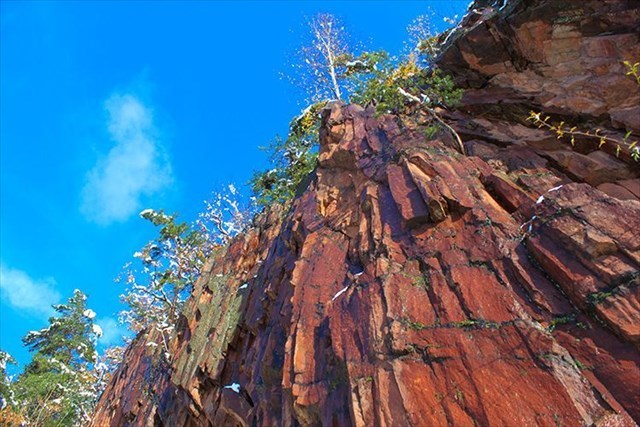
Wielisławskie Organs in winter / Photos & background photo: Hanbei

Die Große Orgel, früher auch Porphyrbruch genannt, zeigt auf spektakuläre Art und Weise Rhyolithe des unteren Perm. Die Porphyrwand bildet einen der Hänge von Wielisławka (375 m ü.d.m.) im Bober-Katzbach-Vorgebirge. Die moderne geologische Fachsprache verwendet den Begriff ‚Porphyr‘ streng genommen nur für die Gefügeform eines vulkanischen Gesteins und nicht bei einem bestimmten Gestein. Somit wird das Gestein, aus dem die Orgel besteht - feinkörniges, gleichzeitig sehr quarzreiches Vulkanit - als Quarzporphyr bezeichnet: die heute gültige Bezeichnung ist Rhyolith. Dieses wurde wissenschaftlich erst 1860 von Ferdinand von Richthofen beschrieben, dem Begründer der modernen Geomorphologie.
Rhyolith entspricht in seiner chemischen und mineralischen Zusammensetzung dem Granit. Der einzige Unterschied: "Granit-Magma" kühlte langsam im Erdinneren ab, während "Rhyolith-Magma" an der Erdoberfläche sehr rasch abkühlte und kristallisierte. Bei rascher Abkühlung entstehen zahlreiche, mikroskopisch kleine Kristalle, die als Grundmasse bezeichnet werden. Die großen, mit bloßem Auge gut sichtbaren Kristalle - eine der Aufgaben dieses Earthcaches - werden als Einsprenglinge bezeichnet.
Die hiesigen Rhyolithe sind älter als die Alpen. Sie entstanden in einem Vulkankamin des unteren Perm. Ihre charakteristische, säulenförmige Klüftung wurde durch die diagenetischen Prozesse hervorgerufen, genauer gesagt durch die Kontraktion (Schrumpfung) des abkühlenden Gesteins.
Aus dieser Zeit stammen auch die bedeutendsten Naturressourcen Polens: das auf der vorsudetischen Monokline abgebaute Kupfererz (schätzungsweise 26 Mio. Tonnen).
Ihren "Auftritt" verdankt die Große Orgel sowohl einer geologischen Verwerfung als auch menschlichem Einfluss: Im 19. und 20. Jahrhundert befand sich hier ein Steinbruch. Heute trägt sie den Status eines Naturdenkmals.
Bitte sendet eure Antworten über mein Profil. Ihr könnt direkt loggen, ohne auf meine Rückmeldung zu warten. Falls eure Antworten falsch sind, werde ich mich melden. Denkt daran: Log-Einträge ohne die entsprechende Antwort-E-Mail werden gelöscht.
AUFGABEN / Vorsicht: von der Wand lösen sich immer wieder Steine, die sehr ernste Verletzungen verursachen können(!):
- An den Koordinaten stehst du vor der Rhyolith-Wand. Auf welcher Höhe befinden sich die "Überhänge", die das zweite Bild des Listings zeigt?
- Ermittle den - durchschnittlichen - Durchmesser der vier- bis fünfkantigen Säulen.
- Finde ein loses Gestein oder betrachte aufmerksam die Wanddetails. Ist die Struktur des Gesteins glasig, körnig oder porös?
- Betrachtet man ein solches Gesteinstück im Sonnenlicht, glitzern darin feine Kristalle: Einsprenglinge. Welche sind es, die du siehst?
- Welche Farbe haben die hiesigen Rhyolithe und warum diese?
- Wie alt ist die Große Orgel?
- Optional: ein Bild dieses Naturwunders lohnt sich allemal ;)

The Great Organ, formerly also known as the Porphyry Quarry, spectacularly showcases rhyolites from the Lower Permian. The porphyry wall forms one of the slopes of Wielisławka (375 m above sea level) in the Bóbr-Kaczawa Foothills.
In modern geological terminology, the term porphyry is strictly used only to describe the texture of a volcanic rock, not a specific type of rock itself. Thus, the rock forming the Organ—a fine-grained, highly quartz-rich volcanic rock—is referred to as quartz porphyry; however, the currently accepted name is rhyolite. This rock type was first scientifically described in 1860 by Ferdinand von Richthofen, the founder of modern geomorphology.
Rhyolite has the same chemical and mineral composition as granite. The only difference: while granite magma cooled slowly within the Earth's interior, rhyolite magma cooled and crystallized rapidly at the surface. When cooling occurs quickly, numerous microscopic crystals form, creating the groundmass. The large, eye-visible crystals—one of the focal points of this EarthCache—are known as phenocrysts.
The local rhyolites are older than the Alps. They originated in a volcanic conduit during the Lower Permian. Their characteristic columnar jointing resulted from diagenetic processes—specifically, from the contraction (shrinkage) of the cooling rock.
This period also gave rise to some of Poland’s most significant natural resources, including the copper ore deposits mined in the Fore-Sudetic Monocline, estimated at around 26 million tons.
The Great Organ owes its current exposure both to geological faulting and human activity: during the 19th and 20th centuries, a quarry operated at this site. Today, it holds the status of a natural monument.
Please submit your answers via my profile. You may log them directly without waiting for my response. If your answers are incorrect, I will contact you. Please note: log entries without the corresponding answer confirmation email will be deleted.
TASKS / Caution: Rocks frequently come loose from the wall and can cause serious injuries (!):
- At the given coordinates, you are standing in front of the rhyolite wall. At what height are the overhangs shown in the second image of the listing?
- Determine the average diameter of the four- to five-sided columns.
- Find a loose rock or closely examine the details of the wall. Is the texture of the rock glassy, grainy, or porous?
- When you hold such a rock fragment in sunlight, fine crystals—phenocrysts—glitter inside. Which ones can you identify?
- What color are the local rhyolites, and why do they have this particular hue?
- How old is the Great Organ?
- Optional: A photo of this natural wonder is definitely worth taking. ;)
