Stage 1: posted co-ords
How many benches are there on the lower level? =A
How many columns are on the nearby pergola? = B
Stage 2:
Here you will see some words in gold lettering:
Count the number of letters in the last word = C
How many granite obelisks can be seen near here? = D
Stage 3:
Here you will see, on the wall, a 5 digit number of the dead:
Find the 2nd digit = E
Nearby, on the back of the Cross of Sacrifice, you will see some years listed:
Find the last digit of the last year listed = F
Stage 4:
Count the number of words on the 4th line = G
Count the number of words on the last line of the poem = H
Look across the river – you can see 3 large blue & white letters – using a=1,b=2,c=3 etc – give the 3rd letter you can see a number. Call this number = I
Please note : if the doors are closed and you cannot see the 3 large blue letters : walk a bit to your left, until you can see the side of the building - count the number of blue panels on the windows on one side of the building - divide this by 2 and call your answer = I
Checksum = 55
Cache can be found at:
N53 (G*I) . (B-F) A (H+D)
W006 (E*D) . (C-D) (H-I) F
Enjoy and watch out for muggles.

The Irish National War Memorial Gardens (Irish: Gairdíní Náisiúnta Cuimhneacháin Cogaidh na hÉireann) is an Irish war memorial in Islandbridge, Dublin dedicated originally to the memory of Irish soldiers who gave their lives in the Great War, 1914–1918. The Memorial Gardens also commemorate all other Irish men and women who at that time served, fought and died in Irish regiments of the Allied armies, the British, Canadian, Australian, New Zealand, South African and United States armies in support of the Triple Entente's war effort against the Central Powers.
Following a meeting of over 100 representatives from all parts of Ireland on 17 July 1919, a Trust Fund was created to consider plans and designs for a permanent memorial to commemorate all those Irish men and women killed in the Great War. A committee was formed in November 1924 to pursue proposals for a site in Dublin, Merrion Square & St Stephen’s Green being proposed at various stages. In 1930 the present site was suggested - known as the "Longmeadows Estates" it is about 60 acres (24 ha) in extent stretching parallel along the south bank of the River Liffey from Islandbridge towards Chapelizod
A generous gift was sanctioned by the Irish Government in 1933, the Dublin City Council Office of Public Works (OPW) having already commenced work with 164 men during 1932.
Many difficulties arose in 1937 for the WM Committee with regard to plants, trees and the need to obtain a Completion Certificate from the OPW, which finally issued in January 1938.
The Second World War then intervened to delay the official opening.
Design
Designed by the great memorialist Sir Edwin Lutyens who had already landscaped designed several sites in Ireland and around Europe, it is outstanding among the many war memorials he created throughout the world. He found it a glorious site. The sunken Garden of Remembrance surrounds a Stone of Remembrance of Irish granite symbolising an altar, which weighs seven and a half tons. The dimensions of this are identical to First World War memorials found throughout the world, and is aligned with the Great Cross of Sacrifice and central avenue. Opposite to the Phoenix Park obelisk, it lies about three kilometres from the centre of Dublin, on grounds which gradually slope upwards towards Kilmainham Hill. Old chronicles describe Kilmainham Hill as the camping place of Brian Boru and his army prior to the last decisive Battle of Clontarf on 23 April 1014. The Memorial was amongst the last to be erected to the memory of those who sacrificed their lives in World War I, and is “the symbol of Remembrance in memory of a Nation’s sacrifice”. The elaborate layout includes a central Sunken Rose Garden composed by a committee of eminent horticulturalists, various terraces, pergolas, lawns and avenues lined with impressive parkland tress, and two pairs of Bookrooms in granite, representing the four provinces of Ireland, and containing illuminated volumes recording the names of all the dead.
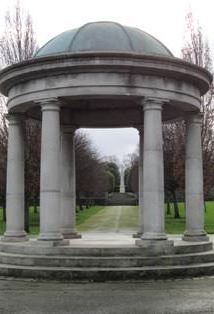
At the North of the Gardens overlooking the River Liffey stands a domed temple. This also marks the beginning of the avenue leading gently upwards to the steps containing the Stone of Remembrance. On the floor of the Temple is an extract from the "War Sonnett II: Safety" by Rupert Brooke.
Construction
There was no discord in its building – workers were so drawn from the unemployed that 50 per cent were former World War I ex-British Army and 50 per cent ex-Irish Army men. To provide as much work as possible the use of mechanical equipment was restricted, and even granite blocks of 7 and 8 tonnes from Ballyknocken and Barnaculla were manhandled into place with primitive tackles of poles and ropes.
Dedication
Although small commemorations took place for a few years from 1948, the political situation did not sanction that the Gardens be "officially" opened and dedicated, subsequent lack of staff also allowing the site to fall into neglect, decay and dilapidation during the 1970s and early 1980s, when it had become an open site for caravans and animals of the Irish Traveller community. In addition, sixty years of storms had left its mark. From the mid-1980s, restoration work to renew the park and gardens to their former splendour were undertaken by the Office of Public Works (OPW), co-funded by the National War Memorial Committee which is representative of Ireland, both north and south. On 10 September 1988 the restored Gardens were formally dedicated by representatives of the four main Churches in Ireland and opened to the public.
A state commemoration to mark the 90th anniversary of the Battle of the Somme on the 1 July 2006, was attended by the President of Ireland Mary McAleese, Members of the Oireachtas, leading representatives of all political parties in Ireland, the Diplomatic Corps of the Allies of World War I, delegates from Northern Ireland, representatives of the four main Churches, and solemnly accompanied by a Guard of Honour of the Irish Army and the Army Band.
In the Republic of Ireland, the National Day of Commemoration which commemorates all Irish men and women who died in past wars or on service with the United Nations, occurs on the Sunday nearest to 11 July.
Rolls of honour
In the granite paved pergolas surrounding the Garden are illuminated Volumes recording the names of all the dead, and were once publicly accessible, although the threat of vandalism has now had these Bookrooms closed except for visits by appointment, and which can be digitally viewed in an onsite office.
A wooden cross, the Ginchy Cross, built by the 16th (Irish) Division and originally erected on the Somme to commemorate 4,354 men of the 16th who died in two engagements, is housed in the same building. Three granite replicas of this cross are erected at locations liberated by Irish divisions - Guillemont and Messines-Wytschaete in Belgium, and Thessaloniki in Greece.
The Irish National War Memorial Gardens are now managed by the OPW in conjunction with the National War Memorial Committee.

A formal visit to the Memorial Gardens on May 18, 2011 was one of the historic highlights of England’s Queen Elizabeth II's visit to the Republic of Ireland. The Queen and President Mary McAleese laid wreaths of poppy and laurel respectively to honour the dead.